Oriental Hornet invasion rises 30% in Andalucía
By Molly Grace • Updated: 17 Jun 2025 • 9:13 • 3 minutes read
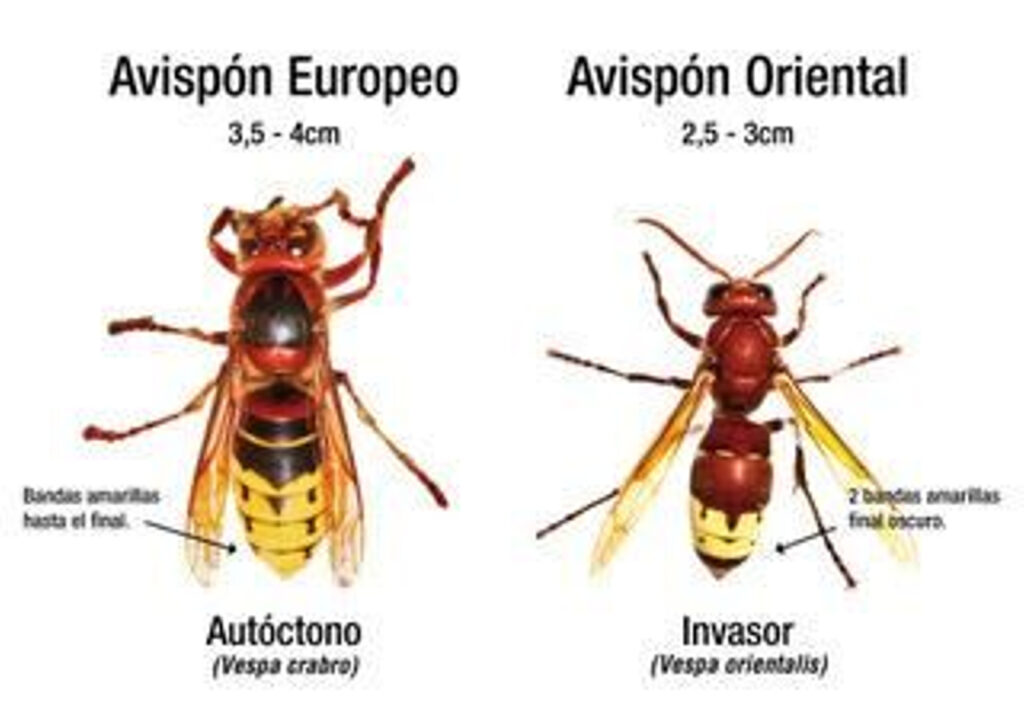
European hornet, V. crabro (left) compared to the Asian hornet, V.oriensalis (right) Photo credit: Europa sur
A sharp rise in sightings of the oriental hornet (Vespa orientalis) has been recorded across Andalucía, with confirmed reports increasing by more than 30 percent since the species was first detected in the Campo de Gibraltar in 2018. According to data from the environmental office in Málaga, nest removals grew from 28 in 2023 to over 380 by September 2024, indicating rapid expansion across several provinces.
This hornet, native to arid regions of North Africa and the Middle East, has now established itself in Cádiz, Málaga, Seville, Córdoba, Huelva, and Jaén, prompting concern among environmental authorities, agricultural unions, and beekeepers.
“We’re seeing serious ecological pressure on honeybee colonies and fruit growers,” said Luis Morales of COAG-A, a regional agricultural organisation. “This is not a native species, and it has no natural predators here.”
Identification: Vespa orientalis vs Vespa crabro
Officials are urging the public to accurately distinguish between the oriental hornet (Vespa orientalis), which is invasive and harmful, and the European hornet (Vespa crabro), which is native to Europe and ecologically beneficial. The two species are frequently confused, particularly due to their similar size and overlapping colours.
To aid identification, the following features may help:
Oriental Hornet (Vespa orientalis)
- Reddish-brown body with a single thick yellow band on the second abdominal segment
- Entire face is bright yellow
- Slightly smaller (20–30 mm)
- Nests often found in walls, compost heaps, or underground cavities
- Active during hot, sunny hours
- Aggressive near food sources and known to attack honeybee hives
- Invasive species in Spain
European Hornet (Vespa crabro)
- Brownish thorax with striped yellow and brown abdomen
- Reddish-yellow head with a pale yellow face
- Slightly larger (25–35 mm)
- Nests in tree hollows, wall cavities, or attics
- Typically non-aggressive when undisturbed
- Feeds on flies and pest insects; does not target bees
- Native and considered beneficial to ecosystems
“The two species are similar at a glance, but their behaviour and ecological impact are very different,” said Dr. María Sánchez, entomologist at the University of Granada.
Yellow jacket wasps (Vespula spp.), often mistaken for hornets in general, are significantly smaller, with sharper black-and-yellow contrast and more aggressive behaviour near food and waste. However, they are not commonly mistaken for either Vespa crabro or Vespa orientalis by trained observers.
Ecological Impact and Spread
The oriental hornet poses a significant threat to bee colonies, often ambushing foragers at hive entrances. It also damages soft fruit crops such as grapes, figs, and plums. Its rapid spread is being aided by climate conditions and urban structures.
“These hornets are thriving in Andalusian heat and adapting well to man-made environments,” Dr. Sánchez explained. “We believe their expansion is being fuelled by climate change, human infrastructure, and a lack of natural predators.”
Public Guidance
Members of the public are advised not to approach or disturb nests, which may be hidden in garden walls, compost heaps, or other cavities. The oriental hornet can sting repeatedly and becomes aggressive when threatened.
If a suspected oriental hornet or nest is found:
- Do not touch or attempt removal
- Take a photograph from a safe distance if possible
- Report the sighting to the local environmental authorities
- Beekeepers should consider installing protective mesh and monitoring hives closely
Reporting Sightings
Confirmed or suspected sightings of Vespa orientalis should be reported through the following channels:
- Andalusian Environmental Hotline: 900 900 051
- Red de Alerta de Especies Invasoras: https://redalerta.especiesinvasoras.es
A Call for Public Awareness
With the species now firmly established in southern Spain, experts stress that accurate identification and early reporting are essential to limiting its impact.
“People often kill the wrong species out of fear,” said Dr. Sánchez. “But Vespa crabro, the European hornet, is part of our ecosystem and helps control pests. The oriental hornet is the real threat — and public awareness is our first line of defence.”
Follow Euro Weekly News on Google News
Get breaking news from Spain, travel updates, and expat stories directly on your Google News feed.
Follow on Google NewsSign up for personalised news
Subscribe to our Euro Weekly News alerts to get the latest stories into your inbox!
By signing up, you will create a Euro Weekly News account if you don't already have one. Review our Privacy Policy for more information about our privacy practices.





Molly Grace
Molly is a British journalist and author who has lived in Spain for over 25 years. With a background in animal welfare, equestrian science, and veterinary nursing, she brings curiosity, humour, and a sharp investigative eye to her work. At Euro Weekly News, Molly explores the intersections of nature, culture, and community - drawing on her deep local knowledge and passion for stories that reflect life in Spain from the ground up.
Comments