Will the 2026 solar eclipse turn the Costa Tropical and Axarquia Dark?
By Adam Woodward • Published: 03 May 2026 • 17:00 • 2 minutes read
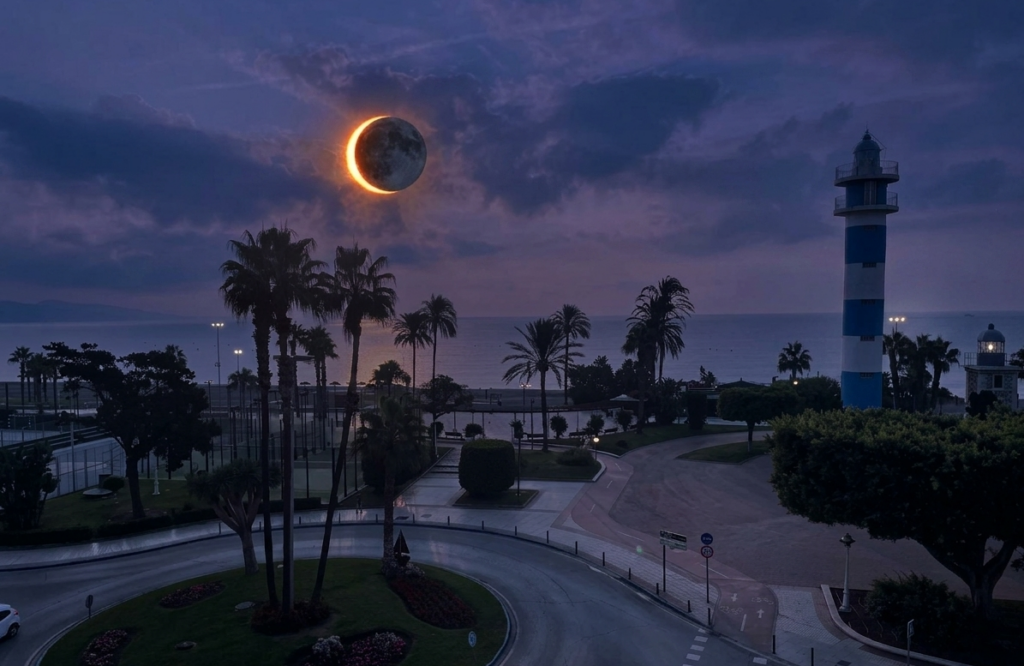
AI helped image of Torre del Mar. Credit: EWN
August 12, 2026, promises to deliver a celestial event of a lifetime as a highly rare total solar eclipse sweeps across Europe. Residents across the Axarquia and the Costa Tropical will find themselves in a prime position to witness this cosmic dance, even if the region sits just outside the path of total darkness.
Near-total darkness on the Southern coast
Lunar shadows will cover between 90 per cent and 95 per cent of the solar disc in these southern districts, creating a high-magnitude partial eclipse. Darkness will descend noticeably, casting a strange, eerie twilight over the landscape that differs from any typical dusk. Natural colours will likely fade into muted tones as the moon obscures the majority of the sun’s power, and the temperature will drop rapidly, as though it were already nighttime.
This “almost total” phenomenon remains deeply impressive because it provides a unique atmosphere without requiring travel to other regions.
Spectacular views at sunset
Timing plays an important role in making this specific event so visually arresting for local observers. Peak darkness will occur between 20.30pm and 20.40pm, coinciding perfectly with the sun’s descent toward the Mediterranean horizon. Golden hour will take on a supernatural quality as the “bitten” sun nears the waterline. Observers will have to find a clear westward view to see the final moments before the sun disappears below the waves.
Path of totality across northern Spain
Full darkness remains reserved for northern cities like Oviedo and Bilbao, where the moon will completely block the solar face. The narrow corridor of totality travels from west to east across the Iberian Peninsula, leaving Andalusia with a partial yet breathtaking experience. Coastal scenery will provide a dramatic backdrop that northern inland locations may struggle to match.
Essential safety for skywatchers
Protecting your vision is vital during any solar observation, even when only a sliver of the sun remains visible. Standard sunglasses provide zero protection against harmful radiation that can cause permanent ocular damage. Approved eclipse glasses are a must for direct viewing, while indirect projection methods offer a safe alternative for families watching the sky together. A small hole pierced into a piece of cardboard with a piece of paper or card on the floor so that the shape of the sun behind the moon projects through the card and onto the paper below works well. As long as the weather stays clear, the streets are expected to be full at this time with something of a party atmosphere for this once-in-a-lifetime event.
Sign up for personalised news
Subscribe to our Euro Weekly News alerts to get the latest stories into your inbox!
By signing up, you will create a Euro Weekly News account if you don't already have one. Review our Privacy Policy for more information about our privacy practices.

Adam Woodward
Adam is a writer who has lived in Spain for over 25 years. With a background in English teaching and a passion for music, food, and the arts, he brings a rich personal perspective to his work at Euro Weekly News. As a father of three with deep roots in Spanish life, Adam writes engaging stories that explore culture, lifestyle, and the everyday experiences that shape communities across Spain.
Comments