Travelling with fake designer goods in Europe: what tourists need to know
By Letara Draghia • Updated: 12 Sep 2025 • 13:22 • 6 minutes read
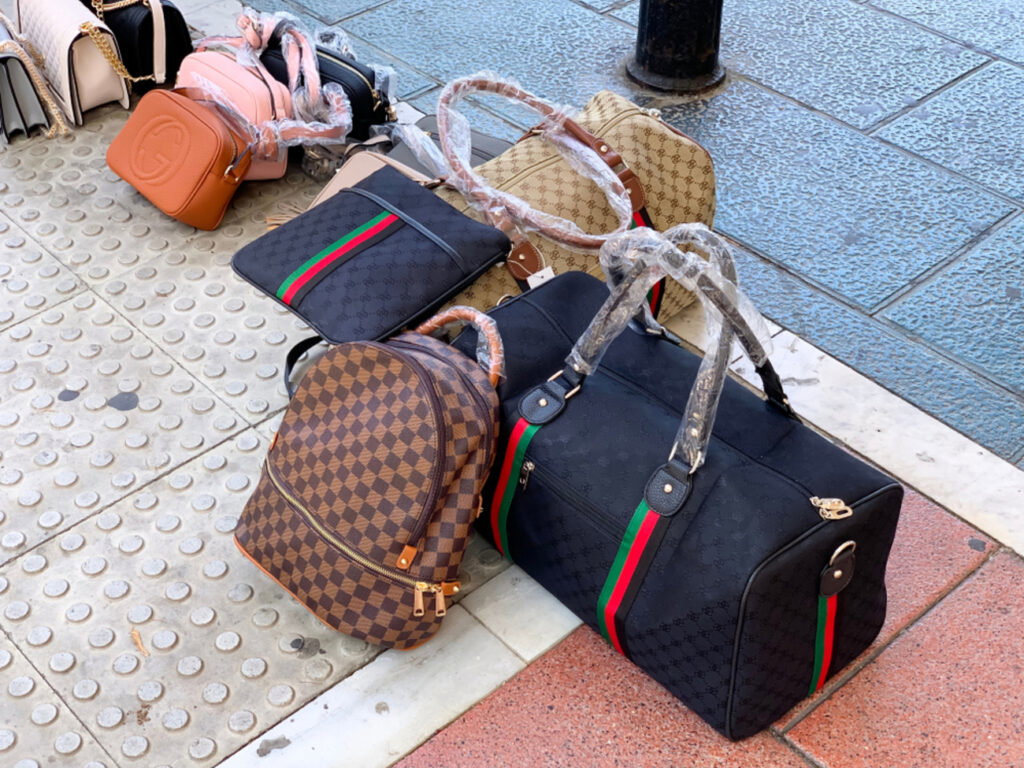
Fake designer bags in Puerto Banus, Marbella, Spain. Credit: makesushi1, Shutterstock
Travelling in Europe with a counterfeit handbag, watch, or pair of trainers can mean confiscation, fines and legal trouble – and EU detentions are surging. Read on to find out what you need to know before travelling.
In 2023, authorities detained 152 million fake items worth €3.4 billion, which was a 77 per cent jump year-on-year, according to the EUIPO/European Commission’s report published in November 2024). (European Commission – DG TAXUD)
Counterfeit designer items in Europe
Most of us have seen the “looky looky men” lining the beachfronts and strips offering fake designer bags, trainers, football kits, and accessories. The prices are definitely too good to be true. While these counterfeit goods are often quite easy to spot, there are other retailers including online that sell higher quality replica items.
OLAF cracks down on counterfeit fashion smuggling
The European Anti-Fraud Office (OLAF) has been at the centre of one of the biggest recent strikes against counterfeit fashion in Europe. In a large-scale operation launched in 2024, OLAF coordinated with customs authorities in several countries to intercept over 1.8 million fake designer items, with an estimated market value of more than €180 million (OLAF).
The operation spanned Austria, Belgium, Germany, Italy and non-EU countries, and revealed how counterfeiters try to outsmart border controls. Smugglers concealed fake luxury garments, shoes and accessories behind layers of legitimate textiles inside shipping containers. At the Port of Trieste alone, Italian customs and Guardia di Finanza seized nearly one million counterfeit products that had originated from Ambarli Port in Türkiye and were headed for the Netherlands.
Brussels has urged tough, tech-driven enforcement via a new “toolbox against counterfeiting.” The Commission says this will strengthen cooperation among platforms, brands and enforcers and adapt IP practices to AI and virtual worlds. As Margrethe Vestager puts it, “The fight against counterfeiting is a crucial element in safeguarding our innovative landscape.” (European Commission press release)
Thierry Breton adds, “Effective tools against counterfeiting are essential for the protection of intellectual property, consumer safety and innovation.”
EU countries and their rules on counterfeit goods
Key reminder: “There are no common rules for the purchase and use of counterfeit goods in the EU.” (Consumer Europe Denmark)
Italy
Italy treats counterfeiting not just as a nuisance but as “an economic crime which causes serious damage to [the] global economy” and a direct threat to both jobs and public safety, according to the Italian Customs and Monopolies Agency (ADM).
Enforcement in Italy is also shaped by EU Regulation No. 608/2013, which sets the rules for customs action against counterfeit goods. As ADM explains, the regulation expanded customs protection to new rights, introduced a “specific procedure for small consignments”, and established COPIS, the EU’s central database. This framework allows Italian customs officers to seize goods in transit, coordinate with other EU states, and destroy counterfeit products before they reach consumers.
For travellers, Italian authorities can also act at airports and ports if you are carrying counterfeit goods in your luggage. While EU law (Regulation No. 608/2013) generally exempts “goods contained in travellers’ personal luggage provided that they are of a non-commercial nature”, the ADM notes that customs officers still have powers to intervene where there is suspicion of resale or if the fake items pose safety risks.
France
French customs treat counterfeiting as a major economic and consumer threat, warning that fake goods can be dangerous. In 2022, customs officers “intercepted 11.53 million items… an increase of +27% compared to 2021. The results have more than doubled in two years.” (douane.gouv.fr)
Travellers should know that controls cover every point of entry. Customs states it operates on “import, export, circulation, detention, and also after customs clearance, a posteriori,” with brigades empowered to stop people and check luggage. That means tourists carrying a counterfeit handbag or watch risk immediate seizure and potential sanctions under the national customs code.
France has also stepped up in action against online counterfeiting, with its dedicated Cyberdouane unit tracking fraud and warning that seizures from postal and courier services are “constantly increasing.”
To raise awareness among holidaymakers, customs partners with the National Anti-Counterfeiting Committee (CNAC), the Colbert Committee and UNIFAB, running poster campaigns at “the main tourist crossing points” to remind passengers that a “cheap” luxury souvenir could end up confiscated, and leave them with fines instead of memories.
Spain
Spain’s authorities describe counterfeiting as a direct attack on the country’s economy, jobs and consumer safety. According to the Spanish Patents and Trade Mark Office (OEPM), it destroys “around 53,500 jobs per year”, causes “almost €7 million in sales lost”, and is controlled by organised crime networks, making it “the second most profitable form of trafficking by criminals after arms trafficking.” Counterfeit goods are also branded a health hazard, since they “do not pass the quality controls that ensure safe consumption” and can endanger buyers. In terms of fake bags and shoes, this can mean the inclusion of banned materials and chemicals that are harmful to health.
For travellers, the Spanish warning is clear: counterfeit products are monitored both “on the Spanish market, or at the point of entry into Spain… at any border checkpoint.” Customs officers can detain goods suspected of infringing industrial property rights, and the OEPM stresses that offences are prosecuted ex officio, meaning police and customs do not need a formal complaint to act.
This translates into strict rules for holidaymakers. As reported in a recent tourism alert, Spanish police now issue hefty on-the-spot fines to tourists caught buying knock-off handbags, sunglasses or watches from the so-called “looky looky men.” Penalties can run into hundreds of euros for even a single counterfeit item, and police often confiscate the goods as evidence.
Spain has also strengthened coordination between agencies through a multi-sector committee and a Bureau against illegal practice of a profession, tying the counterfeit trade to the shadow economy and lost tax revenue. The OEPM advises that counterfeit sales are typically linked to “illegal and itinerant sellers” controlled by criminal groups, and urges anyone who encounters such activity to report it via the Policía Nacional (091), municipal police (092), or the Guardia Civil (062).
Switzerland
Switzerland enforces some of the strictest anti-counterfeiting rules in Europe. Perhaps this has something to do with the protection of the country’s beloved Rolex watches. The Federal Office for Customs and Border Security (FOCBS) states clearly that it is “strictly prohibited to import into or export from Swiss customs territory counterfeited trademarks and counterfeited designs. This also applies to tourist traffic goods for personal use which are imported, exported or are in transit. Counterfeits may be confiscated and destroyed when crossing the border”– regardless of whether the goods are new or already used (BAZG).
According to the FOCBS, “goods brought into or out of Switzerland for private purposes in tourist traffic are withheld… if there are reasonable grounds to suspect that they infringe trademark or design rights.” In most cases, travellers are asked to sign a “declaration of surrender”, after which the item is destroyed. While the FOCBS itself charges no fees for this simplified procedure, the rights holder may demand compensation from the traveller for the infringement.
Most counterfeit goods entering Switzerland now arrive via postal or courier services, with the FOCBS noting that “over 90 per cent of the goods withheld arrived… in small consignments” linked to online shopping. This shift has intensified parcel inspections, especially around luxury brands like Rolex, Louis Vuitton and Chanel.
To help consumers, Switzerland runs the STOP PIRACY campaign, a public–private partnership that raises awareness about the dangers of counterfeit goods.
Denmark
Private-use ownership and buying can be legal, and bringing such goods from another EU country is allowed for private use. But selling is illegal, and parcels bought from outside the EU can be withheld by the tax agency. (Consumer Europe Denmark)
Turkey (Türkiye)
A viral “dupe haul” culture highlights easy access to fake designer goods in Turkey. The Sun notes “Turkey is the third biggest exporter of counterfeit products to the EU, following only China and Hong Kong,” and “customs authorities have the power to stop and seize counterfeit goods entering or leaving Turkey.”
Turkish Customs Directorates work closely with IP rights holders, and law enforcement officers to prevent the import, export and transit of counterfeit goods. They use advanced risk analysis systems to identify potentially counterfeit goods before they enter Turkish markets.
For travellers, Türkiye’s counterfeit laws are not just aimed at big smugglers. Customs rules apply equally to tourist traffic goods for personal use, meaning even one fake handbag or pair of trainers can be seized at the airport. Officials regularly carry out exit checks at airports and ferry ports, especially for passengers flying back into the EU.
Seized items can be destroyed within days, often without a court order, leaving buyers with nothing to show for their purchase. While tourists are rarely prosecuted, Turkish law makes no exception for “personal use” items.
How to avoid buying fake designer items while travelling
Buy from official boutiques or authorised retailers. Check serial numbers/holograms/authentication cards and keep receipts, which can be very useful at border checks. (Cuservi)
If you bought a counterfeit in the EU believing it was genuine, “you are entitled to either get your money back or to receive the genuine product,” and distance buyers can use the cooling-off period (you may pay return postage). For purchases outside the EU, protections are weaker; in Denmark, SKAT can withhold the parcel and the brand owner may act. (Consumer Europe Denmark)
Have you ever been stopped at EU customs while travelling with counterfeit designer goods? Let us know in the comments below.
View all European news.
View all lifestyle news.
Follow Euro Weekly News on Google News
Get breaking news from Spain, travel updates, and expat stories directly on your Google News feed.
Follow on Google NewsSign up for personalised news
Subscribe to our Euro Weekly News alerts to get the latest stories into your inbox!
By signing up, you will create a Euro Weekly News account if you don't already have one. Review our Privacy Policy for more information about our privacy practices.




Letara Draghia
Letara is a seasoned lifestyle journalist and copywriter with over a decade of experience writing for leading UK brands including Harrods, John Lewis, and Dreams. She specialises in lifestyle, property, wellness, fashion, and consumer tech—helping brands connect with their audiences through compelling, on-brand storytelling. Since relocating to Spain in 2022, Letara has been a regular contributor to Euro Weekly News, covering local culture, expat life, community events, and family-focused stories. Her deep understanding of both British and Spanish lifestyles allows her to craft content that resonates strongly with the expat community.
Comments
Ann Rosser
13 September 2025 • 10:21Im amazed at all the rules etc and i dont agree with the selling of all the fake goods on beaches etc but its allowed where i live, the vendors are on the prom every day and nobody does anything about it, its an eyesore and taking business away from the shops etc who are paying all their correct dues. So its being encouraged dosnt make any sense.
Brian
13 September 2025 • 12:39Take a match or lighter and set fire to the fakes as you walk past?
Mavis
13 September 2025 • 18:09“In 2023, authorities detained 152 million fake items worth €3.4 billion”
If they’re fake they cannot be worth €3.4 billion!
Letara Draghia
14 September 2025 • 23:04Thanks for reading. For clarification, this figure is the equivalent retail value of genuine goods. Sorry for any confusion.
Algoz
20 September 2025 • 10:32You see them every day in Calpe….police take no notice at all. Complete and utter waste of time…It’s not the people that buy stuff that should be fined – it’s the muppets selling the stuff…
Comments are closed.