How the Romany Family Is Reviving the Valencian Coca
By Tory Tustin • Updated: 14 Oct 2025 • 15:57 • 2 minutes read
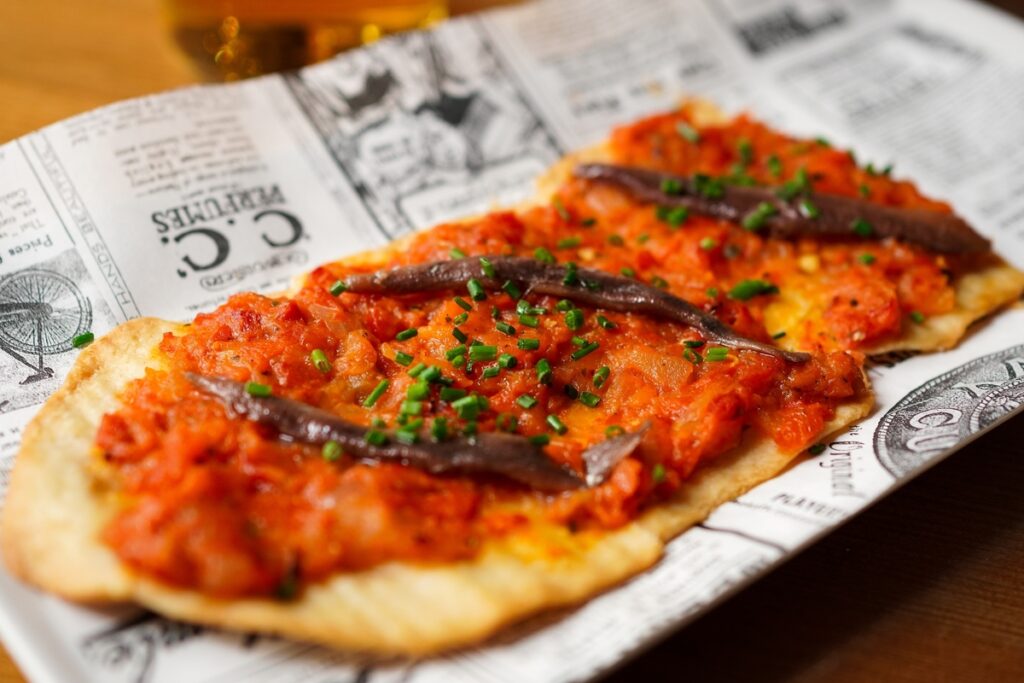
Photo Title: Coca with sobrasada and anchovies Photo Credit: LaMerce / Shutterstock
In the heart of Dénia, a gastronomic revival is underway – one that’s taking a centuries-old dish and giving it the respect that typically only paella gets. At El Pont Sec, a family-run restaurant beneath the Montgó mountain, chef Carles Romany and his father Pep Romany are creating what they call a “revolution around coca.”
Coca – a flat, round base topped with local ingredients – is one of the most traditional foods in the Valencian Community. To a tourist, it might look like a pizza, but it’s very well known in Mediterranean history. “It probably predates pizza,” Carles says. “Visually, people relate it to Italian cuisine, but it’s ours — and that’s the revolution: accepting what belongs to us and putting it proudly on the table.”
How the Romany Family Is Reviving the Valencian Coca
What used to be an everyday food in the Valencian Community, coca slowly disappeared from everyday cooking as menus evolved, and more modern dishes came into existence. For years it was mostly sold cold in bakeries, but rarely seen on restaurant menus. The Romany family decided it was time to change that.
From their farmhouse restaurant in Dénia, they began working on the traditional recipe and pairing it with local produce. “We wanted to bring back the dishes our grandmothers made,” Carles explains, “but with today’s technology and techniques.”
At the recent D*NA Gastronomic Festival in Dénia, the Romanys showcased their work to visitors. Standing beside their stand on the Marineta Cassiana promenade, Carles proudly declared that coca now holds a place “almost on the same level as paella – an emblem of the Marina Alta and the wider Valencian Community.”
Their menu changes with the seasons, depending on which local produce is the most popular. Summer might bring aubergine or tomato coca, while autumn has options such as botifarra (Valencian sausage) or anchovy.
Not all cocas are savoury. The Romanys also experiment with sweet versions that surprise people. Among their most popular is a sobrasada and honey coca, and a new standout made with carob – a local alternative to chocolate. “Instead of importing cocoa, we use what we have here,” Carles explains. “Carob is our version of chocolate – it’s the Marina’s own.”
Coca has evolved from a forgotten food into a modern symbol of Valencian identity. As Carles puts it: “The revolution lies in embracing what’s ours – and reminding people how good it’s always been.”
Follow Euro Weekly News on Google News
Get breaking news from Spain, travel updates, and expat stories directly on your Google News feed.
Follow on Google NewsSign up for personalised news
Subscribe to our Euro Weekly News alerts to get the latest stories into your inbox!
By signing up, you will create a Euro Weekly News account if you don't already have one. Review our Privacy Policy for more information about our privacy practices.


Tory Tustin
Victoria (Tory) Bouanati Tustin is a local news reporter covering the Costa Blanca South region as well as tackling stories for the Euro Weekly News webpage. Tory has over 4 years of experience in the realm of journalism, and has covered an array of topics from travel and tourism to fashion, beauty, and health. With a Bachelor of the Arts degree in Journalism, a minor in Spanish, and a certificate in Film Studies, Tory has a passion for writing and reporting up-to-date, accurate, and newsworthy information to people all over the world.
Comments