Planetary parade: How to see 6 solar system planets all in a row in February
By Adam Woodward • Published: 08 Feb 2026 • 11:49 • 2 minutes read
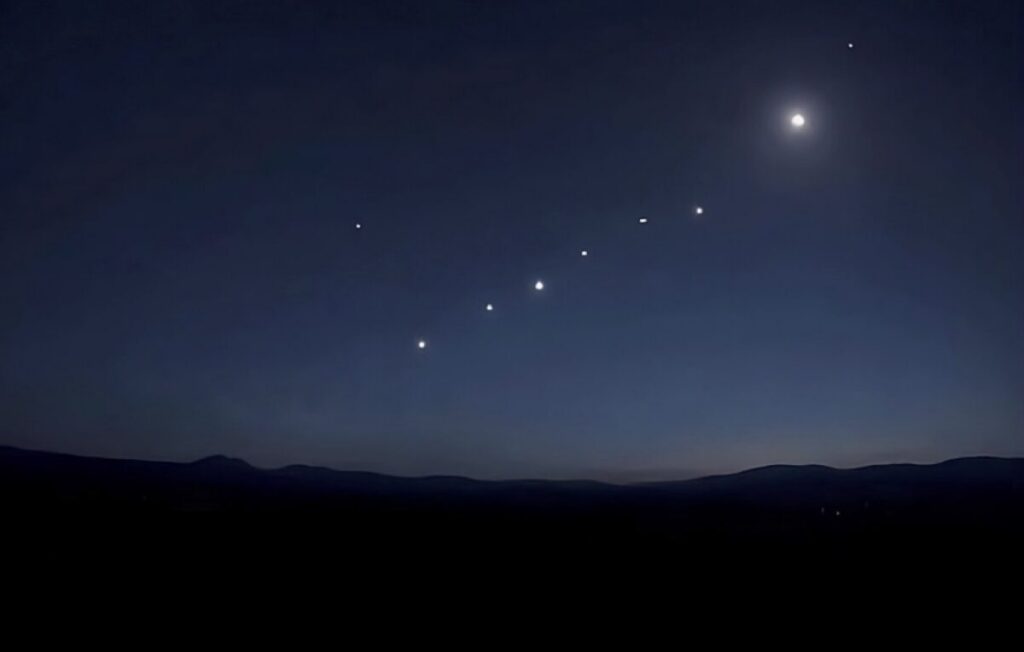
Planets in a line. Credit: James Webb Space Telescope
The six-planet alignment peaks on February 28 and will offer stargazers in Spain and across Europe a chance to observe Mercury, Venus, Saturn, Jupiter, Uranus, and Neptune clustered along the ecliptic shortly after sunset. Four of these, Venus, Mercury, Saturn, and Jupiter, will be easily visible to the naked eye under clear conditions, while Uranus and Neptune will require binoculars or a telescope.
Excitement is brewing among astronomy enthusiasts, as such alignments provide a stunning visual display of our solar system’s architecture.
What is the February 2026 planetary alignment?
This evening planetary parade occurs when six planets appear grouped in one section of the sky from Earth’s perspective. It’s not a perfect straight-line alignment in space but an optical effect along the ecliptic plane. On February 28, the alignment will be at its most compact, visible across both hemispheres, including Spain. The planets will stretch from the western horizon toward higher in the sky.
Which planets will be visible in Spain?
- Venus: The brightest planet in the lineup, shining intensely low in the west.
- Mercury: Visible to the naked eye but low and subtle, near Venus and setting quickly.
- Saturn: Higher up with its soft yellowish glow, in the constellation Pisces.
- Jupiter: Bright and prominent, higher in the sky for easier viewing.
- Uranus and Neptune: fainter outer planets, requiring optical aid for clear observation.
- Venus, Mercury, and Saturn form a compact group near the western horizon, making them the focal points for naked-eye viewers in Spain.
Best time and viewing tips for the six-planet parade
The best viewing window is approximately one hour after sunset on February 28, though the display is visible from the last week of February into early March.
Look west toward the horizon immediately after sunset:
- Mercury and Venus will be low and set quickly (within about an hour).
- Saturn appears slightly higher.
- Jupiter stands out brightly higher up.
- Use binoculars or a small telescope for Uranus (near Saturn in Pisces) and Neptune.
For the best experience in Spain:
- Choose a location with a clear, unobstructed western horizon (avoid city lights and buildings).
- Ensure clear skies – check local weather forecasts.
- Apps like Star Walk or Stellarium can help locate the planets precisely.
- A near-full moon may be present, potentially washing out fainter objects, so darker sites away from light pollution are ideal.
How the alignment evolves through the night
As the evening progresses:
- Mercury sets rapidly, visible only briefly at the start.
- Venus, though dazzling, also remains low and disappears early.
- Saturn lingers longer with its characteristic pale yellow light.
- Jupiter remains high and steady for much of the night.
The dynamic change allows observers to track planetary motion and compare brightness, colours, and positions, offering insights into celestial mechanics. Six-planet alignments like this are extremely rare, and in February 2026 this is a highlight of the year’s astronomical calendar, reminding us of the beauty and scale of our solar system. Grab a clear night, head outdoors, and enjoy the cosmic show over Spain’s skies!
Follow Euro Weekly News on Google News
Get breaking news from Spain, travel updates, and expat stories directly on your Google News feed.
Follow on Google NewsSign up for personalised news
Subscribe to our Euro Weekly News alerts to get the latest stories into your inbox!
By signing up, you will create a Euro Weekly News account if you don't already have one. Review our Privacy Policy for more information about our privacy practices.




Adam Woodward
Adam is a writer who has lived in Spain for over 25 years. With a background in English teaching and a passion for music, food, and the arts, he brings a rich personal perspective to his work at Euro Weekly News. As a father of three with deep roots in Spanish life, Adam writes engaging stories that explore culture, lifestyle, and the everyday experiences that shape communities across Spain.
Comments