Spanish government pledges €23bn to tackle housing shortage
By Molly Grace • Published: 16 Feb 2026 • 19:10 • 3 minutes read
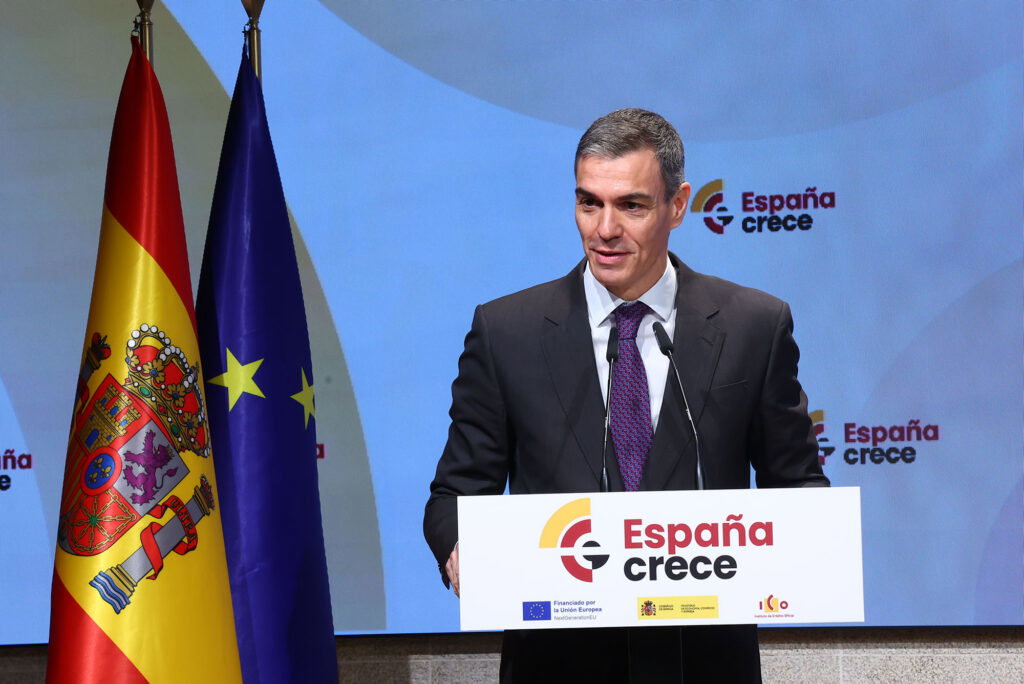
Government officials stressed that the 15,000 homes per year would be protected and affordable. Photo credit: Pool Moncloa/Fernando Calvo
The Spanish government has unveiled a major new public investment vehicle designed to tackle the national housing shortage and stimulate long-term economic growth, with an initial focus on affordable housing.
Prime Minister Pedro Sánchez announced the creation of a sovereign wealth fund named España Crece (Spain Grows), pledging that it will mobilise up to €23 billion in public and private capital to finance the construction of 15,000 homes per year. The announcement comes amid mounting political pressure over soaring property costs and limited housing supply in urban centres.
The fund was presented at the Colegio Oficial de Arquitectos de Madrid on Monday, February 16, in an event attended by several senior cabinet ministers, including the ministers for Economy and for Housing. Sánchez described the initiative as a “decisive response” to Spain’s persistent housing affordability issues.
A strategic successor to EU recovery funds
España Crece is explicitly designed to build on the legacy of the EU’s NextGenerationEU recovery programme, which supported Spain’s post-pandemic economic rebound. These pandemic recovery resources are scheduled to expire later this year, and the new fund aims to “recycle” unused portions into longer-term investment opportunities.
Under the structure announced today, the fund will be managed by the Instituto de Crédito Oficial (ICO), Spain’s state-owned promotional bank. The ICO will initially receive €13.3 billion in capital, comprising €10.5 billion in unused EU recovery loans and €2.8 billion in non-repayable transfers.
These resources will be leveraged to generate the broader €23 billion earmarked for housing. Of that total, around €14 billion is expected from public financing (direct injections and ICO-secured long-term debt), while roughly €9 billion will come from private investors attracted by long maturity terms and investment incentives.
Housing focus within a broad investment remit
While housing is a headline commitment, España Crece has a multi-sector mission. Sánchez emphasised that the fund will operate across sectors viewed as crucial to Spain’s future competitiveness, including energy transition, digitalisation, artificial intelligence, re-industrialisation, circular economy, infrastructure, water and sanitation, and national security.
According to government sources, the broader target for the fund is to mobilise €120 billion in combined public and private investment over time, with the initial €23 billion serving as the first substantial tranche directed at housing.
Sánchez characterised the scale of the programme as “the highest volume of public and private investment on advantageous terms in Spanish history” to confront the housing crisis. He said financing should not be a “bottleneck” preventing new affordable homes from being built.
Ambition to boost affordable rental stock
Government officials stressed that the 15,000 homes per year would be protected and affordable, specifically aimed at addressing the chronic shortage of rental housing accessible to middle- and low-income households. Housing ministry sources told EFE that these units would be additional to those already planned under separate industrialisation initiatives in the construction sector.
Sánchez underscored that private investors would be welcomed but that speculation on housing as a financial asset would not be encouraged. “We are creating a red carpet for investment, but not to speculate on a constitutional right, to build homes for those who today cannot access housing,” he said.
Political reaction and broader context
The announcement was met with mixed responses from political parties and stakeholders. Some opposition figures accused the government of recycling old pledges without addressing deeper structural issues in the housing market. Others welcomed elements of the plan but urged complementary measures such as stronger rent protections.
Critics from smaller parties described the announcement as “words without substance” unless accompanied by regulatory reforms tackling speculation and rent inflation. They argue that building 15,000 homes annually, while helpful, may fall short of meeting broader demand in a market where housing affordability remains strained.
Meanwhile, proponents of the plan highlighted Spain’s broader economic backdrop: relatively modest public debt compared with some EU peers and stronger growth projections, which supporters say create space for long-term investment in social infrastructure.
Implementation timeline and outlook
Officials indicated that España Crece is expected to begin operations in the second quarter of 2026, with initial investment mechanisms and partnerships being finalised before funds are deployed. The ICO’s expanded financing capacity, backed by both European and private capital, will be central to disbursing resources to builders and developers.
Longer-term success, analysts say, will depend on factors such as the pace of permitting and construction, availability of suitable land, and the ability to attract sustained private capital without fuelling price escalation. Government figures acknowledge that while building 15,000 homes annually represents progress, it must be part of a broader policy response to Spain’s housing supply deficit.
As the initiative unfolds, the balance between social impact goals, investor incentives and political expectations will be scrutinised by voters, developers and economic commentators alike.
Follow Euro Weekly News on Google News
Get breaking news from Spain, travel updates, and expat stories directly on your Google News feed.
Follow on Google NewsSign up for personalised news
Subscribe to our Euro Weekly News alerts to get the latest stories into your inbox!
By signing up, you will create a Euro Weekly News account if you don't already have one. Review our Privacy Policy for more information about our privacy practices.





Molly Grace
Molly is a British journalist and author who has lived in Spain for over 25 years. With a background in animal welfare, equestrian science, and veterinary nursing, she brings curiosity, humour, and a sharp investigative eye to her work. At Euro Weekly News, Molly explores the intersections of nature, culture, and community - drawing on her deep local knowledge and passion for stories that reflect life in Spain from the ground up.
Comments
Rodrigues Sanchez
18 February 2026 • 09:26Obviously an election looming because the housing shortage for Spanish nationals is created by the Spanish government. They are not known for being good to the people of Spain, OK if you are rich but if you are the average Spanish citizen you are on your own so it will be good to get some homes built for the people who need them and that is a long list but like everything else in Spain talk is cheap and normally after the big Headlines nothing happens.
Comments are closed.