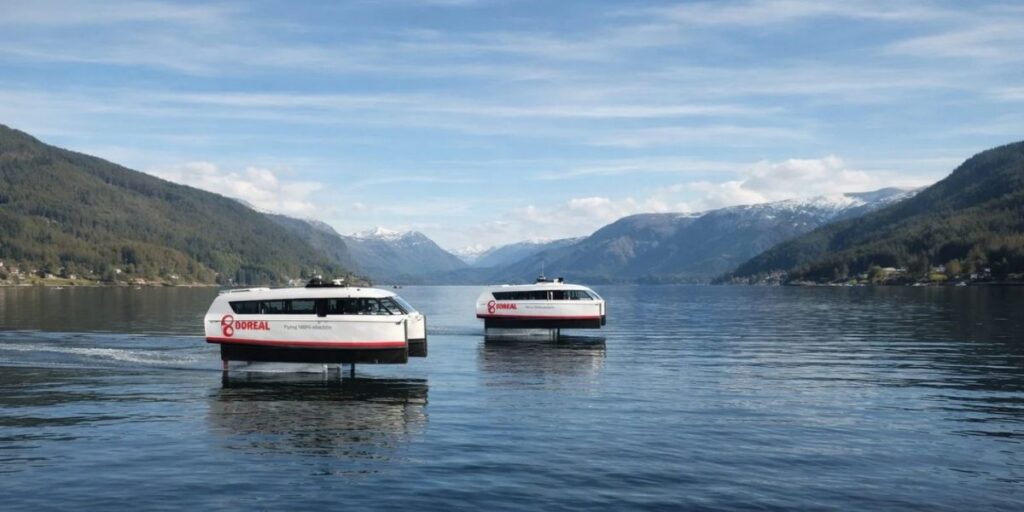
Norway is once again pushing the boundaries of sustainable travel, announcing plans to deploy the world’s largest fleet of electric hydrofoil ferries. The landmark order, 20 cutting-edge vessels, marks a major leap forward in zero-emission maritime transport and could reshape how coastal communities and travellers move across water.
Commissioned by transport operator Boreal, the fleet will consist of Candela P-12 “flying” ferries, so-called because they glide above the water on hydrofoils. The first vessels are expected to enter service in 2027, with the full rollout continuing through to 2030.
What makes these ferries different?
Unlike traditional ferries, these vessels use underwater wings that lift the hull above the surface once at speed. This dramatically reduces drag, enabling faster journeys while cutting energy consumption by around 80% compared to conventional boats.
The result is a transport experience that is not only greener, but also smoother and quieter. Passengers can expect minimal vibration, reduced seasickness, and cabin noise levels lower than many trains.
With cruising speeds of around 25 knots and a range of roughly 40 nautical miles, the ferries are designed to rival the diesel-powered “express boats” that currently connect Norway’s remote coastal communities.
Solving the electric ferry challenge
Electrifying high-speed ferries has long been a challenge. While Norway already leads the world in electric car adoption and short-route ferries, longer-distance, high-speed vessels have remained dependent on fossil fuels due to energy demands and charging constraints.
The new hydrofoil technology changes that equation. Because the vessels require significantly less energy, they can recharge in about an hour using standard fast chargers—avoiding the need for expensive, large-scale charging infrastructure.
This breakthrough opens the door to electrifying routes that were previously considered impractical, particularly across Norway’s vast fjord network and rugged coastline.
A boost for tourism and daily travel
Beyond the environmental benefits, the new fleet is expected to transform everyday travel. Increased frequency, shorter journey times, and smoother rides will benefit both commuters and tourists exploring Norway’s iconic fjords.
The vessels are likely to operate on a mix of urban and rural routes, with cities such as Oslo and Trondheim among those being considered.
For travellers, this could mean faster, quieter and more scenic journeys—gliding above the water with minimal wake and zero emissions.
Setting a global blueprint
Norway has long been a leader in sustainable transport, but this latest move signals a new phase in maritime innovation. By scaling up electric hydrofoil technology, the country is demonstrating that high-speed, zero-emission sea travel is not only possible but commercially viable.
As other nations look to decarbonise their transport networks, Norway’s “flying ferries” could become a blueprint for coastal cities worldwide, from island nations to major urban waterfronts.
In short, the future of ferry travel may not just be electric, it may be flying just above the waves.



Lottie Verrier
Lottie Verrier is a journalist and digital media specialist based in Mallorca. After a decade in London media, including a role as Deputy Editor for the MailOnline’s eCommerce division, she now combines her editorial expertise with a passion for the island to create engaging content that celebrates the best of life in Spain. Instagram @lottieinmallorca
Comments