300+ in one day risk lives in deadly Atlantic crossings to Canaries as Madrid accused of abandonment
By Adam Woodward • Published: 11 May 2026 • 18:26 • 2 minutes read
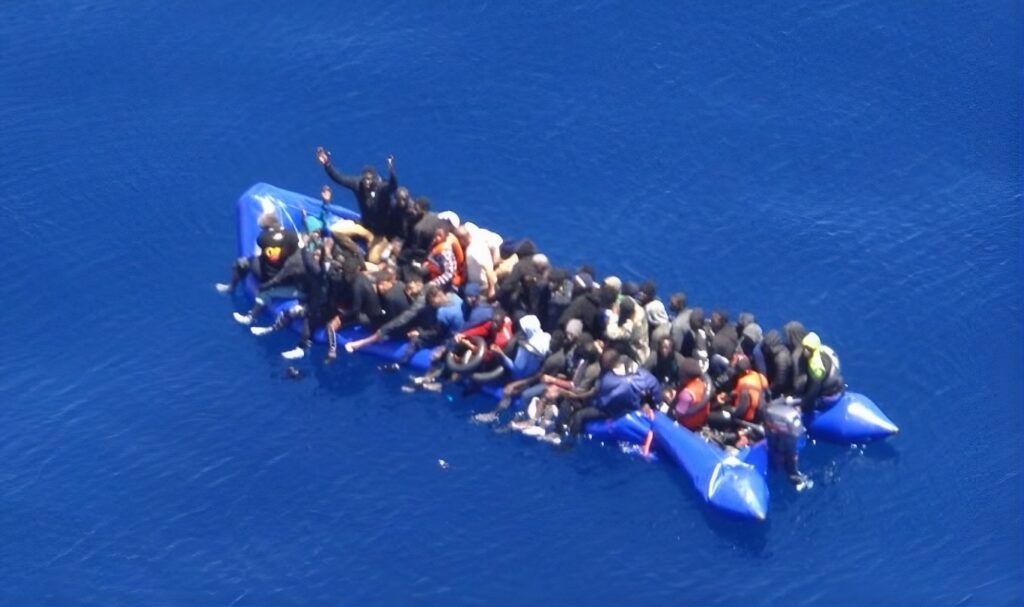
Half-sunk inflatable with 50 migrants. Credit: Salvamentogov
Rescue services deployed sea vessels and aircraft to assist migrant boats reaching the Canary Islands over the weekend, with more than 300 people needing rescuing in operations that showed the extreme dangers of these Atlantic journeys.
Spanish maritime teams responded to multiple incidents that exposed how easily such voyages can turn fatal. One wooden vessel carrying 125 individuals suffered engine trouble off El Hierro island late on Sunday night, May 10, and required towing to safety by the Salvamar Diphda. Passengers numbered 116 males, three females and six minors, all disembarked in “good condition” at La Restinga.
A las 21:10 hora local se localiza un cayuco a 9.5 millas al sureste de La Restinga (El Hierro) con 125 personas subsaharianas a bordo (116 varones, 3 mujeres y 6 menores). El CCS Tenerife moviliza la Salvamar Diphda que remolca el cayuco, con problemas en el motor. Ya en puerto,… pic.twitter.com/rBvaUOOtXT
— SALVAMENTO MARÍTIMO (@salvamentogob) May 11, 2026
Earlier that Sunday authorities guided a crowded inflatable craft with 116 men, three women and six minors into Tenerife port after spotting it near Las Galletas beach. Migrants had departed Gambia at least a week earlier aboard the overcrowded craft.
Rescue missions highlight life-threatening vulnerabilities at sea
Aircraft surveillance located a partially submerged inflatable boat off Lanzarote carrying 55 migrants, none wearing life jackets. Fast response teams transferred the group to Arrecife port for checks; fortunately, there were calm seas that prevented worse outcomes, yet conditions were still extremely precarious with a leak and feet submerged in water.
Saturday saw additional groups of 62 people arrive on Gran Canaria and 61 on Lanzarote. Such episodes demonstrate how fragile these boats prove in open ocean, where mechanical failure or deflation can rapidly endanger every life aboard.
Canary Islands leaders condemn government inaction and isolation
Officials from the Gobierno de Canarias have expressed profound concern over the structural crisis that leaves the islands handling this burden without adequate support. President Fernando Clavijo has stressed the need for national and European coordination while criticising the “soledad” (solitude) faced by the archipelago from central authorities.
Regional representatives invested €190 million in 2025 for migration measures and obtained decrees for minor redistribution when capacity limits are met. Past shortfalls in sharing responsibility for around 3,090 unaccompanied minors have created political friction and deepened local strain from record numbers of arrivals in prior years.
Latest demands focus on EU pact implementation and shared responsibility
On May 8, officials from the Canaries joined the Basque Country in requesting an urgent meeting with central government to examine the EU Migration and Asylum Pact rollout. Authorities alerted Brussels days earlier about receiving zero details on its application to the islands.
Clavijo reiterated in early May interviews the requirement for a state pact on migration to avoid turning border areas into rights “black holes”. They reject any plan that designates the Canary Islands as a long-term detention zone and insist richer EU nations cannot simply pay to evade hosting duties.
Broader trends show reduced arrivals but unresolved humanitarian pressures
Recent data indicates there have been sharp drops in 2026 compared to previous years, with overall Spanish entries down 43 per cent in early months and Atlantic route figures falling 80 per cent in the first quarter. Canary officials care for around 3,337 unaccompanied minors and call for help from other regions to prevent more overload.
Bilateral agreements with West African nations have curbed departures to some extent, yet migrants still attempt the crossing that carries a mortal risk. Local voices demand Madrid deliver clarity, resources and genuine burden-sharing so the islands escape their frontline isolation once and for all.
Follow Euro Weekly News on Google News
Get breaking news from Spain, travel updates, and expat stories directly on your Google News feed.
Follow on Google NewsSign up for personalised news
Subscribe to our Euro Weekly News alerts to get the latest stories into your inbox!
By signing up, you will create a Euro Weekly News account if you don't already have one. Review our Privacy Policy for more information about our privacy practices.




Adam Woodward
Adam is a writer who has lived in Spain for over 25 years. With a background in English teaching and a passion for music, food, and the arts, he brings a rich personal perspective to his work at Euro Weekly News. As a father of three with deep roots in Spanish life, Adam writes engaging stories that explore culture, lifestyle, and the everyday experiences that shape communities across Spain.
Comments
Ron
12 May 2026 • 11:21They are no immigrants, they are criminals and we should not let
Them in to the country.
Brian
12 May 2026 • 14:46Quite right Ron! Seems the Spanish government is as blind as the British one!
Susan
12 May 2026 • 12:59Why are the authorities not returning them whence they came?
Comments are closed.