A huge solar hole is now pointing straight at Earth and could light up skies across Europe this week
By Farah Mokrani • Published: 14 May 2026 • 12:12 • 4 minutes read
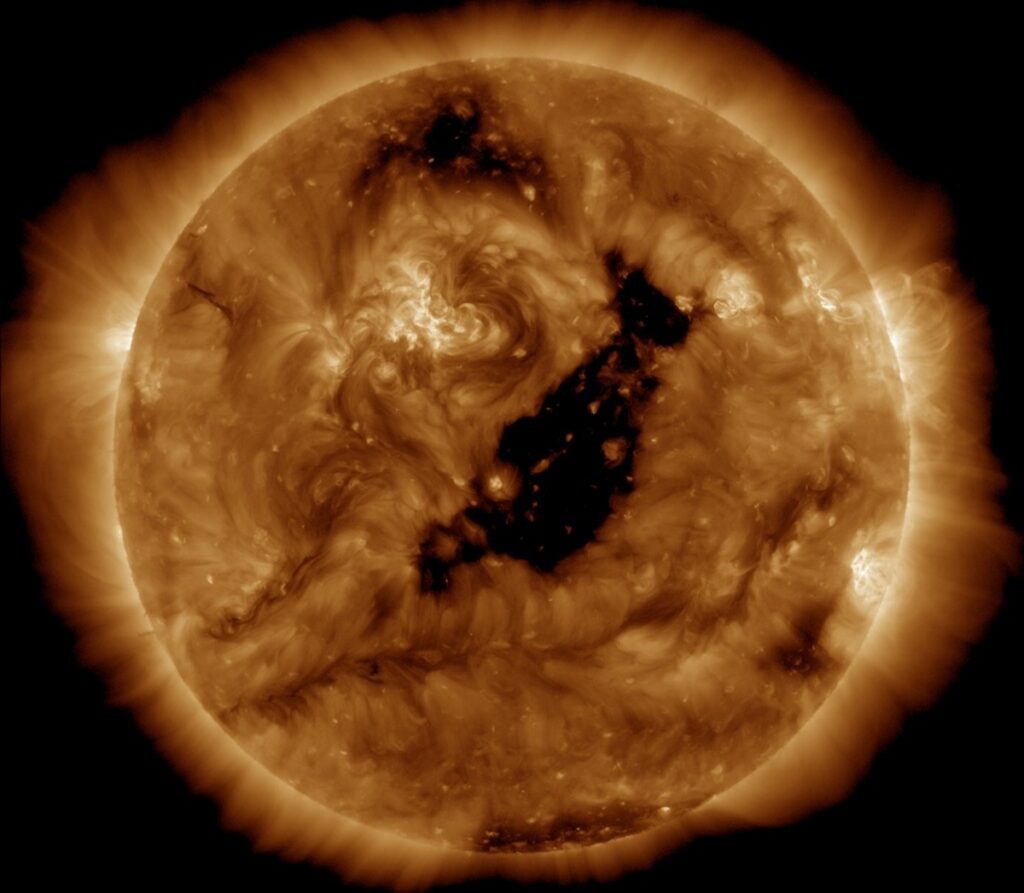
Scientists are monitoring a giant coronal hole on the Sun that could trigger geomagnetic activity and rare auroras this week. Credit sdo.gsfc.nasa.gov
Astronomers and space weather experts are closely monitoring a massive coronal hole on the Sun that is now directly facing Earth and could send strong solar winds towards the planet from May 15. Scientists say the phenomenon may lead to geomagnetic disturbances capable of affecting radio communications, GPS systems and satellites, while also increasing the chances of rare aurora displays appearing much further south than normal.
There is no danger to people on Earth, experts stress. Our planet’s magnetic field and atmosphere continue protecting us from harmful radiation linked to solar activity. But events like this are still taken seriously because modern life depends heavily on technology that can be sensitive to geomagnetic storms.
The timing has attracted particular attention because solar activity has remained unusually intense over recent months, producing spectacular northern lights in places where they are almost never seen.
Now scientists are waiting to see how strongly the incoming solar wind interacts with Earth’s magnetic field once it arrives later this week.
What exactly is the giant ‘hole’ scientists are tracking?
Despite the dramatic headlines circulating online, the Sun has not literally developed a hole.
What scientists are observing is something known as a coronal hole, a region in the Sun’s outer atmosphere where magnetic fields open up and allow charged particles to escape into space much more easily.
These areas often appear darker in solar images because they are cooler and less dense than surrounding regions.
The important part is not how they look, but where they are positioned. When a large coronal hole turns directly towards Earth, the solar wind released from it can travel straight towards our planet at extremely high speeds.
That flow of charged particles can then interact with Earth’s magnetosphere, the invisible magnetic shield surrounding the planet.
According to astronomers monitoring the event, the current coronal hole is both large and positioned in a particularly active area of the Sun, making it capable of producing stronger solar wind streams over the coming days.
Space weather specialists have therefore been following developments very closely ahead of the expected arrival of the solar wind from May 15 onwards.
What people on Earth could actually notice
For most people, the effects may end up being minimal. Scientists continue insisting there is no direct health risk to the public from this type of solar activity. But technology can sometimes react differently.
Moderate geomagnetic storms have the potential to interfere temporarily with GPS precision, radio communications and some satellite operations. Airlines, navigation systems and power operators also tend to monitor these events carefully whenever solar activity increases.
That does not mean major blackouts or widespread disruptions are expected.
In most cases, events of this scale pass with limited impact. Still, experts pay close attention because stronger geomagnetic storms have caused serious technological problems in the past.
One possible side effect attracting excitement rather than concern is the chance of seeing auroras much further south than usual.
Over the past year, northern lights became visible across parts of Europe and North America where sightings are normally extremely rare.
Photos of skies glowing pink, green and purple spread rapidly online during previous geomagnetic events, surprising many people who had never seen auroras outside Scandinavia or Iceland.
If the incoming solar wind interacts strongly enough with Earth’s magnetic field again, similar scenes could become visible in parts of Europe over the next few days.
That possibility is one reason why amateur astronomers and photographers are already keeping a close eye on forecasts.
Why solar storms worry scientists more today than in the past
Interest in space weather has grown sharply over recent years because modern societies are far more dependent on vulnerable technology than they were in the past.
Satellites, GPS navigation, aviation systems, communications networks and electricity infrastructure can all potentially be affected during major geomagnetic storms.
That concern explains why governments and space agencies invest heavily in solar monitoring systems designed to track activity on the Sun continuously.
The event scientists still talk about most is the Carrington Event of 1859, considered the strongest solar storm ever recorded.
At the time, telegraph systems across Europe and North America reportedly failed, with some operators receiving electric shocks and telegraph lines even catching fire.
Back then, the world relied far less on electrical technology than it does today.
Experts believe a solar storm on that scale now could create enormous economic disruption because modern infrastructure depends so heavily on electronic systems and satellites.
That does not mean the current event is expected to reach anything close to those levels. Scientists monitoring the coronal hole are describing it as significant, but not catastrophic.
Even so, events like this remind researchers how closely daily life on Earth remains connected to activity happening millions of kilometres away on the surface of the Sun.
The Sun is entering a particularly active period
Another reason scientists are paying attention is that the Sun is currently moving through one of the most active phases of its natural cycle.
Solar activity rises and falls over roughly 11 year periods. During more active phases, the Sun produces more sunspots, solar flares and coronal holes capable of generating geomagnetic storms.
That increase has already been noticeable throughout the past year.
Several strong solar events produced widespread auroras and raised concerns among satellite operators and communications agencies monitoring space weather conditions.
Researchers expect this active period to continue for some time, meaning similar solar events could become more frequent over the coming months.
For now, scientists are continuing to monitor the incoming solar wind closely while reassuring the public that there is no reason for alarm. But if skies suddenly light up with unusual colours later this week, many people across Europe may end up looking towards the night sky for a very different reason.
Follow Euro Weekly News on Google News
Get breaking news from Spain, travel updates, and expat stories directly on your Google News feed.
Follow on Google NewsSign up for personalised news
Subscribe to our Euro Weekly News alerts to get the latest stories into your inbox!
By signing up, you will create a Euro Weekly News account if you don't already have one. Review our Privacy Policy for more information about our privacy practices.




Farah Mokrani
Farah is a journalist and content writer with over a decade of experience in both digital and print media. Originally from Tunisia and now based in Spain, she has covered current affairs, investigative reports, and long-form features for a range of international publications. At Euro Weekly News, Farah brings a global perspective to her reporting, contributing news and analysis informed by her editorial background and passion for clear, accurate storytelling.
Comments