A giant asteroid found just days ago is now passing close to Earth
By Farah Mokrani • Published: 18 May 2026 • 17:33 • 4 minutes read
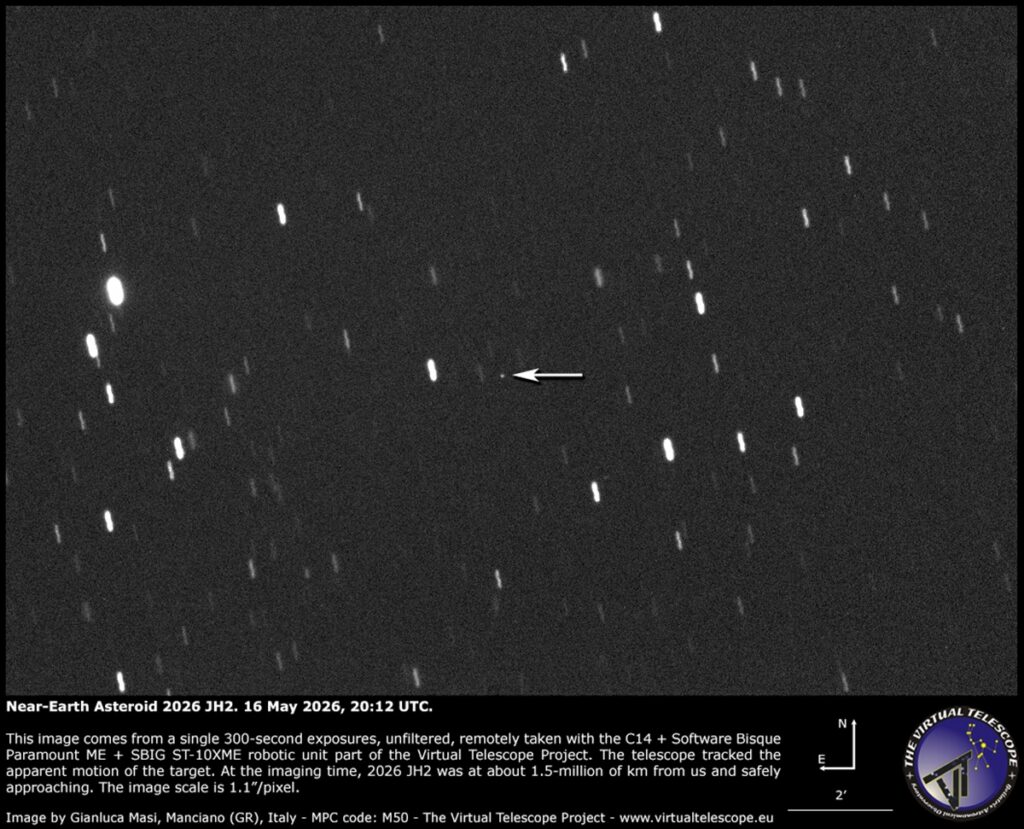
Asteroid 2026 JH2 was photographed by the Virtual Telescope Project just days before its unusually close pass by Earth. Credit : www.virtualtelescope.eu
An asteroid that astronomers only discovered a few days ago will fly unusually close to Earth this Monday, May 18, passing at a distance of around 91,000 kilometres from the planet. Scientists insist there is no danger of impact, but the object is still close enough to attract serious attention because it will pass at barely a quarter of the distance between Earth and the Moon.
The asteroid, named 2026 JH2, was first spotted on 10 May by astronomers working with the Mount Lemmon Survey in Arizona. Since then, observatories and space agencies have been tracking it closely as it heads towards its nearest point to Earth.
And yes, the numbers sound dramatic. Whenever an asteroid is described as ‘passing close to Earth’, people naturally imagine disaster films, emergency warnings and giant rocks falling from the sky. But astronomers say this particular flyby is more fascinating than dangerous.
What surprised many scientists more than the approach itself is how recently the object was discovered.
Researchers openly admit there are still countless space rocks moving through Earth’s cosmic neighbourhood that remain completely undetected until they become bright enough for telescopes to finally spot them.
Scientists say objects like this pass by Earth more often than people realise
For most people, hearing that a space rock the size of one or two school buses is heading near Earth sounds terrifying.
Astronomers see it differently.
According to Richard Binzel, a planetary scientist at MIT, objects of this size pass through Earth’s vicinity several times every year. Smaller objects travel between Earth and the Moon even more frequently without attracting public attention.
The difference today is technology. Modern sky surveys have become much better at spotting faint moving objects that previous generations of astronomers would never even have noticed.
In other words, these asteroids are not suddenly appearing more often. Humans are simply getting better at detecting them.
The asteroid belongs to a family known as Apollo asteroids, objects whose orbit around the Sun crosses Earth’s orbital path. Scientists currently estimate 2026 JH2 measures somewhere between 15 and 30 metres across, although nobody knows the exact size yet.
That uncertainty comes from how telescopes work. When astronomers first observe a newly discovered asteroid, they mainly measure how much visible light it reflects. A larger darker object can appear similar in brightness to a smaller reflective one, which makes precise size calculations difficult.
Researchers say infrared observations would help determine the dimensions more accurately, but those observations are harder to obtain quickly from Earth based telescopes.
The asteroid is close enough to sound alarming but scientists say there is zero risk
At its closest point, 2026 JH2 will pass roughly two and a half times farther away than the altitude used by many geostationary satellites orbiting Earth.
Cosmically speaking, that is extremely close.
Still, experts stress that the asteroid will remain safely away from Earth itself and will not enter the atmosphere.
Patrick Michel, astrophysicist at France’s National Centre for Scientific Research, described the flyby as ‘far enough that there is absolutely nothing to worry about’.
Scientists also compared the asteroid’s possible size to previous famous events. At the smaller end of current estimates, it could resemble the Chelyabinsk object that exploded above Russia in 2013, injuring more than a thousand people after the shockwave shattered windows throughout the city.
At the larger end, researchers say it approaches the scale of the Tunguska event in Siberia in 1908, which flattened vast sections of forest.
But astronomers repeatedly emphasise one important point. Unlike those objects, 2026 JH2 is not on a collision course with Earth.
Not even remotely.
Astronomers admit we still know surprisingly little about nearby asteroids
One reason this story attracted attention so quickly is because it highlights how incomplete our knowledge of near Earth objects still is.
Jean Luc Margot, professor of planetary science at UCLA, explained that astronomers may have detected only around one percent of near Earth asteroids within this size range.
That means there are likely many more objects similar to 2026 JH2 that nobody has identified yet.
Part of the problem comes from limited observation infrastructure. The famous Arecibo Observatory collapsed in 2020, removing one of the world’s most important planetary radar systems. NASA’s Goldstone radar facility is also currently undergoing major repairs, leaving astronomers with fewer tools to analyse nearby asteroids in detail.
Even so, scientists say there is positive news too.
Space agencies around the world are now investing more heavily in asteroid detection programmes designed to improve monitoring of potentially hazardous objects. And researchers are already looking ahead to an even more spectacular event.
In April 2029, the enormous asteroid Apophis will pass much closer to Earth than 2026 JH2. It will come close enough to become visible to the naked eye across parts of Europe, Africa and the Middle East. But, astronomers are not afraid of that flyby either.
Actually, many of them are excited about it.
Because close encounters like these give scientists a rare chance to study objects that normally remain incredibly distant and difficult to observe.
For now though, researchers say Monday’s asteroid will simply pass by harmlessly before continuing its journey through the solar system.
Close enough to sound frightening. But not close enough to threaten Earth.
Follow Euro Weekly News on Google News
Get breaking news from Spain, travel updates, and expat stories directly on your Google News feed.
Follow on Google NewsSign up for personalised news
Subscribe to our Euro Weekly News alerts to get the latest stories into your inbox!
By signing up, you will create a Euro Weekly News account if you don't already have one. Review our Privacy Policy for more information about our privacy practices.





Farah Mokrani
Farah is a journalist and content writer with over a decade of experience in both digital and print media. Originally from Tunisia and now based in Spain, she has covered current affairs, investigative reports, and long-form features for a range of international publications. At Euro Weekly News, Farah brings a global perspective to her reporting, contributing news and analysis informed by her editorial background and passion for clear, accurate storytelling.
Comments