Millions of drivers in Spain could eventually need to replace their V16 lights
By Farah Mokrani • Published: 21 May 2026 • 23:58 • 4 minutes read
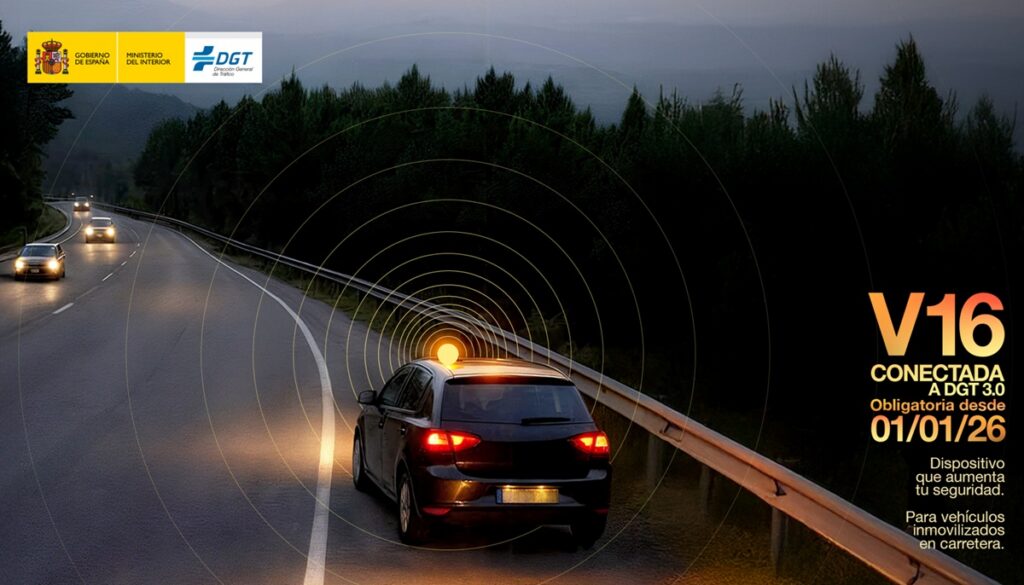
Spain’s connected V16 warning lights became mandatory for drivers on 1 January 2026. Credit : DGT.es
A lot of drivers in Spain bought the new V16 emergency warning lights thinking they were basically a modern replacement for the old warning triangles.
Buy it once, leave it in the car and forget about it.
Turns out it is not that simple.
Spain’s traffic authority, the DGT, has now confirmed that the connected V16 devices eventually expire because of the SIM card installed inside them. And if drivers fail to replace outdated or non approved models in the future, they could end up facing fines of between €80 and €200.
The clarification came after growing confusion around the devices and whether they had an expiry date at all.
During a recent press conference, DGT director Pere Navarro initially said the lights did not expire. Moments later, he corrected himself and explained that they effectively stop being valid after around 11 years because that is when the internal SIM card reaches the end of its service life.
That detail caught many people off guard.Especially because the old emergency triangles could sit in the boot of a car for years without anybody really thinking about them unless they became damaged.
The new devices work very differently.
Why Spain’s V16 lights are connected to the DGT
The entire point of the V16 system is connectivity.
Unlike the old reflective triangles, these warning lights communicate directly with the DGT’s traffic platform through a built in SIM card. Once activated during a breakdown or accident, the device can send the vehicle’s location automatically to traffic authorities.
The idea is that nearby drivers can then be warned much faster about a stopped vehicle ahead.
And to be fair, the safety logic behind the system is easy to understand.
For years, one of the biggest dangers during roadside breakdowns came from drivers having to get out of the vehicle and walk along roads or motorways to place warning triangles properly.
That becomes especially risky at night, during heavy rain or on fast moving roads.
The V16 beacon was supposed to solve that problem.Instead of walking down the road carrying triangles, drivers simply place the flashing light on the roof of the vehicle and remain close to the car.
That is the reason the DGT has defended the system so strongly despite the criticism surrounding it.
But because the device relies on connectivity, it also behaves more like a piece of technology than a traditional safety tool.
It depends on batteries.It depends on a SIM card.
And eventually, according to the DGT itself, it needs replacing.
Many drivers are questioning whether the new system is really better
That is where the debate has started becoming more heated.
Some drivers fully support the move away from triangles and believe the connected lights are genuinely safer. Others feel the system has introduced unnecessary complications for something that used to be very straightforward.
Part of the frustration comes from the fact that many people assumed the V16 light was a permanent purchase.
Now they are discovering it has a limited lifespan.
There have also been complaints about other aspects of the devices. Some motorists questioned their brightness, others raised concerns about durability in bad weather and some criticised the fact that batteries need checking regularly to guarantee the device still works properly.
At one point, there was even controversy surrounding unofficial maps allegedly showing the location of connected beacons online, which triggered privacy concerns among some users.
That controversy helped fuel suspicion around a system many people already viewed as overly technological.
Still, the DGT is making one thing very clear : The connected V16 lights are staying.
Spain’s traffic authority says drivers must already be using approved V16 devices
Pere Navarro also reminded drivers during the press conference that the connected V16 system is already in force in Spain and that motorists are expected to carry approved devices connected to the DGT platform.
That means not every beacon sold online necessarily complies with Spanish regulations.
Drivers must use homologated models capable of connecting to the DGT 3.0 traffic system, which allows authorities to receive the vehicle’s location automatically during a roadside emergency or breakdown.
And yes, the fines are real.
According to the DGT, motorists carrying non approved devices could face penalties of around €80. If the warning light is not used correctly during an emergency situation or breakdown, the fine could reportedly increase to €200.
Even though the 11 year lifespan sounds long, the announcement still changes how many people see the product.
The old triangles were passive objects. You bought them once and they simply existed in the background for years.
The V16 lights are different. They belong to a newer generation of connected driving equipment where even emergency devices now depend on telecommunications systems, batteries and digital infrastructure.
And honestly, that reflects what is happening across modern motoring in general.
Cars themselves are becoming increasingly connected and software dependent. Safety systems that once worked mechanically are now tied to apps, sensors, updates and data platforms.
For some drivers, that feels reassuring and modern. For others, it feels like ordinary driving is slowly becoming more expensive, more monitored and more complicated than it used to be.
Either way, millions of motorists in Spain are eventually going to have to adapt because the old warning triangles are gradually disappearing and the V16 system is becoming the new normal on Spanish roads.
Follow Euro Weekly News on Google News
Get breaking news from Spain, travel updates, and expat stories directly on your Google News feed.
Follow on Google NewsSign up for personalised news
Subscribe to our Euro Weekly News alerts to get the latest stories into your inbox!
By signing up, you will create a Euro Weekly News account if you don't already have one. Review our Privacy Policy for more information about our privacy practices.



Farah Mokrani
Farah is a journalist and content writer with over a decade of experience in both digital and print media. Originally from Tunisia and now based in Spain, she has covered current affairs, investigative reports, and long-form features for a range of international publications. At Euro Weekly News, Farah brings a global perspective to her reporting, contributing news and analysis informed by her editorial background and passion for clear, accurate storytelling.
Comments