Drivers in Spain can be fined €200 for checking WhatsApp at a red light
By Farah Mokrani • Published: 28 May 2026 • 23:23 • 4 minutes read
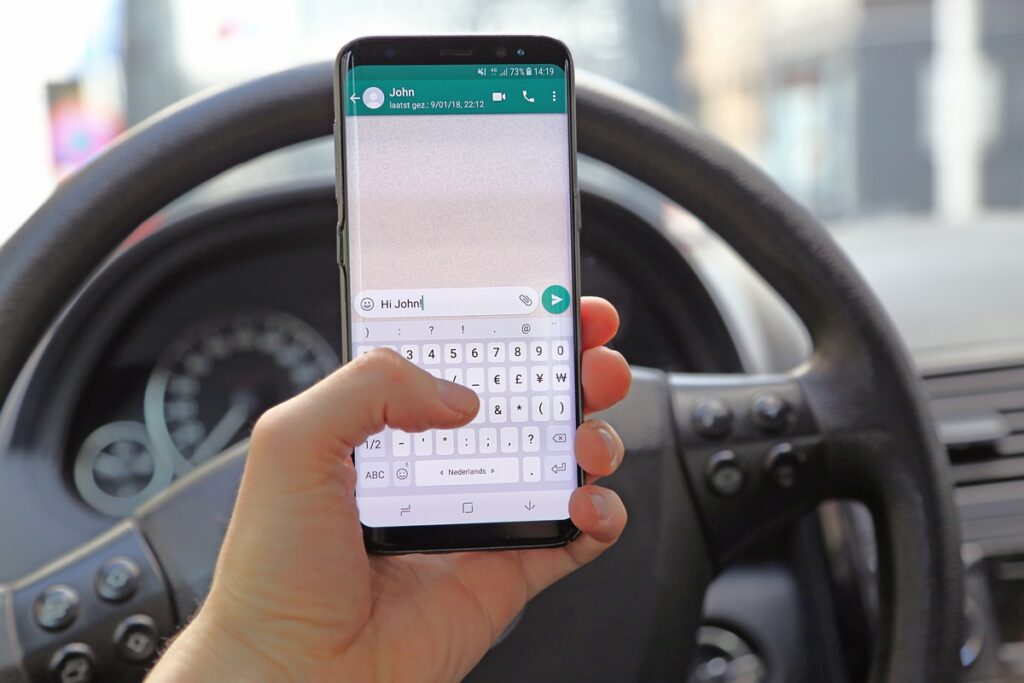
Drivers in Spain can face fines and licence point losses for checking WhatsApp at traffic lights or in traffic. Credit : ThomasDeco, Shutterstock
A lot of drivers in Spain still think the same thing when traffic stops at a red light : ‘If the car isn’t moving for a few seconds, checking my phone quickly can’t really matter.’
But according to Spain’s traffic laws, that assumption can become expensive very fast. The DGT can fine drivers €200 and remove up to six points from their licence for using a mobile phone while behind the wheel, even if the vehicle is stopped at traffic lights or stuck in traffic.
And honestly, many people are still shocked when they discover the rule applies even when the car is not actively moving.
The reason is simple. Under Spanish traffic law, a vehicle stopped temporarily at a red light or in congestion is still considered to be participating in traffic.
That means the driver is expected to remain fully attentive to the road at all times.
The stricter rules were reinforced after changes to Spain’s Traffic and Road Safety Law, which increased penalties linked to mobile phone use while driving because authorities consider distractions one of the biggest dangers on Spanish roads.
Why Spain’s traffic authorities are taking phone use so seriously
For the DGT, the problem is not simply about somebody glancing at a screen for two seconds. The concern is what happens during those lost moments of attention.
Pere Navarro, director of the DGT, has repeatedly warned about how dramatically reaction times change when drivers focus on their phones instead of the road.
He gave a very direct example. A driver travelling at 100 kilometres per hour who looks down to dial a number on a mobile phone may continue travelling around 140 metres before even reacting and touching the brake. By the time the vehicle finally stops completely, the total stopping distance could reach around 155 metres.
Under normal attentive driving conditions, that same vehicle could potentially stop in roughly 30 metres.
In practical terms, authorities say distracted drivers may travel the equivalent length of a football pitch without proper control of the vehicle.
That is exactly why Spanish traffic authorities have spent years intensifying campaigns around mobile phone distractions.
And the statistics help explain why.
According to figures from the Emotional Driving study, almost 63 per cent of drivers in Spain admit they use their phones while driving at least occasionally.
Some check messages, others search for directions while some record videos, read news articles or reply to texts.
And although younger adults living in cities are often identified as the most common offenders, authorities say the behaviour now affects every age group.
The difference between a €200 fine and losing six licence points
One detail many drivers still misunderstand is that Spanish law now distinguishes between different types of phone use behind the wheel.
That distinction became much stricter after reforms introduced in 2022. Drivers physically holding a mobile phone while driving face the harshest penalties.
That includes holding the phone in your hand while checking WhatsApp at traffic lights or during traffic jams.
In those cases, the sanction can reach €200 alongside the loss of six licence points.
The fine itself may sometimes be reduced through early payment procedures, but the licence points are not reduced.
Meanwhile, using the phone differently can still trigger penalties too.
Drivers manipulating phones mounted on holders, or using certain communication devices improperly, may also face €200 fines with the loss of three points depending on the circumstances.
Spanish traffic rules state very clearly that drivers cannot use mobile phones, navigation systems or communication devices manually while driving unless the communication occurs entirely hands free and without headphones or similar equipment.
Even hands free conversations themselves are still viewed cautiously by traffic experts. Because although hands free systems remain legal, authorities say concentration levels still drop significantly during conversations.
Some studies cited by traffic authorities suggest drivers may fail to notice up to 40 per cent of road signs after several minutes of conversation, even when using hands free technology.
Reaction times also slow down considerably.
Why distracted driving remains one of Spain’s biggest road safety problems
For traffic authorities, the issue goes far beyond fines. Distracted driving continues appearing repeatedly in serious accident statistics across Spain.
Cristóbal Cremades, provincial traffic chief for Madrid, recently warned that distractions remain the most common contributing factor in road accidents nationwide.
According to official figures, distractions were linked to more than 13,000 traffic incidents, representing around 18 per cent of all recorded road accidents.
In fatal accidents, the proportion becomes even more alarming. Distractions appeared in around 30 per cent of deadly crashes analysed by authorities.
That is one reason campaigns against mobile phone use behind the wheel continue appearing constantly across Spain.
And honestly, traffic officers know many drivers still underestimate the risk because using a phone has become so normal in everyday life.
A lot of drivers now check notifications almost instinctively, whether they are waiting at traffic lights, sitting in queues or stopped briefly in slow moving traffic.
The habit itself has become almost instinctive for many drivers. But the law in Spain remains extremely clear.
If you are sitting in the driver’s seat while the car remains part of active traffic, your attention is supposed to stay on the road.
Even if the light is red, even if traffic is barely moving and even if the message on WhatsApp feels urgent at the time.
Follow Euro Weekly News on Google News
Get breaking news from Spain, travel updates, and expat stories directly on your Google News feed.
Follow on Google NewsSign up for personalised news
Subscribe to our Euro Weekly News alerts to get the latest stories into your inbox!
By signing up, you will create a Euro Weekly News account if you don't already have one. Review our Privacy Policy for more information about our privacy practices.




Farah Mokrani
Farah is a journalist and content writer with over a decade of experience in both digital and print media. Originally from Tunisia and now based in Spain, she has covered current affairs, investigative reports, and long-form features for a range of international publications. At Euro Weekly News, Farah brings a global perspective to her reporting, contributing news and analysis informed by her editorial background and passion for clear, accurate storytelling.
Comments