A 6.2 earthquake rattled southern Italy and was felt hundreds of kilometres away
By Farah Mokrani • Published: 02 Jun 2026 • 15:07 • 3 minutes read
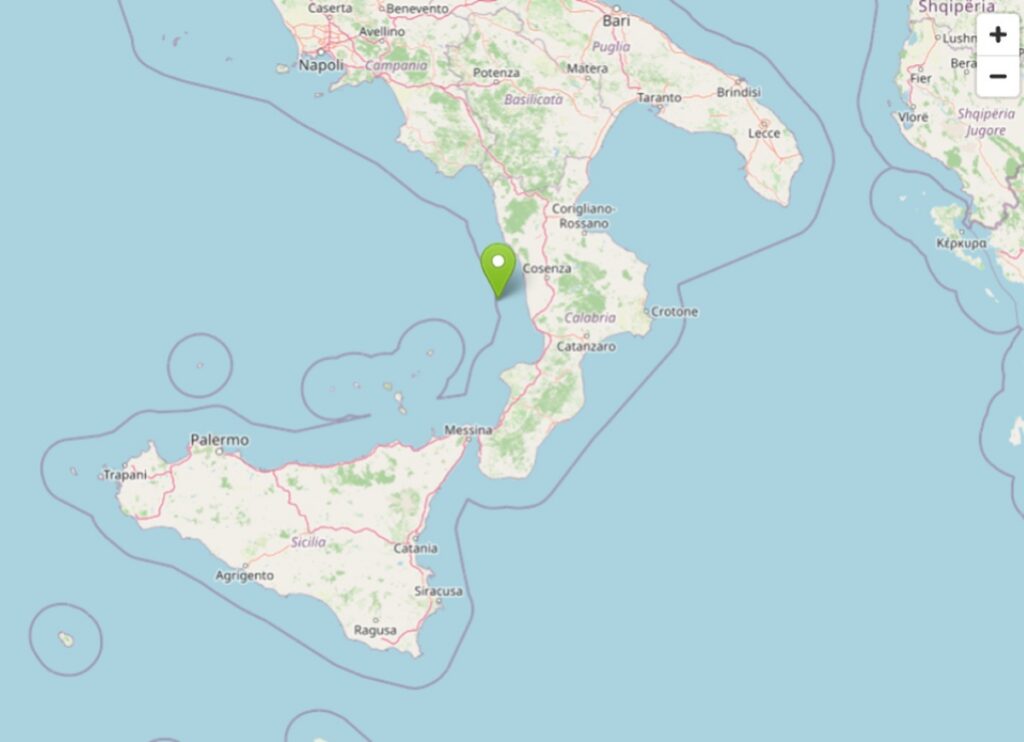
The earthquake's epicentre was located offshore near Calabria and was felt across much of southern Italy. Credit : terremoti.ingv.it
For thousands of people across southern Italy, the first sign that something unusual had happened was not a news alert or a warning from authorities. It was the sound.
Shortly after midnight on 2 June, residents in several regions reported hearing a loud rumble and feeling their homes shake. Some were already asleep when the tremor woke them. Others took to social media within minutes, trying to work out whether what they had just experienced was an earthquake.
It was.
According to Italy’s National Institute of Geophysics and Volcanology (INGV), a magnitude 6.2 earthquake struck beneath the Tyrrhenian Sea off the coast of Calabria shortly after midnight. The epicentre was located offshore near Belmonte Calabro, in the province of Cosenza.
A quake of that size would normally raise immediate concerns about possible damage. Yet as daylight arrived and emergency services began checking the areas closest to the epicentre, a surprising picture emerged.
Despite being felt across a large part of southern Italy, no damage had been reported.
The earthquake was felt far beyond Calabria
The shaking was not limited to communities nearest the epicentre. Residents reported feeling the tremor along Calabria’s Tyrrhenian coastline, but reports also came from much further away.
People in Naples and the area surrounding Mount Vesuvius said they noticed the earthquake. Similar reports emerged from parts of Basilicata, Puglia and Sicily.
That wide geographical reach is one of the reasons the earthquake attracted so much attention overnight.
When a tremor can be felt across several regions at the same time, many people naturally assume that serious consequences are likely to follow.
That did not happen here.
Civil Protection officials quickly contacted municipalities closest to the epicentre, including Amantea, Cetraro and Lamezia Terme.
No significant problems were reported.
The mayor of Cosenza, Franz Caruso, later reassured residents that the situation remained under control.
Firefighters also carried out precautionary inspections along parts of the Tyrrhenian coast to ensure no issues had gone unnoticed during the night.
Those checks did not reveal any major damage.
Why a strong earthquake caused so little damage
The answer lies beneath the surface. Very far beneath the surface.
According to INGV, the earthquake occurred at a depth of around 250 kilometres. That figure is unusually high compared with many earthquakes that cause severe damage.
When an earthquake happens closer to the surface, a much larger share of its energy reaches buildings, roads and infrastructure.
This event unfolded very differently.
Although the earthquake released enough energy to be felt over a huge area, much of that energy weakened before reaching ground level.
The result was an earthquake that many people noticed but one that did not produce the kind of destructive shaking often associated with a magnitude 6 event.
Experts say that depth made all the difference. Had an earthquake of the same magnitude occurred much closer to the surface, the outcome could have been very different.
A familiar seismic zone with a long geological history
According to the Italian institute, the earthquake is linked to geological processes that have shaped southern Italy for millions of years.
The region sits above an area where the Ionian lithosphere gradually moves beneath Calabria. This process regularly generates deep seismic activity beneath the southern Tyrrhenian Sea.
For scientists, the earthquake was not entirely unexpected. The area has recorded similar deep earthquakes in the past, including events above magnitude 5.
For residents, however, being reminded of those powerful forces beneath their feet can still be unsettling, particularly when it happens in the middle of the night.
For now, authorities continue to report no damage and no injuries linked to the earthquake.
That will be the detail many people remember most. A magnitude 6.2 earthquake is not a minor event.
Yet in this case, the story that emerged by morning was not one of destruction.
It was the story of a powerful tremor that rattled homes across southern Italy, woke thousands of people from their sleep and then, remarkably, left no significant damage behind.
Follow Euro Weekly News on Google News
Get breaking news from Spain, travel updates, and expat stories directly on your Google News feed.
Follow on Google NewsSign up for personalised news
Subscribe to our Euro Weekly News alerts to get the latest stories into your inbox!
By signing up, you will create a Euro Weekly News account if you don't already have one. Review our Privacy Policy for more information about our privacy practices.




Farah Mokrani
Farah is a journalist and content writer with over a decade of experience in both digital and print media. Originally from Tunisia and now based in Spain, she has covered current affairs, investigative reports, and long-form features for a range of international publications. At Euro Weekly News, Farah brings a global perspective to her reporting, contributing news and analysis informed by her editorial background and passion for clear, accurate storytelling.
Comments