Scientists discover hidden Structure beneath Antarctica that could reshape what we know abouth earth
By Farah Mokrani • Published: 09 Jun 2026 • 0:13 • 4 minutes read
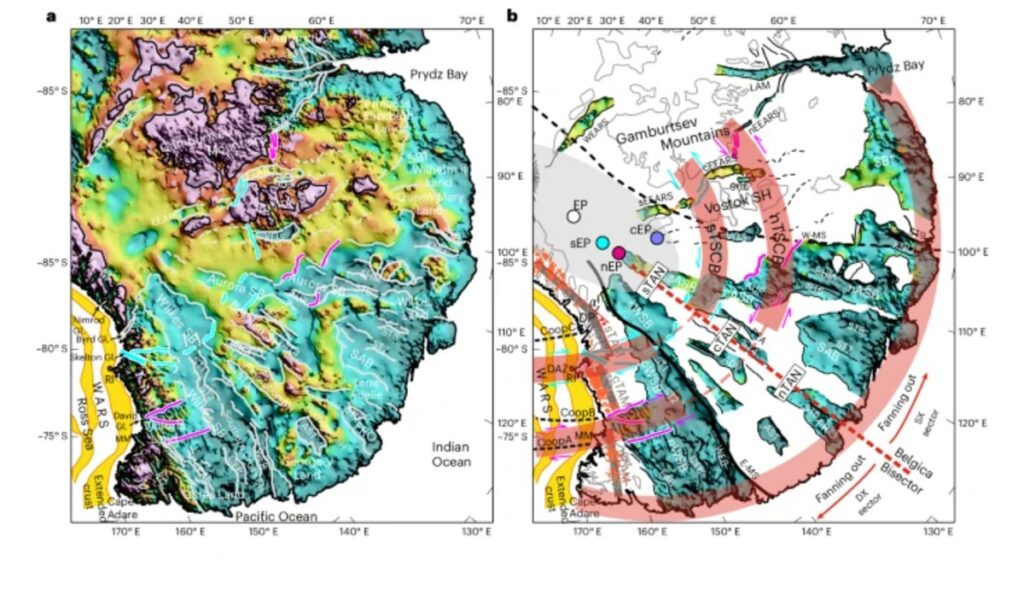
Researchers mapped a giant underground structure beneath East Antarctica by combining geological, gravity and magnetic data. Credit : www.nature.com
For most people, Antarctica is a place of endless ice, freezing temperatures and very little else. But beneath that frozen surface lies an entirely different world, and scientists have just realised it may be far bigger and more complex than anyone thought.
Researchers have identified what could be one of the largest hidden geological structures on Earth, buried beneath around two miles of Antarctic ice. The discovery brings together several famous Antarctic features that had always been treated as separate pieces of the puzzle. According to the new study, they may actually belong to one enormous underground formation stretching beneath a huge section of East Antarctica.
The findings were published in the journal Nature and could help scientists better understand not only how Antarctica formed millions of years ago, but also how its vast ice sheets might behave in a warming climate.
It’s the kind of discovery that reminds us how much of our own planet remains unexplored.
A discovery hiding in plain sight beneath Antarctica
What makes this finding unusual is that none of the individual features involved are new.
Scientists have known about places such as the Wilkes Basin, the Aurora Basin and Lake Vostok for years. Lake Vostok, in particular, has fascinated researchers for decades because it is the largest known lake hidden beneath Antarctic ice.
The surprise came when researchers stopped looking at these features individually.
By combining huge amounts of geological information collected over many years, they began to notice a pattern.
What had appeared to be separate basins and underground landscapes suddenly looked connected.
Rather than a collection of isolated geological features, researchers believe they may form part of a single giant structure known as the East Antarctic Fan-shaped Basin Province.
Imagine looking at a map and discovering that several lakes, valleys and mountain ranges you thought were unrelated are actually connected beneath the surface. That is essentially what happened here.
The structure remained hidden not because nobody was looking, but because nobody had previously put all the pieces together in quite the same way.
What scientists found beneath two miles of ice
Antarctica presents a unique challenge for researchers.
You cannot simply walk across the continent and examine what lies underneath. Much of East Antarctica is covered by ice that reaches depths of several kilometres.
To investigate the hidden landscape, scientists relied on a combination of techniques.
They used geological observations, gravity measurements, magnetic data and models of the Earth’s crust. Individually, each dataset tells only part of the story. Combined, they offer a much clearer picture of what lies beneath the ice.
The evidence suggests the giant structure formed over millions of years through a geological process in which sections of continental crust gradually stretched apart.
Long before Antarctica became the frozen continent we know today, the land beneath it was changing shape. Vast basins formed as the crust slowly expanded, creating the hidden landscape that now sits beneath the ice sheet.
Although Antarctica often feels timeless, geologically speaking it has had a remarkably active past.
The continent was once connected to other landmasses within ancient supercontinents. The newly identified structure may provide valuable clues about those distant chapters of Earth’s history.
Researchers caution that more work will be needed to confirm every detail of the proposed formation, but the evidence gathered so far points strongly towards a massive interconnected system rather than a collection of unrelated features.
Why this matters far beyond Antarctica
At first glance, a buried geological structure in one of the world’s most remote places might sound like something of interest only to scientists.
In reality, it could have implications that extend well beyond Antarctica.
The newly identified province lies beneath roughly half of the East Antarctic Ice Sheet. That matters because the shape of the land underneath influences how ice behaves above it.
Ice does not simply sit still.
It slowly moves, shifts and responds to changes in temperature and pressure. The valleys, basins and ridges hidden beneath the ice help determine how that movement happens.
Scientists trying to predict future changes in Antarctica need accurate maps of the landscape below. Without understanding the terrain, forecasting the behaviour of the ice becomes much more difficult.
As concerns about climate change and rising sea levels continue to grow, researchers are paying increasing attention to the parts of Antarctica that remain hidden from view.
The East Antarctic Ice Sheet is generally considered more stable than some regions of West Antarctica, but scientists are still working to understand how it may respond to future warming.
Discoveries like this provide another piece of that puzzle.
Perhaps the most remarkable aspect of the finding is the reminder that even today, our planet still holds enormous secrets.
We often think of exploration as something that happened centuries ago. Yet one of the largest geological structures on Earth may have been sitting beneath Antarctica all along, waiting for scientists to recognise what was there.
Q&A section
What did scientists discover beneath Antarctica?
Researchers identified what may be one of the largest geological structures on Earth beneath East Antarctica’s ice sheet.
How deep is the structure buried?
It lies beneath approximately two miles of ice.
What is the structure called?
Scientists have named it the East Antarctic Fan-shaped Basin Province.
Does the discovery include Lake Vostok?
Yes. The newly identified structure includes Lake Vostok as well as the Wilkes and Aurora subglacial basin regions.
Why is the discovery important?
The hidden landscape influences how ice moves across Antarctica and could improve scientific understanding of future ice sheet behaviour.
Was the structure completely unknown before?
No. The individual features were already known, but researchers had not previously recognised them as parts of one much larger system.
Follow Euro Weekly News on Google News
Get breaking news from Spain, travel updates, and expat stories directly on your Google News feed.
Follow on Google NewsSign up for personalised news
Subscribe to our Euro Weekly News alerts to get the latest stories into your inbox!
By signing up, you will create a Euro Weekly News account if you don't already have one. Review our Privacy Policy for more information about our privacy practices.





Farah Mokrani
Farah is a journalist and content writer with over a decade of experience in both digital and print media. Originally from Tunisia and now based in Spain, she has covered current affairs, investigative reports, and long-form features for a range of international publications. At Euro Weekly News, Farah brings a global perspective to her reporting, contributing news and analysis informed by her editorial background and passion for clear, accurate storytelling.
Comments