A giant asteroid will pass Earth this weekend and some people in Europe could actually see it
By Farah Mokrani • Published: 25 Jun 2026 • 1:40 • 4 minutes read
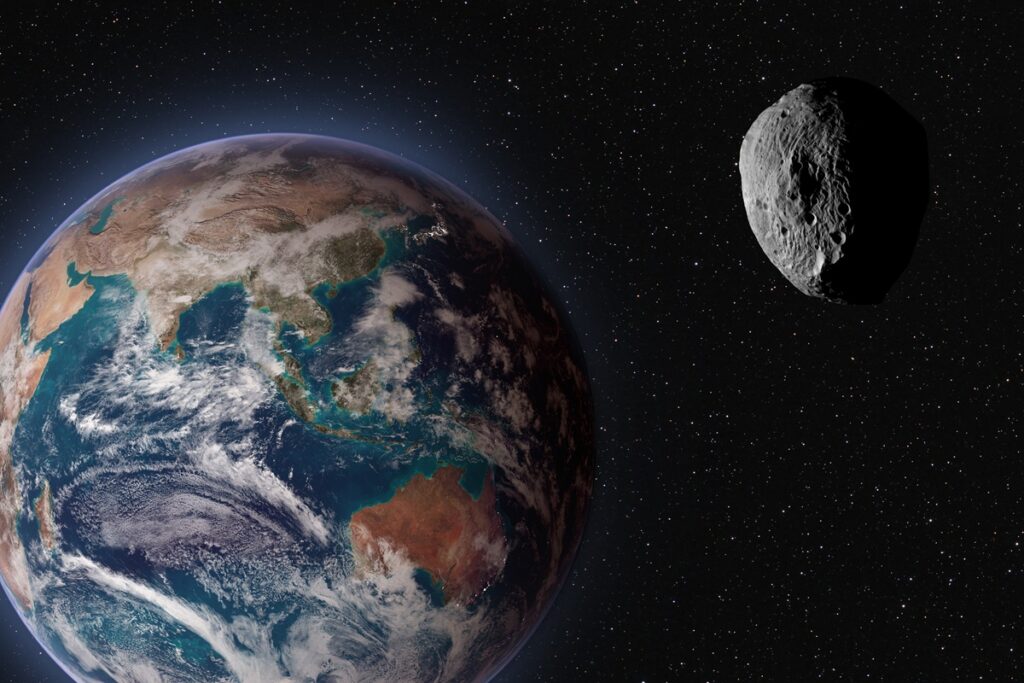
Asteroid 1997 NC1 will pass Earth safely this week, though close enough to draw attention from astronomers. Credit : Lukasz Pawel Szczepanski, Shutterstock
A large asteroid known as 1997 NC1 will make a close but safe pass by Earth on Friday 27 June, coming within about 2.56 million kilometres of the planet. There is no impact risk, but it is still a notable flyby because the object is unusually large and close enough to be tracked in detail by astronomers. In very dark skies, and with the right equipment, some skywatchers in Europe may even be able to spot it.
It is one of those space stories that sounds far more alarming than it really is.
A big asteroid is heading our way. It is moving fast. It will pass ‘close’ to Earth. Put those three things together and the internet more or less writes its own headline.
The calmer version is this: yes, asteroid (152637) 1997 NC1 is making a close approach to Earth this weekend, but no, it is not about to hit us, clip the atmosphere or do anything remotely dramatic. At its closest point, it will still be around 2.56 million kilometres away, which is roughly 6.6 to 6.7 times the distance between Earth and the Moon. In space terms, that is close enough to be interesting. In human terms, it is still a very long way off.
So why is it getting attention?
Partly because of the size. Estimates vary, but current figures put 1997 NC1 somewhere in the region of 710 to 1,600 metres across, which is big enough to make astronomers take notice whenever it passes relatively near Earth. ESA has also cited a range of roughly 750 to 1,650 metres, while some working estimates place it around the 1km mark. That uncertainty is normal with asteroids, because a lot depends on how reflective the surface is. A brighter surface can make an object look larger or smaller than it really is when seen from afar.
Why this asteroid flyby matters even though Earth is safe
The phrase ‘potentially hazardous asteroid’ tends to do a lot of unnecessary scaring in stories like this, so it is worth being clear about what it actually means.
It does not mean astronomers think it is about to hit Earth. It means the asteroid is large enough, and its orbit comes close enough to Earth’s orbit, that it stays on the watchlist. That is all. It is more of a ‘keep an eye on this over time’ label than a ‘brace for impact’ label.
And 1997 NC1 is very much a watchlist asteroid rather than an emergency one.
It was discovered back in 1997, so this is not a case of some mysterious rock suddenly appearing a few days before a near miss. Scientists have known about it for years and have had plenty of time to calculate this flyby properly. That is why the tone from space agencies has been so calm. The approach is being described as close but safe, which is exactly what it is.
There is another reason astronomers are interested. A flyby like this gives them a good chance to study the asteroid in more detail. When an object gets relatively near Earth, radar and telescope observations can help refine its size, shape, brightness and rotation. NASA had already been planning observations around this pass, precisely because it is a useful opportunity to gather better data on a fairly large near-Earth object.
That is the real story here. Not “asteroid scare”, but “rare chance to get a closer look at a big asteroid without any actual danger attached”.
Can you see 1997 NC1 from Spain or the rest of Europe? Possibly, but don’t expect a sky show
This is the part that makes it fun. Because the asteroid will brighten as it approaches, it may be visible to amateur observers with a small telescope, and possibly strong binoculars in good conditions. The Virtual Telescope Project has been following it ahead of the flyby and says it should become bright enough to be an easy target for small telescopes around the time of closest approach.
That does not mean it will look like a shooting star or a giant glowing object flying over Spain. It will not. If you do manage to see it, it will appear as a faint point of light moving slowly against the background stars.
And there are a few catches.
First, you need dark skies. Trying from the middle of a brightly lit city is not ideal. Second, you need to know where to look. This is not the kind of thing you spot by stepping onto the balcony with a coffee and glancing up for 30 seconds. Third, the Moon may make life harder. ESA has already pointed out that the bright moon nearby could affect visibility around closest approach, which is mildly annoying but very typical of astronomy. The interesting thing always seems to happen when the Moon decides to get in the way.
Still, for skywatchers in Spain and elsewhere in Europe, it is one of those rare moments that is actually worth trying for if you have the kit. The asteroid should be around over 26 and 27 June, with online observing sessions also planned by the Virtual Telescope Project.
So how unusual is this really?
Unusual enough to be worth a story, but not unusual enough to suggest anything sinister.
The Virtual Telescope Project notes that an object of this size passing this close happens roughly once every ten years or so. ESA has also suggested that a close approach by an object this large comes around only every few years. In other words, it is not once-in-a-lifetime territory, but it is not routine either.
That is why this flyby sits in a sweet spot for public interest. It is large enough to sound impressive, close enough to be tracked with real attention, and safe enough that people can enjoy it without any of the usual asteroid-doom nonsense.
So if you see dramatic headlines about a giant asteroid racing past Earth, the sensible reaction is not panic. It is probably closer to: fair enough, that’s actually quite cool. Because that is what this really is. A large asteroid, passing by at a safe distance, giving astronomers a useful chance to study it and giving keen skywatchers a small but genuine shot at seeing it for themselves.
No apocalypse. No last-minute deflection mission. Just a big lump of rock, passing through our cosmic neighbourhood, and doing so close enough for us to notice.
Follow Euro Weekly News on Google News
Get breaking news from Spain, travel updates, and expat stories directly on your Google News feed.
Follow on Google NewsSign up for personalised news
Subscribe to our Euro Weekly News alerts to get the latest stories into your inbox!
By signing up, you will create a Euro Weekly News account if you don't already have one. Review our Privacy Policy for more information about our privacy practices.




Farah Mokrani
Farah is a journalist and content writer with over a decade of experience in both digital and print media. Originally from Tunisia and now based in Spain, she has covered current affairs, investigative reports, and long-form features for a range of international publications. At Euro Weekly News, Farah brings a global perspective to her reporting, contributing news and analysis informed by her editorial background and passion for clear, accurate storytelling.
Comments