Greece’s world-first wildfire satellites could spot fires before people are trapped
By Harry Dennis • Published: 01 Jul 2026 • 14:45 • 4 minutes read
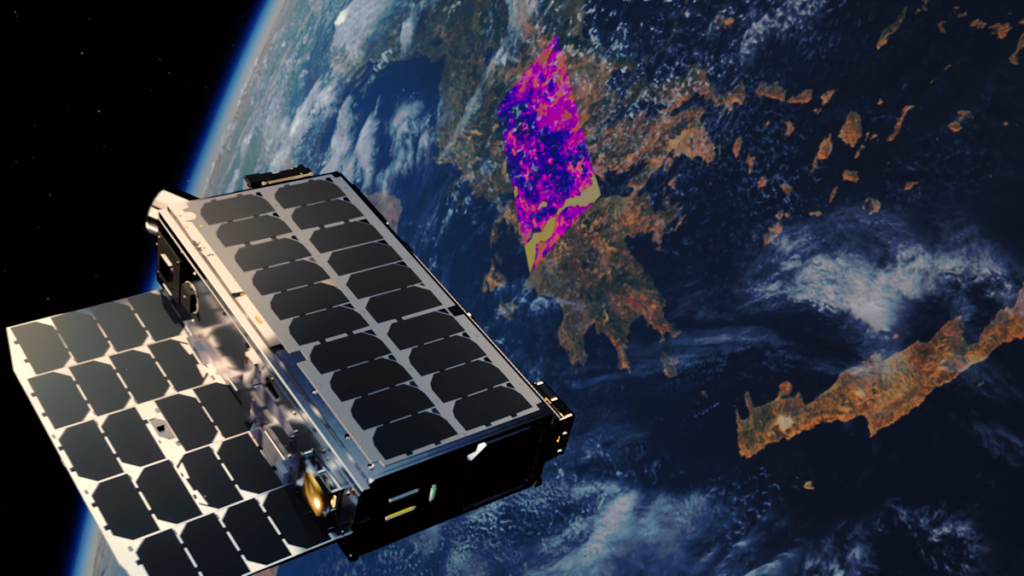
Greece’s new wildfire satellites aim to spot small fires before they become disasters. Credit: OroraTech
A fire breaking out above a village, beside an island road or near a holiday resort can become dangerous before anyone on the ground fully understands what is happening.
Greece is now trying to shorten that frightening gap between the first spark and the first emergency response. Four thermal satellites, built by German company OroraTech, were launched in May as part of the Hellenic Fire System, a national wildfire detection network developed with the Greek government and the European Space Agency (ESA). ESA has described it as a world first for a national satellite capability dedicated to wildfire detection and tracking.
How the new fire satellites could change the first warning
The system is designed to detect heat from space before a small fire becomes a major emergency. According to OroraTech, the satellites are equipped with thermal infrared cameras, supported by a ground station in Greece and a wildfire platform linked to the country’s emergency services. The company says the system can deliver fire data to Greek fire services with latency measured in minutes and identify hotspots as small as four by four metres.
The earliest minutes of a wildfire are often when decisions are most critical, therefore this new system could dramatically change how fire services tackle these situations from the beginning. A small fire in remote scrubland may not yet be visible from a village, road or beach. But if wind, heat and dry vegetation combine, it can move quickly towards homes, farms, power lines or tourist areas.
The Associated Press reported that Greece has become the first country to integrate a dedicated satellite array into its national firefighting system, with alerts able to provide commanders with information including location, size and intensity.
Europe is watching Greece’s wildfire satellite test
Greece has more reasons than most to move quickly. In 2018, a fire east of Athens killed more than 100 people. In 2023, the Alexandroupolis fire became the largest wildfire ever recorded in the European Union, according to Copernicus data, burning around 96,000 hectares.
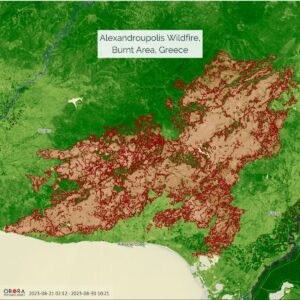
However the problem is no longer only Greek. The European State of the Climate 2025 report, produced by the Copernicus Climate Change Service and the World Meteorological Organization (WMO), said Europe experienced record wildfire burnt areas in 2025, with around 1,034,000 hectares burned. The same report said at least 95 per cent of Europe experienced above-average annual temperatures.
For readers in fire-prone parts of Europe, the Greek system is a glimpse of how emergency services may try to deal with future summers when several fires can start at once and crews must decide where aircraft, engines and evacuation alerts are needed first.
How AI helps firefighters choose which blaze needs crews first
The satellites do not simply take images. They use thermal detection and artificial intelligence to help identify active fires and thermal anomalies. ESA says each satellite carries midwave and longwave infrared imagers, allowing the system to assess fire activity and fire radiative intensity, a measure linked to how strongly a fire is burning.
This could help commanders when several alerts arrive at the same time. AP quoted Fire Service Col. Zisoula Ntasiou, vice president of the International Association of Fire and Rescue Services, explaining that fire radiative power can help decide which ignition needs priority when multiple fires are burning.
Research into satellite wildfire detection is also moving quickly. Recent scientific work has explored how artificial intelligence can help turn thermal satellite images into faster fire alerts, but experts still stress that satellite warnings must work alongside firefighters, evacuation systems and prevention on the ground.
For now, satellites will not replace 112 alerts, firefighters or prevention
The new system does not mean Greece can suddenly relax on forest management, evacuation planning or public safety. Satellites are an extra layer, not a guarantee that a fire will be stopped immediately.
Existing satellite fire-detection systems already help emergency teams monitor wildfires from space, but they have limits. NASA guidance says some fires can still be missed if they are hidden by cloud, smoke or tree cover, if they are too small or cool to detect, or if they start and end between satellite observations.
The technology is still developing, but the direction it is taking us in is positive. Satellites and artificial intelligence are being used to shorten the time between a fire starting and emergency crews receiving a useful alert.
Greece’s 112 emergency system can send mass alerts when a natural disaster or dangerous situation is expected or already in progress, including instructions for self-protection. The Greek Civil Protection service says those alerts can arrive through mobile phone cell broadcast messages and other channels.
How Greece’s wildfire satellites could shape future summer fire protection
The Hellenic Fire System is still at an early stage. ESA said after the May launch that OroraTech would closely monitor and commission the satellites before they were ready for service in the following months.
The first real test will come during the Greek summer, when heat, wind and dry vegetation place extra pressure on fire crews. If the system helps authorities spot remote fires earlier, direct crews faster or issue warnings sooner, other Mediterranean countries will be watching closely and considering following suit.
Follow Euro Weekly News on Google News
Get breaking news from Spain, travel updates, and expat stories directly on your Google News feed.
Follow on Google NewsSign up for personalised news
Subscribe to our Euro Weekly News alerts to get the latest stories into your inbox!
By signing up, you will create a Euro Weekly News account if you don't already have one. Review our Privacy Policy for more information about our privacy practices.




Harry Dennis
Born in the UK and raised on the Cádiz coast, Harry brings his background in design, music, and photography to his writing for Euro Weekly News, sharing stories that celebrate culture and lifestyle across Spain and beyond.
Comments