Next full moon in Spain: The exact dates to look up this summer and the rare sky event you won’t want to miss
By Farah Mokrani • Published: 10 Jul 2026 • 12:50 • 4 minutes read
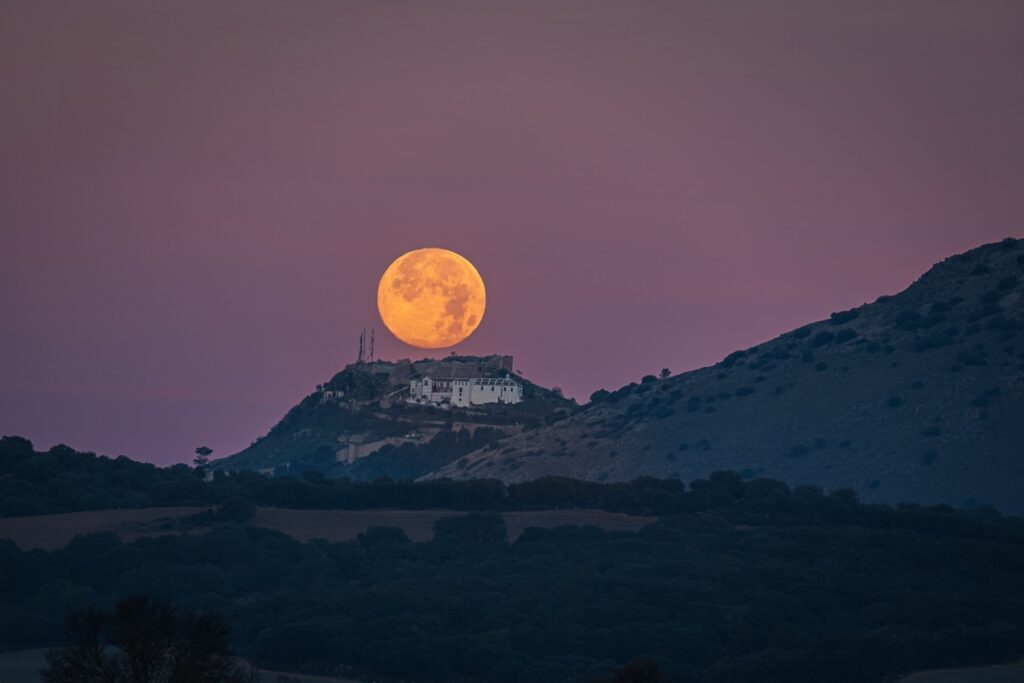
The Buck Moon will be the first full moon of summer, peaking on 29 July. Credit : mvera, Shutterstock
There are plenty of reasons to enjoy a warm summer evening in Spain, but this year the night sky has something special in store. The next full moon will light up the skies on 29 July, followed less than a month later by another full moon on 28 August that will coincide with a partial lunar eclipse. If you enjoy watching the Moon rise over the coast, photographing the night sky or simply sitting outside after sunset, both dates are worth marking on your calendar.
Although a full moon technically lasts for only a single moment, it appears full for several nights, giving plenty of time to enjoy one of nature’s simplest but most impressive displays. Here’s what to expect over the coming weeks.
When is the next full moon in Spain?
The next full moon, traditionally known as the Buck Moon, reaches its peak on Wednesday 29 July at 4.36pm.
If that timing sounds disappointing because it happens while the sun is still up, don’t worry. The Moon will still look completely full after sunset that evening and for the following nights, which is when most people will get their best view.
Every full moon happens for the same reason. The Earth moves directly between the Sun and the Moon, allowing sunlight to illuminate the entire side of the Moon facing us. While the precise astronomical moment is over in an instant, our eyes cannot tell the difference, so it appears full for up to three nights.
The name Buck Moon has nothing to do with astronomy itself. It comes from an old seasonal tradition in North America, where July is the time when male deer, or bucks, begin growing a fresh set of antlers. Over time, the name became attached to July’s full moon and is still widely used today.
For many people across Spain, the Buck Moon is one of the most enjoyable of the year simply because the weather is usually warm enough to spend the evening outdoors. Whether you’re watching from a beach, a mountain viewpoint or your own balcony, the end of July often provides excellent conditions for moon watching.
August’s full moon comes with an extra surprise
If you miss July’s display, August offers another opportunity, and this one comes with an added attraction.
The Sturgeon Moon reaches full phase on Friday 28 August at 6.19am. As with July’s full moon, the best views will come during the surrounding evenings rather than at the exact moment it becomes full.
What makes this full moon stand out is that it will coincide with a partial lunar eclipse. During the eclipse, part of the Moon will pass through the Earth’s shadow, creating the impression that a section of the lunar disc has been gently darkened.
Unlike a total lunar eclipse, the Moon will not turn the deep reddish colour often called a Blood Moon. Instead, observers in the parts of the world where the eclipse is visible will see only part of the Moon covered by shadow.
The name Sturgeon Moon also comes from seasonal traditions. It refers to the time of year when sturgeon were historically caught in abundance in North America’s Great Lakes. Like many full moon names still used today, it reflects changes in nature rather than any scientific characteristic of the Moon itself.
Why does the Moon seem full for several nights?
One of the most common questions people ask is why the Moon appears full on more than one evening if the full moon has an exact time.
Actually, the Moon’s orbit around Earth is gradual, so the difference in illumination from one night to the next is extremely small around the moment of full moon. To the naked eye, the Moon can look completely round for up to three consecutive nights.
The full moon is just one stage in a cycle that lasts around 29.5 days. During that time, the Moon passes through eight recognised phases before returning to full illumination again.
These repeating phases have helped people measure time for thousands of years, long before modern calendars existed. Even today, many gardening traditions, fishing calendars and cultural festivals continue to follow the lunar cycle.
Another reason to keep an eye on the August sky
The end of August is not the only date worth remembering.
Earlier in the month, 12 August will bring both a new moon and a total solar eclipse, with the eclipse expected to be visible from the Balearic Islands. That combination will make August one of the busiest months of the year for anyone interested in astronomy.
Of course, whether you see any of these events depends largely on the weather. Clear skies make all the difference, particularly when watching the Moon as it rises above the horizon. Fortunately, late July and August often bring long, dry evenings across much of Spain, making them some of the best months for looking up.
You do not need a telescope or expensive equipment to enjoy either full moon. In fact, the Moon is bright enough to appreciate with the naked eye. Binoculars can reveal more detail, including craters and darker volcanic plains, but even without them the experience is impressive.
If you’re planning a late evening walk, dinner on the terrace or a trip to the coast, 29 July and 28 August are the dates to remember. One brings the familiar glow of the Buck Moon, while the other combines the beauty of a full moon with the added spectacle of a partial lunar eclipse, giving skywatchers two excellent reasons to look up before summer comes to an end.
Follow Euro Weekly News on Google News
Get breaking news from Spain, travel updates, and expat stories directly on your Google News feed.
Follow on Google NewsSign up for personalised news
Subscribe to our Euro Weekly News alerts to get the latest stories into your inbox!
By signing up, you will create a Euro Weekly News account if you don't already have one. Review our Privacy Policy for more information about our privacy practices.



Farah Mokrani
Farah is a journalist and content writer with over a decade of experience in both digital and print media. Originally from Tunisia and now based in Spain, she has covered current affairs, investigative reports, and long-form features for a range of international publications. At Euro Weekly News, Farah brings a global perspective to her reporting, contributing news and analysis informed by her editorial background and passion for clear, accurate storytelling.
Comments