Spain Wildfire Emergency: Exactly what to do if fire comes near you (and is your holiday still safe?)
By Adam Woodward • Published: 25 Jul 2026 • 16:00 • 4 minutes read
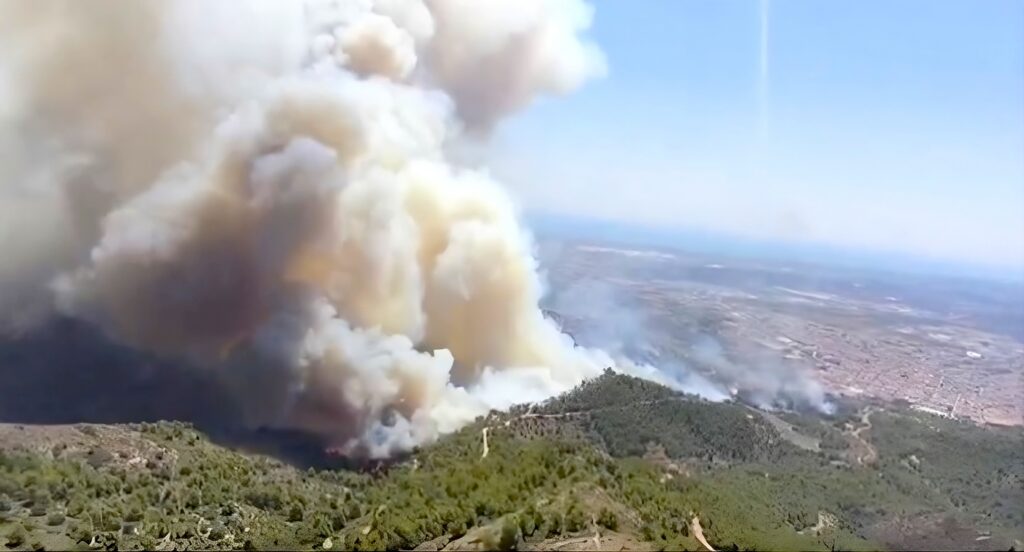
Wildfire near Valencia. Credit: Bomberos
Fast-moving wildfires powered by extreme heatwaves have forced tens of thousands from their homes across Spain and southwest France this July, with Spain declaring its first national emergency ever for fires. British holidaymakers and residents now face the same urgent questions: is Spain still safe to visit, and would you know exactly what to do if flames appeared near your villa or campsite?
Spain declared its first-ever national emergency for wildfires, covering the Madrid region and neighbouring Avila province. Blazes west of Madrid around Villa del Prado, San Martin de Valdeiglesias and nearby villages have merged into larger fronts, while a major fire at Burgohondo in Avila continues to spread.
Roughly 60,000 to 73,000 people have been evacuated or told to stay indoors. Tens of thousands of hectares have burned and strong winds keep conditions tricky, though overnight weather offered limited relief. Military Emergency Unit teams now lead the response, backed by EU Canadair aircraft from Italy and Greece. Other fires burn in parts of Castilla-La Mancha and Leon, yet the Madrid-Avila cluster remains the most serious. AEMET maps still show high, very high or extreme fire danger across wide areas of the country.
Noria de abastecimiento! ✈️💦
5 Canadair CL-415 realizando la carga de tanque en el lago Sainte-Croix, Francia.
▫️Evite la navegación en las zonas de carga de aeronaves.
▫️Las maniobras de carga requieren de una lámina de agua libre de >1.300 metros. pic.twitter.com/ypdr0A9YVI
— DiarioTES – Javier G. Rendo (@DiarioTES) July 23, 2026
Southwest France faces an even larger evacuation. Fires in the Gironde and Landes departments near Bordeaux and the Cap Ferret peninsula have driven more than 140,000 to 200,000 people from homes and campsites, many tourists leaving by boat. Military support and extra EU aircraft are on the ground. Smaller fires continue elsewhere in Europe, including Italy and the UK, while the overall EU burned area for 2026 already ranks among the higher years on record.
Is Spain still safe for a summer holiday?
#Spain: Read our latest travel advice for new information about wildfires in parts of Madrid and Ávila, including updated safety advice and the emergency number for travellers: https://t.co/WZrhPtNWTL pic.twitter.com/b43hLF6pNE
— FCDO Travel Advice (@FCDOtravelGovUK) July 24, 2026
Most of Spain remains open and practical for visitors. Major coastal and island destinations, such as Costa del Sol, Costa Blanca, Catalonia coast, Balearics, Canaries and Barcelona, are all well clear of the current major fire zones. Airports and standard tourist transport continue to operate without reported issues. UK Foreign Office advice says the national emergency around Madrid and Avila plus other inland fires, yet does not advise against travel to Spain overall. Official guidance simply tells people to follow local authorities, avoid affected zones, check updates and dial the 112 emergency line if needed.
What to do the moment you spot smoke or flames
Ring 112 at once and give the most precise location you can. They speak English well and are extremely serious about their work. If possible, take note of the direction of the fire and plan an escape route immediately. Move towards open ground with little or no vegetation. Always head against the wind and, in hills, run downhill, as fire races uphill. Never try to cross flames unless you can clearly see safe ground beyond and have no other option; if forced to, wet your clothes first and cover your head. Already-burned ground offers the safest temporary refuge if the fire surrounds you.
Drivers should close all windows, switch on headlights and turn back the moment danger increases. Abandon the vehicle only if flames force the choice, then follow the same ground rules as on foot.
If fire closes in or you cannot leave
Drop low to the ground and cover as much of your body as possible with earth or clothing. Breathe close to the soil where air is cleaner. Seek already-burned patches, rocky clearings or water if available. Avoid ravines, narrow valleys and running uphill. Keep calm and stay put once you reach the safest open spot until help arrives or the front passes.
Protecting a house or villa
Close every door, window and shutter. Block gaps with wet towels or cloths to keep smoke out. Shut off gas and other fuel supplies. Wet the roof and surrounding ground with a hose if it is safe to do so, but be careful to never direct water near electrical cables. Fill baths and sinks with water. Stay inside unless authorities order evacuation. Follow any official order to leave at once, taking only essentials – documents, medication, phone and charger – and use only the routes they indicate.
Staying one step ahead
Check AEMET’s fire-risk map daily if still concerned. Prepare a simple go-bag with water, medication, documents and a torch. Keep the car fuelled and facing out. Know two escape routes from your location. Never light fires or discard cigarettes in dry countryside. Report any smoke column the moment you see it.
Spain’s popular holiday coasts and islands continue to welcome visitors under current conditions, provided people stay alert, follow local instructions and treat the elevated fire risk with respect. Official Spanish guidance from the Comunidad de Madrid, Junta de Andalucia and national authorities remains the clearest source of practical steps. Ring 112 first, move smartly, and put personal safety, and that of family above everything else.
Wow la puissance folle de la photo ! 😳😞#incendies #Gironde pic.twitter.com/mfDi1420sz
— Bleu Blanc Rouge ! 🇫🇷 (@LBleuBlancRouge) July 25, 2026
Follow Euro Weekly News on Google News
Get breaking news from Spain, travel updates, and expat stories directly on your Google News feed.
Follow on Google NewsSign up for personalised news
Subscribe to our Euro Weekly News alerts to get the latest stories into your inbox!
By signing up, you will create a Euro Weekly News account if you don't already have one. Review our Privacy Policy for more information about our privacy practices.




Adam Woodward
Adam is a writer who has lived in Spain for over 25 years. With a background in English teaching and a passion for music, food, and the arts, he brings a rich personal perspective to his work at Euro Weekly News. As a father of three with deep roots in Spanish life, Adam writes engaging stories that explore culture, lifestyle, and the everyday experiences that shape communities across Spain.
Comments