Dogs, horses & lions saved as wildfires force heart-stopping rescues across Spain: The unspoken toll of the fires on animals
By Adam Woodward • Updated: 26 Jul 2026 • 14:42 • 5 minutes read
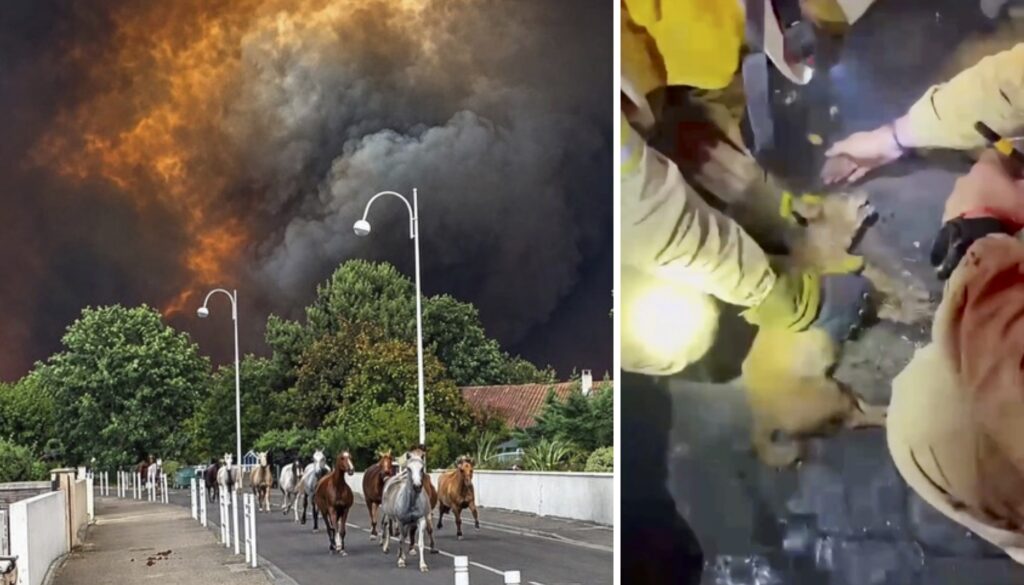
Horses flee in Biscarrosse, and Salamanca firefighters resuscitating dogs. Credit: Miriam Cosic X & Bomberos Salamanca X
Flames racing through the Spanish countryside have left thousands of animals fighting for their lives this week. From hunting packs trapped in farmhouses to lions locked indoors and horses set free to run, ordinary people and emergency crews have risked everything to keep pets, livestock and wildlife alive.
Pack of dogs pulled from the flames in Avila
Salamanca firefighters sent to help tackle the huge Burgohondo blaze in Avila found themselves racing to save a ‘rehala’, a full hunting pack of dogs, trapped inside a rural house as the fire closed in.
Crews threw up a wall of water around the building, holding the flames back just long enough to protect the structure. Once the immediate danger passed, they moved in, calmed the terrified dogs, gave them water and stayed with them until the stress of the smoke and heat began to ease.
Locals watching the rescue said the animals were shaking and panting when the firefighters first reached them. Without that rapid intervention the entire pack would almost certainly have perished.
🐶❤️ ¡Final feliz! Un perro atrapado por el incendio forestal de Ávila fue rescatado por los bomberos portugueses desplazados a España y, posteriormente, trasladado por la Guardia Civil hasta Salamanca para garantizar su atención pic.twitter.com/kr73eC9n6n
— EL ESPAÑOL (@elespanolcom) July 26, 2026
Ordinary people open their homes to stranded pets and livestock
While professional crews worked the fire lines, ordinary residents quietly got organised themselves. A WhatsApp network that first sprang up two years ago during earlier Madrid fires has swung back into action.
Thank you to the brave fire fighters and civil guards saving the lives of dogs and cats from the terrible fires sweeping France Spain & Italy pic.twitter.com/vnhl1OCSsg
— dominic dyer (@domdyer70) July 25, 2026
Neighbours have already taken in 20 cats, 25 sheep and three dogs from families forced to flee the western Madrid towns of Villa del Prado, Aldea del Fresno, San Martin de Valdeiglesias and Pelayos de la Presa. One Carabanchel resident, Eli, is ready to take three cats currently living in a garage if their temporary carer needs a break. Much as in the same way, neighbours of Los Gallardos and Bedar raced to the aid of those with animals during the devastating wildfires to help rehouse dogs, cats, and even horses before they had a chance to bolt for their lives.
Un grupo de ‘WhatsApp’ de acogida de animales por los incendios ha salvado ya a 20 gatos, 25 ovejas y 3 perros: así funcionan estos héroes https://t.co/bmBO57cyPM
— El Periódico de España (@ElPeriodico_Esp) July 24, 2026
Messages fly back and forth offering spare rooms, paddocks or even just a safe corner of a garden. Many of the animals arrive covered in ash, eyes streaming from the smoke, and need quiet spaces and steady hands before they can settle.
Singer races against fire to free her horses
In Segovia, singer Isabel Aaiun was celebrating Spain’s World Cup win when the fire near Brieva suddenly changed direction. Still wearing her national team shirt, she raced to her farm as the wind pushed the flames towards the property.
With no time left, she and helpers opened the gates and turned the horses loose into the dehesa so they could run clear of the advancing front. “There was a sudden surge of the fire coming straight at the farm,” she told followers later. Hours of searching followed until every horse was accounted for and the land itself was declared safe.
Her videos, filmed while she was still out of breath, show the same frantic scenes repeated on farms across the region, owners leading or releasing animals in the nick of time as smoke fills the sky.
Safari keepers refuse to leave their animals behind
At Safari Park Madrid in Aldea del Fresno the fire came within 300 metres. Staff had already moved rhinos, lions, jaguars, giraffes, elephants and tigers into indoor quarters, switched on generators for air-conditioning and kept every sprinkler running to soak the ground.
Emergency services ordered a full evacuation. Four keepers, led by veterinary conservator Christian Cabrera, refused to leave. After tense negotiations they were allowed to stay the night, watching for flying embers and ready to move animals again if needed. Firefighters and Guardia Civil stayed close by.
🚨 EN LOS INCENDIOS CADA VIDA CUENTA. 🐾🔥
Ante un incendio forestal nuestra prioridad absoluta es proteger a las personas, pero siempre buscamos tiempo y corazón para auxiliar a los animales:
🐕 Mascotas
🐎 Ganado
🦊 Fauna silvestre#IncendiosForestales #IFSierraOeste… pic.twitter.com/bf5fxFIETJ
— Guardia Civil (@guardiacivil) July 26, 2026
The next morning the big animals were slowly returned to their outdoor areas. Later the same day a team of eight from the park drove to Navas del Rey to help evacuate the Fauna Kuna Iberica centre. They brought out vultures, an Iberian wolf and a lynx. The wolf and lynx had to be sedated for the journey; once safely back at the safari park, the drugs were reversed, and both animals recovered well.
Wildlife takes a heavy hit too
The first concern on everyone’s mind during a wildfire in Spain, is, of course the people. But the animals are defenceless faced with their environments in raging flames. Other than the farms and parks, wild animals have suffered. The Burgohondo fire tore through the Valle de Iruelas nature reserve, home to one of Europe’s most important black vulture colonies. Birds have been photographed streaming away from the smoke columns around San Martin de Valdeiglesias.
In France, similar scenes have played out near Bordeaux and in the Landes, where owners released horses so they could escape the flames. Across both countries the same quiet determination has appeared: people putting animals first even while their own homes stand in danger.
A riding center in Biscarrosse has released its horses so they can escape the wildfires.
When humans flee a wildfire, they know where the roads lead. Animals do not. Releasing these horses may be their only chance to survive, but it also reveals the brutal scale of the disaster:…
— 经磕 (@Tr32com) July 25, 2026
Right now more than 60,000 people in Madrid and Avila alone have been evacuated or confined, and tens of thousands of hectares of countryside lie blackened. Yet among the destruction, small acts of courage keep saving lives on four legs. Firefighters are holding water lines around a farmhouse full of dogs, neighbours are opening their doors to frightened cats and sheep, and a singer is turning her horses loose under a sky full of smoke. These are the stories that will stay long after the last flames are out.
Follow Euro Weekly News on Google News
Get breaking news from Spain, travel updates, and expat stories directly on your Google News feed.
Follow on Google NewsSign up for personalised news
Subscribe to our Euro Weekly News alerts to get the latest stories into your inbox!
By signing up, you will create a Euro Weekly News account if you don't already have one. Review our Privacy Policy for more information about our privacy practices.


Adam Woodward
Adam is a writer who has lived in Spain for over 25 years. With a background in English teaching and a passion for music, food, and the arts, he brings a rich personal perspective to his work at Euro Weekly News. As a father of three with deep roots in Spanish life, Adam writes engaging stories that explore culture, lifestyle, and the everyday experiences that shape communities across Spain.
Comments