Petrol prices in Spain rocket almost 20 per cent: how to find cheapest petrol stations
By Adam Woodward • Updated: 07 Aug 2026 • 11:57 • 3 minutes read
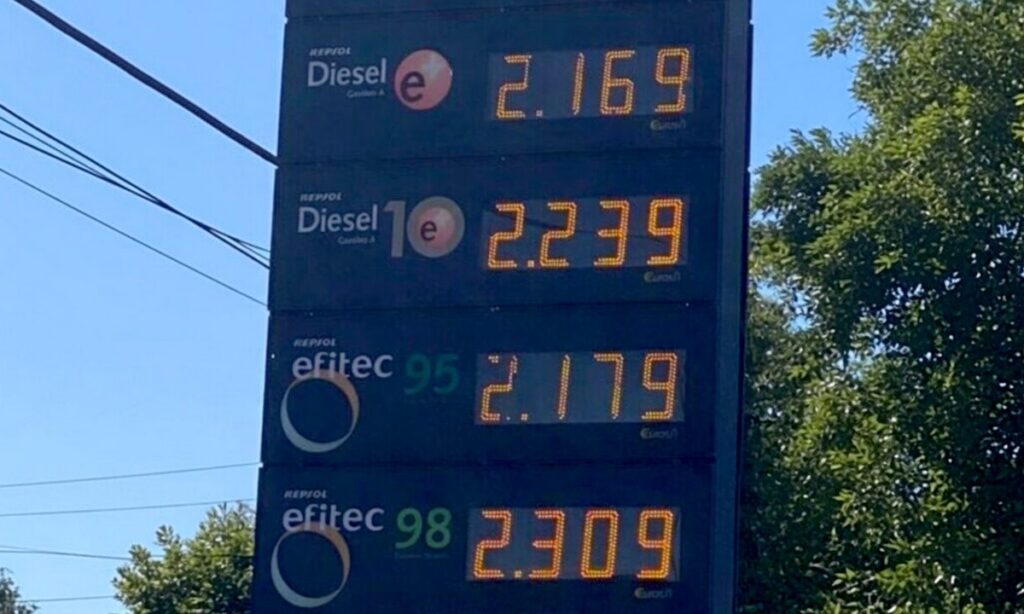
Repsol petrol station prices today. Credit: @Rblc8 X
Drivers heading off on August holidays or making the return trip are finding the pumps a good bit dearer. Filling the tank now costs nearly 20 per cent more than it did at the end of June after five weeks of steady rises. Transport groups and petrol station associations warned the government back in June that ending the temporary tax cuts brought in during the Iran conflict would push prices up hard in peak summer travel. That warning has proved right.
Latest weekly figures from the EU Oil Bulletin show the climb clearly. Average petrol has gone from €1.44 a litre on June 29 to €1.69, up 25 cents, or 17.3 per cent. Diesel has risen from €1.50 to €1.79, a jump of 29 cents, or 19.3 per cent. No other five-week stretch between late June and early August in the past 20 years has seen anything like this pace. It is three times sharper than any previous comparable period.
Prices are still below the painful peaks of summer 2022, when the Ukraine crisis pushed petrol to €2.11 and diesel to €2.08 at the start of July. Even then those figures were already falling by early August. This year the trend runs the other way, and both fuels now sit at their highest levels for this time of year since that energy crisis.
A typical 55-litre tank of petrol now costs €92.79, almost €14 more than the €79.08 it was in late June. Diesel drivers are paying €98.66, a full €16 above the earlier €82.72. These levels land right in one of the busiest periods on Spanish roads. The DGT expects 54.5 million long-distance journeys during August alone.
Why prices keep climbing even as crude eases
Brent crude averaged $92 a barrel in the first half of the year, 28 per cent higher than the same stretch previously. Talks between the United States and Iran have since brought the price back under $80 after a brief spike above $100 in late July. Falls in the raw material usually take time to reach the forecourt, while rises show up quickly. Distributors also sell stock bought earlier when the geopolitical premium was higher.
Crude itself makes up less than half the final pump price. Taxes account for between 40 and 50 per cent. On July 1, the temporary cut that had lowered IVA from 21 per cent to 10 per cent ended. That measure had been worth an estimated €507 million. A parallel reduction in the special hydrocarbon tax (IEH) was scaled back at the same time. The rebate stood at 15 cents a litre in July, dropped to 10 cents from 1 August and will fall to 5 cents in September before disappearing in October. Extra discounts previously offered by major operators such as Repsol and Moeve have largely ended as well. Put together, the changes have produced a clear rebound at stations across the country, and it is being felt in the pocket.
What it means for drivers this August
Anyone planning longer journeys this month will notice the difference straight away. Checking independent petrol stations and supermarket forecourts can still shave a few cents a litre. Free apps that pull official data from the Spanish ministry’s geoportal are also useful. A quick search for “gasolineras España” or “fuel prices Spain” usually brings up the most popular ones and shows the cheapest stations nearby or along a planned route. Smoother driving and lighter loads also stretch each tank a bit further. For longer-term residents the higher cost adds to everyday expenses at a time when many are already watching budgets carefully.
Spain’s petrol prices are, at least, still below the EU average, yet the speed of the recent climb has caught a lot of people by surprise. A possible reactivation clause exists: if fuel inflation exceeds 15 per cent the hydrocarbon tax rebate could return to 20 cents a litre. For now the direction of travel remains upward as the remaining rebate is reduced further next month.
Official weekly data come from the European Commission Oil Bulletin. Live station prices across Spain can be checked via the government’s geoportal or independent trackers such as fuel-prices.eu.
Follow Euro Weekly News on Google News
Get breaking news from Spain, travel updates, and expat stories directly on your Google News feed.
Follow on Google NewsSign up for personalised news
Subscribe to our Euro Weekly News alerts to get the latest stories into your inbox!
By signing up, you will create a Euro Weekly News account if you don't already have one. Review our Privacy Policy for more information about our privacy practices.





Adam Woodward
Adam is a writer who has lived in Spain for over 25 years. With a background in English teaching and a passion for music, food, and the arts, he brings a rich personal perspective to his work at Euro Weekly News. As a father of three with deep roots in Spanish life, Adam writes engaging stories that explore culture, lifestyle, and the everyday experiences that shape communities across Spain.
Comments