Spanish supermarket employee awarded permanent incapacity after freak fish-bone injury
By Molly Grace • Published: 10 Aug 2026 • 18:42 • 4 minutes read
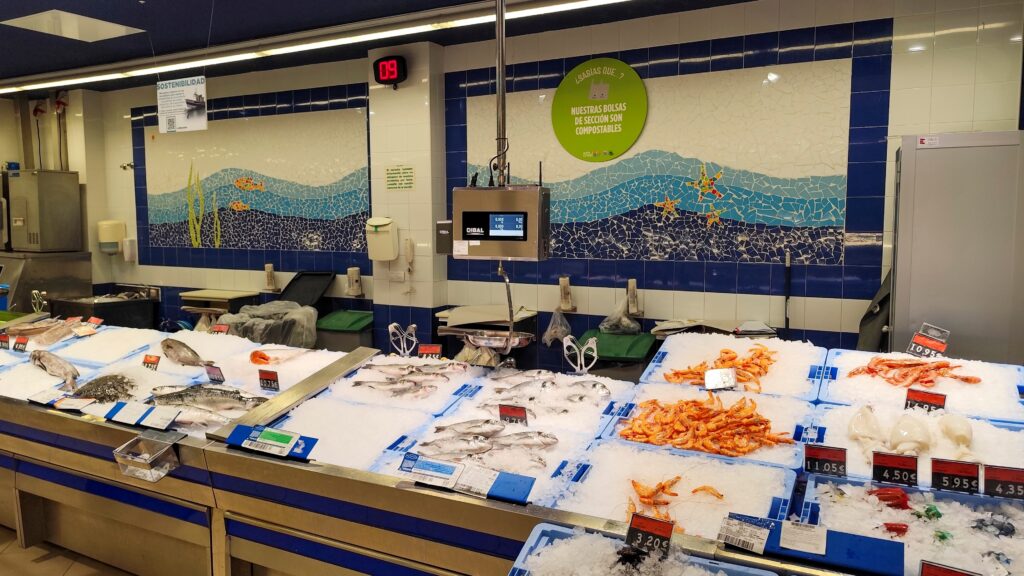
Her restrictions included being unable to use some of the cutting equipment in the fish section. Photo credit: Ruben Fraile/Shutterstock
A tiny injury can be easy to ignore until it refuses to go away, and that is exactly what happened to one Spanish supermarket employee after she suffered a freak workplace accident. She has since won recognition for permanent partial incapacity after the injury left her with lasting damage to her dominant hand and reduced her ability to carry out the job she had been doing. She was able to return to work, but could not resume all of her previous duties and continued to suffer pain and restricted movement.
The dispute followed years of medical treatment and changes to her working conditions. An initial decision awarded her compensation for permanent non-invalidating injuries, but she argued that the damage had gone much further and had permanently reduced her ability to carry out the main duties of her occupation. The courts eventually agreed, overturning the earlier assessment and recognising that the injury had permanently affected her capacity to perform her usual job.
A fish bone caused the injury
The worker was employed in Mercadona’s fish section, where she was cleaning and preparing fish. While removing scales from a fish, the tool she was using struck a bone that had remained in the fish. The force drove the bone into the knuckle of the third finger of her right hand.
The injury did not heal properly and she required further procedures to remove fish bone fragments, followed by surgery after the scar tissue affected a nerve in the hand. She also underwent physiotherapy, which unfortunately, did not resolve the problem. She continued to experience chronic pain, stiffness and reduced movement and strength, affecting her ability to carry out tasks requiring force and precision.
Her duties were changed
When the employee returned to work, Mercadona adapted her duties because of the limitations affecting her hand. She was unable to use certain cutting equipment in the fish section and was restricted from lifting loads above 7kg. The changes allowed her to remain employed, but they also meant she could no longer carry out every task associated with her previous role.
Her medical problems continued, resulting in further treatment and periods of temporary incapacity. The worker subsequently challenged the way her permanent injuries had been assessed. Her initial classification was for permanent non-invalidating injuries. Compensation was first set at €750 and later increased to €1,080. She argued that this did not reflect the effect the injury had on her ability to perform her usual occupation.
Court rules in her favour
The dispute reached the Social Court No. 1 of Santiago de Compostela, which recognised the employee as having permanent partial incapacity resulting from a workplace accident. The finding did not mean she was unable to work. Instead, the court determined that the lasting effects of the injury had reduced her ability to carry out the essential duties of her normal occupation.
That distinction was central to the case. The worker had returned to employment, but the fact that she could still work did not mean she could perform her former duties without significant limitations. Her physical restrictions, continuing symptoms and the demands of her occupation were considered together when assessing her working capacity.
FREMAP appeals the decision
FREMAP appealed against the ruling, arguing that the woman retained sufficient function in her hand to continue working and that her condition did not justify permanent partial incapacity. The appeal was heard by the High Court of Justice of Galicia, which rejected FREMAP’s arguments and upheld the earlier decision.
The court accepted that the worker remained capable of employment. However, her ability to perform some work was not the test being applied. The question was whether the permanent effects of the accident had substantially reduced her ability to perform the principal duties of the occupation she had been carrying out, the court found that they had.
Her compensation is paid as a lump sum
Permanent partial incapacity is compensated differently from total permanent incapacity. The worker is entitled to a single payment equivalent to 24 months of the applicable regulatory base, rather than a lifelong monthly pension.
The €1,080 previously awarded for permanent non-invalidating injuries is separate from this calculation and does not represent the final permanent-partial-incapacity payment. The final amount depends on the worker’s individual regulatory base. The ruling also does not prevent her from continuing to work. She remains capable of employment, but the legal decision recognises that her capacity to perform her former occupation has been permanently reduced.
A lasting injury to her dominant hand
The medical evidence showed that the problem was not solely limited to the original wound. The worker required further procedures, surgery involving a nerve affected by scar tissue and rehabilitation, while continuing to experience pain and reduced function. The injury also affected practical aspects of her employment. Her duties had to be modified when she returned, and she could no longer undertake every task she had previously performed in the fish section.
Those restrictions formed part of the evidence used to assess whether the injury had permanently affected her occupational capacity. The High Court of Justice of Galicia has now upheld the recognition of permanent partial incapacity, meaning the worker has secured a higher level of protection and compensation after an accident that permanently affected her ability to perform her usual job.
Follow Euro Weekly News on Google News
Get breaking news from Spain, travel updates, and expat stories directly on your Google News feed.
Follow on Google NewsSign up for personalised news
Subscribe to our Euro Weekly News alerts to get the latest stories into your inbox!
By signing up, you will create a Euro Weekly News account if you don't already have one. Review our Privacy Policy for more information about our privacy practices.



Molly Grace
Molly is a British journalist and author who has lived in Spain for over 25 years. With a background in animal welfare, equestrian science, and veterinary nursing, she brings curiosity, humour, and a sharp investigative eye to her work. At Euro Weekly News, Molly explores the intersections of nature, culture, and community - drawing on her deep local knowledge and passion for stories that reflect life in Spain from the ground up.
Comments