Free wristbands that spot rape drugs handed out at Malaga Fair as cases rise
By Adam Woodward • Published: 14 Aug 2026 • 12:48 • 2 minutes read
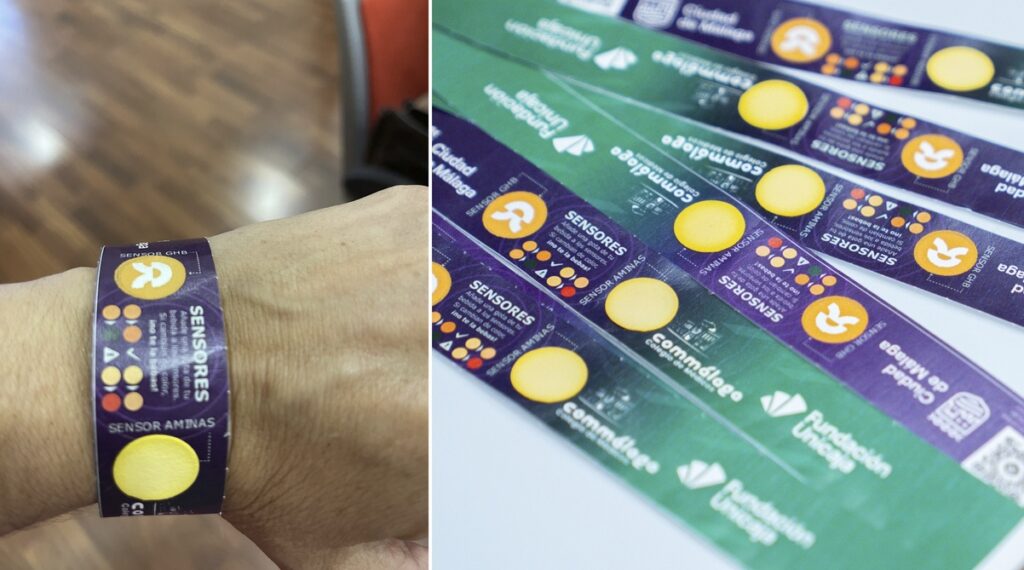
Wristbands to be handed out at Malaga Feria 2026. Credit: Ayto Malaga
More than 3,000 special wristbands capable of detecting common date-rape drugs in drinks will be given out free during this year’s Malaga Fair. Organisers hope the gadgets will help cut the growing problem of chemical submission, also known as drink spiking.
Doctors and officials launched the pilot scheme this week in Malaga. Emergency doctor Patricia Aleman told the presentation that suspected cases now turn up “too often” at her hospital. “Rare is the week we don’t see one,” she said. Greater public awareness means more people recognise the crime and report symptoms such as sudden amnesia, feeling about to pass out, or losing control of what is happening. The brightly coloured bracelets also act as a deterrent to creeps in bars and festivals.
Victims often arrive a day or two later. The drugs cause confusion and memory loss, while guilt and shame delay many from seeking help. Flashbacks can then bring the memories back. Because the substances leave the bloodstream so quickly, medical staff urge anyone with doubts to get checked as soon as possible.
How the wristbands work
Each band carries two reactive sensors. Users simply dip a finger into their drink, place it on the sensors and wait about three seconds. A colour change signals the possible presence of GHB (liquid ecstasy), ketamine, methamphetamines or scopolamine (burundanga).
The devices can be reused up to five times provided they have never given a positive reading. A QR code on every wristband links to clear instructions. If a test comes back positive, the advice is simple: do not drink from the glass, keep both the drink and its container as evidence, and call 112 or head straight to a medical centre. After roughly two hours the drugs may leave no detectable trace.
Where to collect one and what officials say
Wristbands will be on trial and available free of charge at the purple points (puntos violeta) set up across the Real Cortijo de Torres fairground during the Malaga Feria. The project is led by the Malaga Medical Association together with the city council and Fundacion Unicaja.
Association president Pedro J. Navarro described the bands as a deterrent, a preventative tool and an early-warning system. They are not a replacement for proper medical or toxicology tests. “No preventive measure should shift responsibility onto possible victims,” he stressed. “The only person responsible is the one who adulterates a drink or takes advantage of someone else’s vulnerability.”
Anyone planning to enjoy the fair can pick up a wristband and keep it handy. Full details of this year’s celebrations appear in our earlier coverage of Malaga Feria 2026.
Official information is available on the Malaga council website and through Spain’s nationwide emergency number 112, which operates in several languages, including English. It is hoped that these wristbands will soon become commonplace in bars and clubs, including along the Costa del Sol.
Follow Euro Weekly News on Google News
Get breaking news from Spain, travel updates, and expat stories directly on your Google News feed.
Follow on Google NewsSign up for personalised news
Subscribe to our Euro Weekly News alerts to get the latest stories into your inbox!
By signing up, you will create a Euro Weekly News account if you don't already have one. Review our Privacy Policy for more information about our privacy practices.



Adam Woodward
Adam is a writer who has lived in Spain for over 25 years. With a background in English teaching and a passion for music, food, and the arts, he brings a rich personal perspective to his work at Euro Weekly News. As a father of three with deep roots in Spanish life, Adam writes engaging stories that explore culture, lifestyle, and the everyday experiences that shape communities across Spain.
Comments