‘They’d throw themselves down a well if it told them to’: Google Maps traps drivers in Spain’s narrow streets
By Harry Dennis • Published: 17 Aug 2026 • 19:05 • 2 minutes read
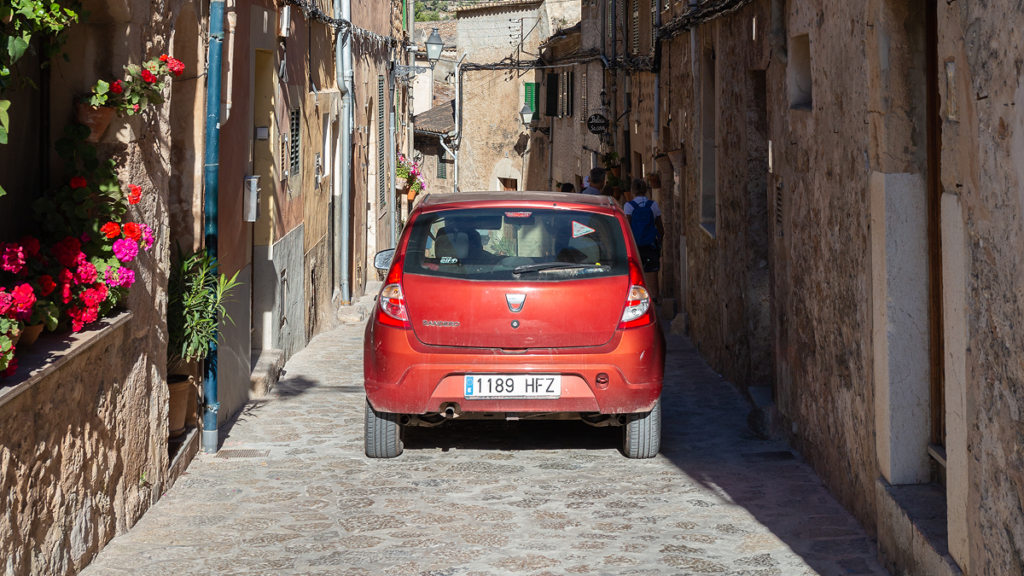
Cars continue to have to squeeze through tight Spanish streets as Google Maps keeps louring drivers into them. Credit: Laborant / Shutterstock
Some drivers who trust Google Maps into Santa Pau’s medieval alleys can’t even open the car door once they realise their mistake. The Girona village is far from alone though, with vehicles regularly getting wedged into streets never built for them across Spain.
Drivers get stuck too tight to open the door
In Santa Pau, a village of 1,500 people in Girona province, Google Maps keeps directing cars towards the historic centre along Carrer Cases Noves, a street that narrows sharply as it climbs towards the main square. Unfortunately, drivers only realise the street is too tight once it’s too late. “The drivers would throw themselves into a well if Google Maps told them to,” Santa Pau mayor Cris Capó told elDiario.es, adding that residents have repeatedly had to help free cars and lorries wedged in the alley, which usually end up with their vehicles scraped along both sides.
A warning sign painted in Google’s own colours
Frustrated by months of unanswered complaints, Santa Pau’s town hall put up a large sign at one entrance to the village, written in Google’s official colours to catch drivers’ attention: “Attention. Google Maps is wrong. Residents-only road.”
Capó said the council spent much of 2026 trying to contact Google directly, without success, and even the Mossos d’Esquadra couldn’t help. After the story drew media attention, Google Maps quietly stopped sending traffic down Cases Noves, though the council was never told why, and the alternative route it now suggests is another very narrow secondary street.
Some of Spain’s other tight squeezes
Santa Pau is far from an isolated case. In Etulain, a Navarra hamlet of around 40 people, lorries are regularly diverted off the Pamplona-Irún road after satnavs tell drivers heading for a petrol station in the next village to loop back through Etulain instead. Miguel Ángel Larrayoz, mayor of Anué, the wider municipality that includes Etulain, said a fruit lorry from Granada got stuck so badly in 2022 that a crane had to remove it, closing the street for 24 hours. A traffic sign now blocks lorries from entering, though even installing that took months of fighting for permits.
Fixing a route means becoming Google’s partner
Google does let councils, businesses and individuals correct its maps through the Maps Content Partners scheme, the company said. But small town halls without dedicated technical staff say the process is far beyond them.
Girona city managed it after Google Maps kept sending tourists through the Barri Vell, its pedestrianised old quarter reserved for residents. “We have to send files with topographic criteria and technical specifications that are not complicated for a professional, but they are for a beginner,” said Jordi Xirgu, who leads the city’s territorial analysis unit and now advises smaller municipalities on the process.
This year, the body that manages traffic across Cataluña (SCT), also became a Google Maps partner, giving it the power to correct routes that send cars through town centres or roads with roundabouts and traffic lights during accidents or roadworks. Guillermo Villuendas, the SCT’s deputy director of traffic management, said the change followed repeated complaints from small councils about dangerous rerouting.
What it means for drivers heading off the motorway
Anyone driving into a small Spanish village this summer, especially one with a historic centre, is better off treating a sudden narrow turn with suspicion rather than trusting it blindly, and watching for local signs that override the satnav. Santa Pau’s mayor said the confusion could easily be avoided if Google simply pointed drivers to the village’s main car park, a two-minute walk from the square it currently directs them towards instead.
Follow Euro Weekly News on Google News
Get breaking news from Spain, travel updates, and expat stories directly on your Google News feed.
Follow on Google NewsSign up for personalised news
Subscribe to our Euro Weekly News alerts to get the latest stories into your inbox!
By signing up, you will create a Euro Weekly News account if you don't already have one. Review our Privacy Policy for more information about our privacy practices.



Harry Dennis
Born in the UK and raised on the Cádiz coast, Harry brings his background in design, music, and photography to his writing for Euro Weekly News, sharing stories that celebrate culture and lifestyle across Spain and beyond.
Comments