Swapping bulls for balls: Indiana Jones inspired wild mountain race near Madrid
By Adam Woodward • Published: 23 Aug 2026 • 16:11 • 2 minutes read
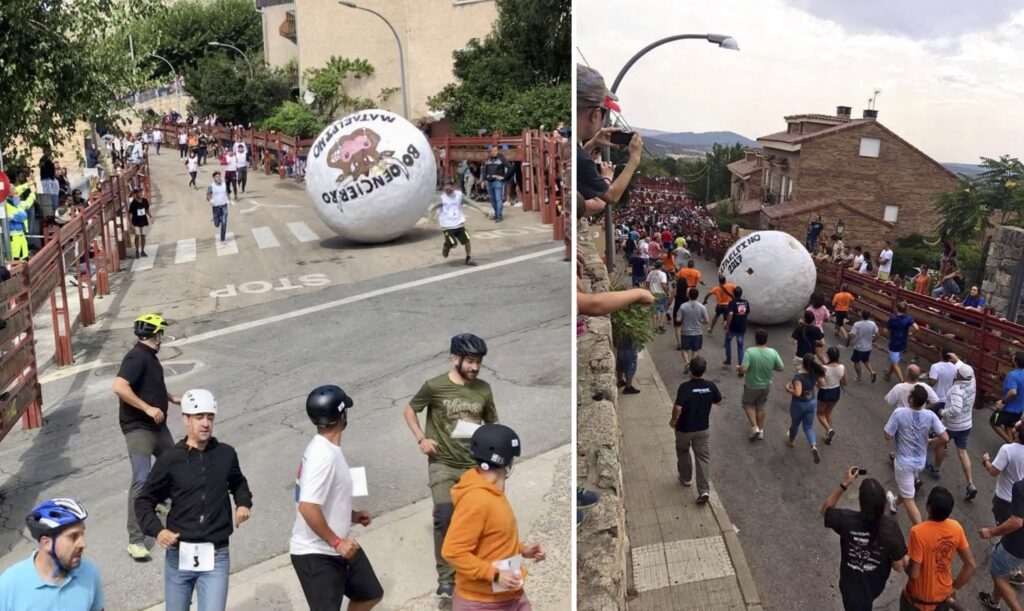
The Boloencierro drawing more runners each year. Credit: Ayto
Dozens of runners sprinting downhill through a Spanish village, chased not by charging bulls but by a massive sphere painted with a bull’s face. It’s somewhere between running with the bulls in Pamplona and the opening scenes of Indiana Jones and the Lost Ark.
Mataelpino’s Boloencierro delivers pure, but slightly mad, adrenaline every summer. Young and old, locals piled into the streets of this Sierra de Guadarrama spot on Saturday for the latest yearly celebration of this quirky tradition. Part of the San Bartolome fiestas in the municipality of El Boalo, Cerceda y Mataelpino, the event turns the usual idea of the encierro on its head. No horns, no livestock, just balls thundering after the crowd.
How a budget crisis created a legendary fiesta
Back in 2010, cash was tight with the economic crash, so councillors had slashed the budget for traditional bull runs. For this reason, a group of friends from the village cooked up an alternative. Why not chuck a huge ball of expanded polystyrene down the steep streets instead? What started as a bit of a laugh quickly stuck. Sixteen years on, the Boloencierro has become the village’s calling card, pulling in crowds from across Spain and now even across the world.
Mataelpino is about 55 kilometres from Madrid City at 1,120 metres up, home to just over 1,600 people. The run itself covers roughly 700 metres, beginning near Calle de la Iglesia and finishing in the bullring. Adult runners face a ball that once tipped the scales at nearly 300 kilos and measured up to three metres across. It could hit speeds around 50 kilometres an hour on the slopes, enough to leave a few people needing hospital treatment over the years, including one who spent days in intensive care and even a former mayor who got flattened in 2019.
Lighter ball, same thrill, helmets now essential
This year’s organisers switched to a rubber version weighing closer to 30 kilos. Festejos councillor Manuel Alonso called the old heavy one “too dangerous”, so the lighter model returns after occasional past use. Helmets are compulsory, along with proper trainers and sensible clothes. Trying to stop the ball or filming while running is a no-go.
Dozens of adults signed up and charged ahead of the decorated sphere on Saturday at midday. Kids got their own version earlier, with smaller, lighter balls, guided by adult helpers. A second children’s run took place on Sunday, August 23. Crowds lined the barriers, cheering as the big white ball, sporting a bull design, bounced and rolled its way to the plaza de toros. No major injuries were reported, just plenty of laughs and that familiar mix of nerves and excitement.
Why it keeps pulling in more crowds
Spanish fiestas love their unique twists, and this one hits the sweet spot. Safer and cheaper than live animals, seen as kinder too, yet still delivers that rush of outrunning something big and unstoppable. You can almost hear the Indiana Jones theme as the ball gathers pace on the steeper sections. Runners stay just ahead, spectators lean over the fencing, and the whole village turns out to watch.
Mataelpino’s version has inspired similar ball runs elsewhere, but the original remains the one to beat. It sits comfortably among Spain’s more offbeat summer celebrations, offering a family-friendly take on the classic encierro spirit without the same level of risk.
Follow Euro Weekly News on Google News
Get breaking news from Spain, travel updates, and expat stories directly on your Google News feed.
Follow on Google NewsSign up for personalised news
Subscribe to our Euro Weekly News alerts to get the latest stories into your inbox!
By signing up, you will create a Euro Weekly News account if you don't already have one. Review our Privacy Policy for more information about our privacy practices.

Adam Woodward
Adam is a writer who has lived in Spain for over 25 years. With a background in English teaching and a passion for music, food, and the arts, he brings a rich personal perspective to his work at Euro Weekly News. As a father of three with deep roots in Spanish life, Adam writes engaging stories that explore culture, lifestyle, and the everyday experiences that shape communities across Spain.
Comments