Almería’s hidden ‘Sistine Chapel’ reopens after a seven-year, marble-and-fresco rebuild
By Harry Dennis • Published: 24 Aug 2026 • 14:28 • 2 minutes read
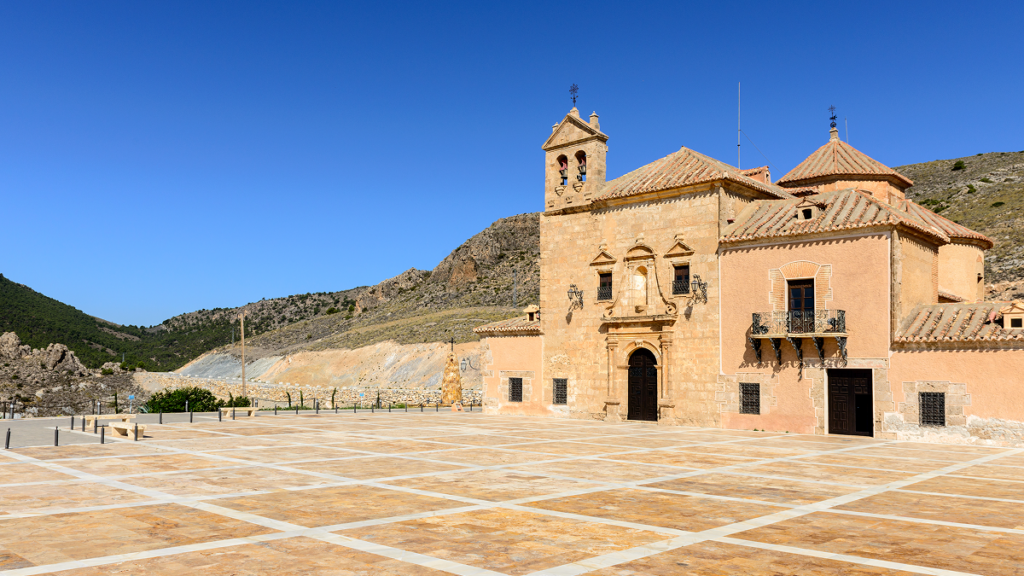
The Santuario del Saliente near Albox, reopening this weekend after seven years of restoration work. Credit: Fotomicar / Shutterstock
A modest hillside chapel in Almería’s Almanzora Valley has spent seven years under redevelopment, yet when its doors reopen this weekend the sanctuary will reveal something its own restorers say no other Christian church can match.
The Santuario del Saliente, just outside Albox, reopens on Sunday September 6 after a seven-year restoration that closed the church to worshippers and pilgrims alike. Work began in 2019 and forced a full closure in 2023, with Bishop Antonio Gómez Cantero due to preside over a formal reconsecration at 7:30pm.
Behind the new marble and scaffolding sits a project few visitors will expect: a complete cycle of paintings and frescoes based on the Book of Revelation, created by Almería artist Andrés García Ibáñez.
The Apocalypse cycle behind the ‘Almería Michelangelo’
García Ibáñez, who is from the Albox area and now lives in nearby Olula del Río, has spent years since 2019 covering the sanctuary in paintings and frescoes tied to the Book of Revelation. The centrepiece is a monumental dome fresco, unveiled over three years ago back in March 2023, depicting a passage from the Apocalypse that sanctuary officials say connects directly to the church’s own venerated image.
By the time that dome piece was finished, diocesan reports put the number of paintings and frescoes García Ibáñez had produced for the sanctuary at around 20, with further work added since as the scheme was completed ahead of reopening. El Mundo nicknamed the artist the “Almería Michelangelo”.
Marble, Cosentino stone and a bishop’s blessing
The reopening also marks the end of a wider rebuild that reaches well beyond the artwork. A new altar carved from white Macael marble, in an Italian style topped with a cross, sun and moon, has replaced the previous one, while new flooring donated by Almería stone company Cosentino has gone down throughout the church.
Roof repairs, needed after decades of wear, were partly funded by the provincial government and Albox town hall, on top of private donations and support from the Patronato-Fundación del Saliente and companies including Cosentino and Arriaga. Architect Francisco Carrasco Pérez oversaw the works.
Why ‘La Pequeñica’ matters so much to Albox
At the centre of it all is a carving barely 60 centimetres tall. Known locally as “La Pequeñica” (the little one) for its diminutive size, the early 18th-century Baroque image of the Virgin was crowned in a Vatican-approved ceremony in 1988 and declared Patrona (patron saint) of Albox in 2019, the same year the restoration project began.
The sanctuary itself dates back further still, founded as a hermitage in 1716 and rebuilt on a grander scale from 1764 under Bishop Claudio Sanz y Torres. It survived royal land seizures, wartime destruction in 1936 and decades of piecemeal repair before this latest, most ambitious rebuild.
Reopening lands two days before the annual pilgrimage
The timing is not a coincidence. Albox’s Romería del Saliente, the town’s annual pilgrimage to the sanctuary, falls on Tuesday September 8 and has been recognised as a Fiesta de Interés Turística Nacional (event of national tourist interest) since 2002.
Organist Rosabel Oller Sevilla will lead the music at Sunday’s reconsecration, and organisers expect thousands to attend. A book documenting the seven-year restoration, titled Signum Magnum, is due to be published in the coming months.
Follow Euro Weekly News on Google News
Get breaking news from Spain, travel updates, and expat stories directly on your Google News feed.
Follow on Google NewsSign up for personalised news
Subscribe to our Euro Weekly News alerts to get the latest stories into your inbox!
By signing up, you will create a Euro Weekly News account if you don't already have one. Review our Privacy Policy for more information about our privacy practices.

Harry Dennis
Born in the UK and raised on the Cádiz coast, Harry brings his background in design, music, and photography to his writing for Euro Weekly News, sharing stories that celebrate culture and lifestyle across Spain and beyond.
Comments