Almost total lunar eclipse turns the Moon blood red over Spain this Friday. No special glasses needed
By Adam Woodward • Published: 25 Aug 2026 • 12:57 • 3 minutes read
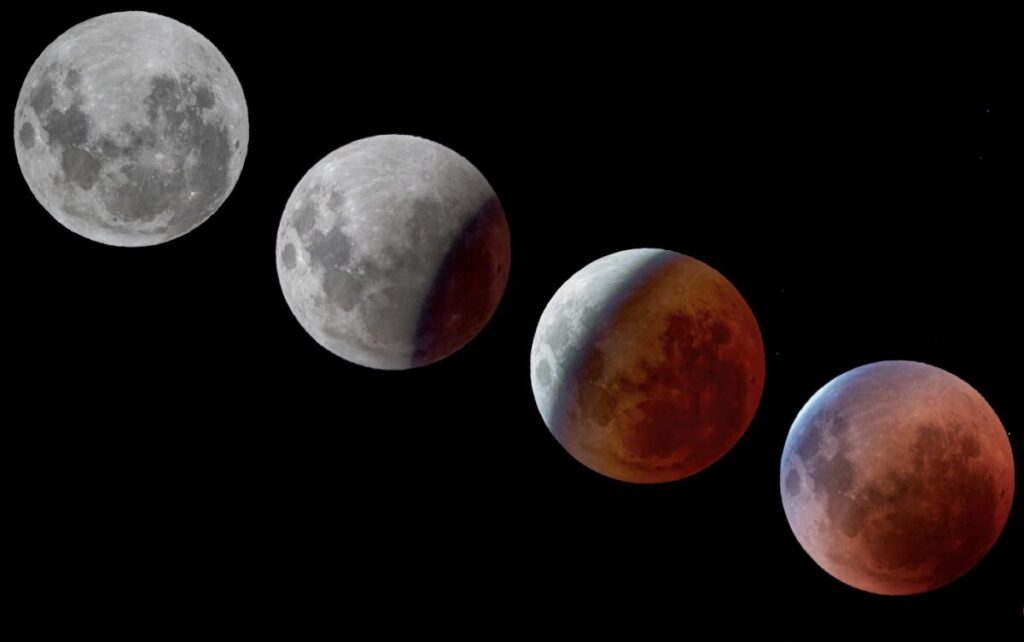
Moon turns blood red this weekend. Credit: Ministry of Science
Thousands packed streets, rooftops and pharmacies two weeks ago for the solar eclipse that gripped Spain on August 12. Now attention is moving towards the Moon. A deep partial lunar eclipse is due to arrive in the early hours of Friday, August 28, covering around 93 per cent of its surface and giving it a striking reddish-orange glow.
According to NASA Science’s page on lunar eclipses, a “Lunar eclipses occur at the full Moon phase. When Earth is positioned precisely between the Moon and Sun, Earth’s shadow falls upon the surface of the Moon, dimming it and sometimes turning the lunar surface a striking red over the course of a few hours.”
How the phases will be seen in Spanish skies
The partial phase kicks off around 4.34am on Friday morning. The Moon then edges deeper into Earth’s darkest shadow until maximum coverage arrives near 6.12am, with roughly 93 per cent of its face covered. By about 7.52am, the Moon returns to normal as it slips out of that shadow.
Expect a particularly reddish and orange look at peak. According to NASA scientists, the colour comes from sunlight having to push through thicker layers of the Earth’s atmosphere, which filters it towards red, much like a sunset or sunrise. Binoculars or a small telescope will make that coppery tint even more obvious, though none of this is essential.
🌕 El 28 de agosto, el cielo vuelve a darnos una cita.
🌘 Un eclipse parcial de Luna será visible desde toda España.
La fase parcial comenzará a las 04:34 h y alcanzará su máximo a las 06:12 h (una hora menos en Canarias), con cerca del 96 % del disco lunar en sombra. 🧵👇 pic.twitter.com/AkaMoSaNXd
— Ministerio de Ciencia, Innovación y Universidades (@CienciaGob) August 19, 2026
Why this eclipse reaches so many more places than a solar one
Lunar eclipses enjoy a huge advantage over their solar cousins. Total solar events are confined to a narrow strip maybe 200 kilometres wide. This lunar eclipse will be complete over most areas of Spain including Malaga, Almeria, Murcia and Alicante; elsewhere it stays partial, and the further north you go the less of the red glow disappears.
In fact, it can be seen across vast stretches of Africa, Europe and the Americas because its visibility band stretches tens of thousands of kilometres wide. Skywatchers from Spain right across to the Americas stand a good chance of catching at least the deepest stages, weather permitting.
🔴 ¿Y por qué puede verse rojiza?
Parte de la luz solar atraviesa la atmósfera terrestre, que filtra los tonos azulados y deja pasar sobre todo los rojizos.
👀 Además, a diferencia de un eclipse solar, puede observarse directamente y sin protección especial. pic.twitter.com/8vKaW5tEaM
— Ministerio de Ciencia, Innovación y Universidades (@CienciaGob) August 19, 2026
Best viewing spots around Spain and simple tips
Unlike a solar eclipse, no special eye protection is required, which will be a welcome change after the scramble for certified glasses for the solar eclipse. Anyone keen to soak up more detail can grab binoculars or a telescope to bring out the redder tones.
In Malaga the top locations include places without cloud cover and any elevated mirador or open high ground. Seasoned skywatchers stress the need for a clear western or south-western horizon free of trees, hills or buildings. The Moon will sit low in the sky during the best moments, so an unobstructed view makes all the difference. Head out early, find a dark spot away from street lights if possible, and settle in for a couple of hours of gradual change.
Spain has already enjoyed a memorable eclipse season in 2026. This near-total lunar show offers a gentle, safe and widely visible follow-up that needs nothing more than clear skies and a bit of early-morning enthusiasm.
Follow Euro Weekly News on Google News
Get breaking news from Spain, travel updates, and expat stories directly on your Google News feed.
Follow on Google NewsSign up for personalised news
Subscribe to our Euro Weekly News alerts to get the latest stories into your inbox!
By signing up, you will create a Euro Weekly News account if you don't already have one. Review our Privacy Policy for more information about our privacy practices.




Adam Woodward
Adam is a writer who has lived in Spain for over 25 years. With a background in English teaching and a passion for music, food, and the arts, he brings a rich personal perspective to his work at Euro Weekly News. As a father of three with deep roots in Spanish life, Adam writes engaging stories that explore culture, lifestyle, and the everyday experiences that shape communities across Spain.
Comments