‘It could kill them’: Experts warn beachgoers against pushing stranded dolphins into sea
By Molly Grace • Updated: 26 Aug 2026 • 23:39 • 3 minutes read
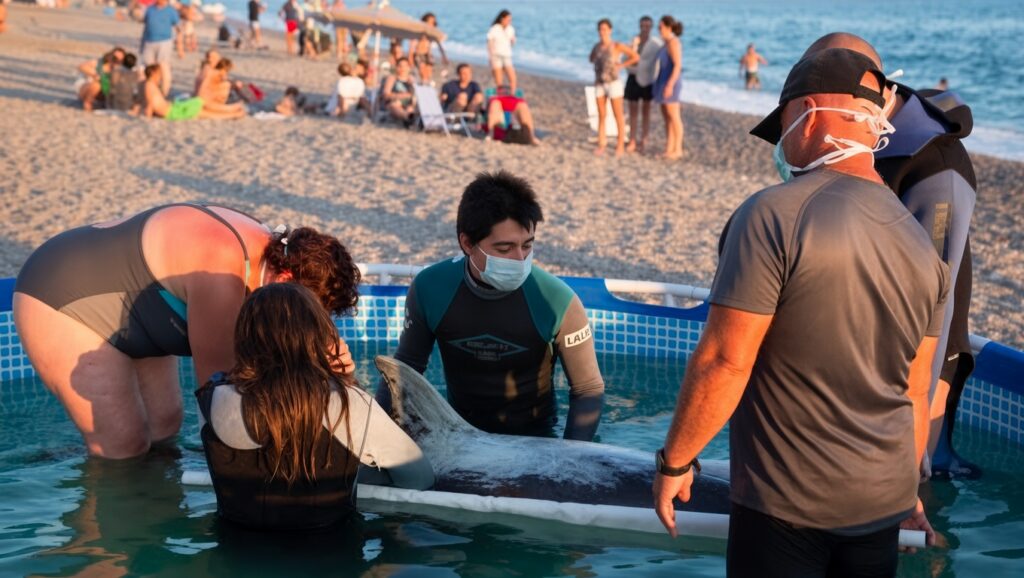
A stranded cetacean has not simply ended up on the sand because it took a wrong turn. Photo credit: Alexander Sánchez
A group of well-meaning beachgoers recently helped a stranded dolphin back into the sea on Spain’s Costa Tropical, however several marine biologist are warning that what looks like a rescue can actually put the animal’s life at greater risk. Dolphins are extremely sensitive animals, and the stress of being surrounded, handled and moved by people can itself have serious consequences.
A dolphin that reaches the beach is often already sick, injured, exhausted or otherwise compromised, meaning simply getting it back into the water does not necessarily save it. The warning comes after bathers on Castell de Ferro beach in Granada helped a striped dolphin return to the sea after it washed ashore on August 19. The people who intervened were trying to help. Alexander Sánchez, a marine biologist for Pelagics Conservation, based in Almerimar, says members of the public should not attempt to reintroduce stranded cetaceans themselves.
Why pushing a stranded dolphin back can be dangerous
Talking to Euro Weekly News Sánchez explains that it is unusual for a striped dolphin to come so close to shore and that the species normally travels in groups. From the footage of the Castell de Ferro incident, he says it was quite possible that the dolphin had some sort of underlying problem.
That is the crucial point for anyone who finds a dolphin on the beach. A stranded cetacean has not simply ended up on the sand because it took a wrong turn. The reason for the stranding needs to be established before anyone decides whether the animal can safely return to the water.
They are already struggling
Sánchez says that in the majority of the cases, a stranded dolphin is either old, sick or injured. Returning it to the sea without veterinary assessment can mean that it simply becomes stranded again somewhere else, continues to suffer or drowns.
Dolphins are also highly sensitive to stress. Being surrounded by crowds, touched repeatedly, dragged across the sand or forced back into the water can place an already compromised animal under enormous physiological strain. In severe cases, that stress can contribute to its death.
Andalucía’s own marine environment service specifically warns that a live stranded cetacean should be reported to 112, with members of the public then following the instructions given by the veterinary team. The regional authority says that releasing an animal without a prior health assessment can result in its death.
A dolphin on the beach needs help, not a push
The risks are not theoretical, In July 2025, a common dolphin stranded at Roquetas de Mar in Almería up to three times. When specialists from the local stranding network assessed the adult male, it had head injuries and signs of respiratory failure. The veterinary team ultimately decided that euthanasia was the most humane option because the animal was already agonising.
Another case in Mijas, Málaga, in May this year ended with a stranded dolphin dying shortly after reaching the beach. Marine conservation teams again advised the public not to handle the animal or attempt to return it to the sea, explaining that stranded dolphins can be injured, disorientated or severely weakened.
There are occasions when a stranded dolphin can be returned to the sea, but that decision only belongs to trained professionals after the animal has been assessed. In La Línea de la Concepción, for example, specialists examined a stranded striped dolphin in 2023 and determined that its condition was apparently good. Its swimming and buoyancy were assessed before it was eventually released.
What beachgoers should do
If a dolphin or another cetacean is found stranded on a Spanish beach, the correct response is straightforward: call 112 and wait for instructions. People should not attempt to drag the animal into the water, push it offshore or surround it in an effort to help. Apart from potentially worsening its condition, unnecessary handling can interfere with the assessment needed to determine why it stranded in the first place.
Andalucía’s official guidance also points out that intervention by untrained members of the public can put people at risk. The bathers at Castell de Ferro were clearly trying to do the right thing. But for marine mammals, the most compassionate response is not always the most obvious one. If a dolphin is stranded, leave the rescue to the people trained to decide whether it can be saved. Call 112, keep your distance and follow the instructions given by the emergency team.
Follow Euro Weekly News on Google News
Get breaking news from Spain, travel updates, and expat stories directly on your Google News feed.
Follow on Google NewsSign up for personalised news
Subscribe to our Euro Weekly News alerts to get the latest stories into your inbox!
By signing up, you will create a Euro Weekly News account if you don't already have one. Review our Privacy Policy for more information about our privacy practices.





Molly Grace
Molly is a British journalist and author who has lived in Spain for over 25 years. With a background in animal welfare, equestrian science, and veterinary nursing, she brings curiosity, humour, and a sharp investigative eye to her work. At Euro Weekly News, Molly explores the intersections of nature, culture, and community - drawing on her deep local knowledge and passion for stories that reflect life in Spain from the ground up.
Comments