September 6 EES deadline: will biometric machines stay paused? Or will long airport queues return?
By Adam Woodward • Published: 30 Aug 2026 • 10:53 • 5 minutes read
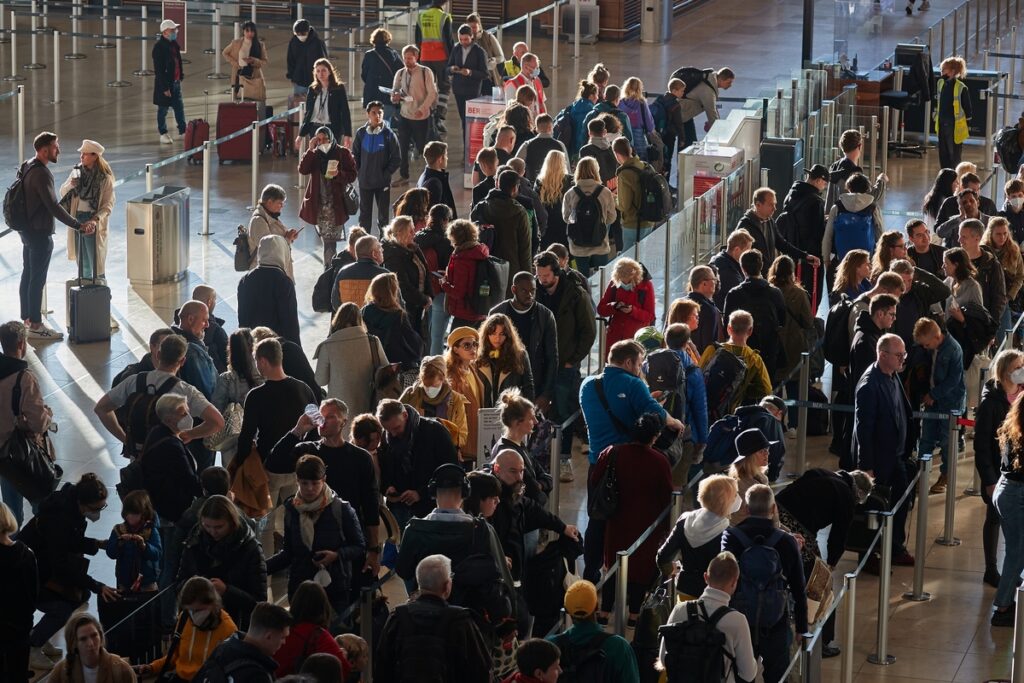
Will the airport queues mount up again? Credit: Desintegrator - Shutterstock
British travellers heading to Spain and the rest of Schengen after the summer rush now have a hard date in the diary. Sunday, September 6, is when the EU’s summer waiver for pausing fingerprint and face scans at crowded borders is due to run out. Full biometric capture at kiosks and booths is then supposed to be fully re-implemented again, unless Brussels gives countries more time.
That timing is awkward after European airports have just come through a packed summer, and September is not expected to be a quiet month. First-time EES enrolment plus still-heavy inbound traffic from the UK is the mix that filled halls in April and July.
How busy European airports have been this summer
Europe’s air network kept setting daily records through July. Eurocontrol logged 37,659 flights on 24 July, the fourth network high of the season. Twelve airports posted new daily peaks that month, including Malaga, Alicante and Rome Fiumicino. Istanbul, Amsterdam Schiphol, Paris Charles de Gaulle, Frankfurt and London Heathrow sat at the top of the daily-flight table.
Spanish airports carried much of the tourist load, with Aena’s network in Spain handling 34.4 million passengers in July, up 5 per cent on July 2025, with 284,423 movements (+6.1 per cent). Madrid-Barajas processed 6.47 million travellers, Barcelona-El Prat 5.87 million (+6 per cent), Palma 4.70 million. Malaga crossed three million in a single month for the first time (3.05 million, +6.3 per cent). Alicante and Valencia both jumped a whopping 11.1 per cent.
ACI Europe (Airports Council International) said passenger traffic across the continent rose 2.6 per cent in the first half, with growth slowing in the second quarter as Middle East disruption and fuel costs cut some long-haul flying. North American visitors to Europe still arrived in record numbers, according to the airports body. Aviation groups warned before peak season that July and August would add tens of millions of extra passengers versus the two quieter months before, the same window in which EES queues of two to four hours and missed connections were reported at several crossings.
Spain’s government still expects about 43 million international tourists between June and September, 6 per cent more than last summer, and is talking about an impressive 100 million foreign visitors for 2026 as a whole.
September is quieter than August, but not quiet
Eurocontrol’s rolling plan (updated 28 August) says traffic will stay high in September, topping 37,000 flights on Fridays, then ease in October. Daily averages versus last year:
- 31 August to 6 September: 36,589 flights a day (+3.6 per cent)
- 7 to 13 September: 36,189 (+3.4 per cent)
- later September weeks: still about 35,700 to 36,000, running 3 to 4 per cent above 2025
That first week straddles the EES waiver expiry.
What actually expires on September 6
EES itself is not being switched off. Brussels rejected a full summer shutdown in July, calling a bloc-wide stop “not needed” and “not possible”. What ends on 6 September is the extra room member states were given to stop collecting fingerprints and facial images for short bursts — often up to six hours — when a hall is overflowing.
Uku Sarekanno, deputy executive director of Frontex, put it plainly earlier in the season: if hundreds of people are stacking up, countries can lift biometric registration during peak hours so the worst queues do not wreck connections and holidays. France, Portugal and Spain have used that valve. Greece went further at times for British visitors, then had to walk a nationality-wide carve-out back after the Commission said the rules do not allow that.
Air France-KLM has said Paris and Amsterdam turn the extra checks off when there are too many passengers. Frankfurt, Brussels and Milan have done the same. Italian airports have also used a 45-minute queue limit to go back to stamping passports. That workaround officially stops being permitted on September 6.
Could the pause be continued?
Nine countries, including Belgium, France, Germany, Greece, Italy, Malta, the Netherlands, Portugal and Switzerland, wrote to Home Affairs Commissioner Magnus Brunner in July asking to keep the congestion EES opt-out after September 6. They still backed full rollout. They just do not want a cliff edge before Christmas, or a messy first week of September.
Transport Commissioner Apostolos Tzitzikostas has privately signalled that pauses could still be used after the deadline if a crossing is in trouble, according to reporting in The Times. He also discussed the file with UK Transport Secretary Heidi Alexander. After their 14 July meeting she said she was reassured he “understood the concerns of holidaymakers”.
No public Commission decision has yet given an extension through the whole of September. Until that comes, border posts should treat September 7 as only using the EES machines and no passport stamps.
Would a hard restart mean more queues?
Yes, no doubt on busy inbound days, if first-time enrolment piles up and the pause button is gone. After 10 April’s full go-live, waits of two to four hours were reported at several crossings. Sweaty fingerprint readers, kiosks that would not read a chip, and too few correctly trained officers all added time per passenger. ACI Europe has already warned of “mayhem” and “chaos” when kit and staffing cannot keep up.
September volumes are below August, which should help. Half-term and weekend UK banks into Spanish airports can still bunch. First-timers still take several minutes. People already on the system should be quicker, and a face check against a file kept for three years after last exit, but technical glitches have forced some passengers to go through the rigmarole all again.
TIE holders in Spain on a proper residence card are not short-stay visitors and should skip EES machines if they present the card with the passport. Green certificates are a whole different story.
Who this hits, and who it does not
EES applies to non-EU short-stay travellers, including most British tourists, going into the 29 Schengen countries: Austria, Belgium, Bulgaria, Croatia, Czechia, Denmark, Estonia, Finland, France, Germany, Greece, Hungary, Iceland, Italy, Latvia, Liechtenstein, Lithuania, Luxembourg, Malta, Netherlands, Norway, Poland, Portugal, Romania, Slovakia, Slovenia, Spain, Sweden and Switzerland. Ireland and Cyprus stay on stamps. Official rules are on the EU EES page.
Scrapping the whole database is not being spoken about yet. Commissioners keep citing tens of thousands of refused entries and more than 100 million crossings logged. Frontex has talked of one to two years before the process is seamless.
What to do if you fly around the deadline
Allow for extra time at passport control from September 6 until Brussels says otherwise. Use a kiosk if it is working; do not assume every airport will flick the pause on just because August was brutal. Carry the same passport used for any earlier enrolment. Residents should have the TIE in hand, not buried in a bag.
Watch for a Commission note in the first days of September. If the nine-country request is granted, local pauses can continue when arrivals halls jam. If it is refused, expect full biometric capture again, on a network that Eurocontrol still puts several per cent above last September, with 13.1 million international seats booked into Spain alone.
Follow Euro Weekly News on Google News
Get breaking news from Spain, travel updates, and expat stories directly on your Google News feed.
Follow on Google NewsSign up for personalised news
Subscribe to our Euro Weekly News alerts to get the latest stories into your inbox!
By signing up, you will create a Euro Weekly News account if you don't already have one. Review our Privacy Policy for more information about our privacy practices.



Adam Woodward
Adam is a writer who has lived in Spain for over 25 years. With a background in English teaching and a passion for music, food, and the arts, he brings a rich personal perspective to his work at Euro Weekly News. As a father of three with deep roots in Spanish life, Adam writes engaging stories that explore culture, lifestyle, and the everyday experiences that shape communities across Spain.
Comments