Why Guardia Civil rarely fine sky-high roof racks on return from Morocco to Spain
By Adam Woodward • Updated: 01 Sep 2026 • 10:03 • 3 minutes read
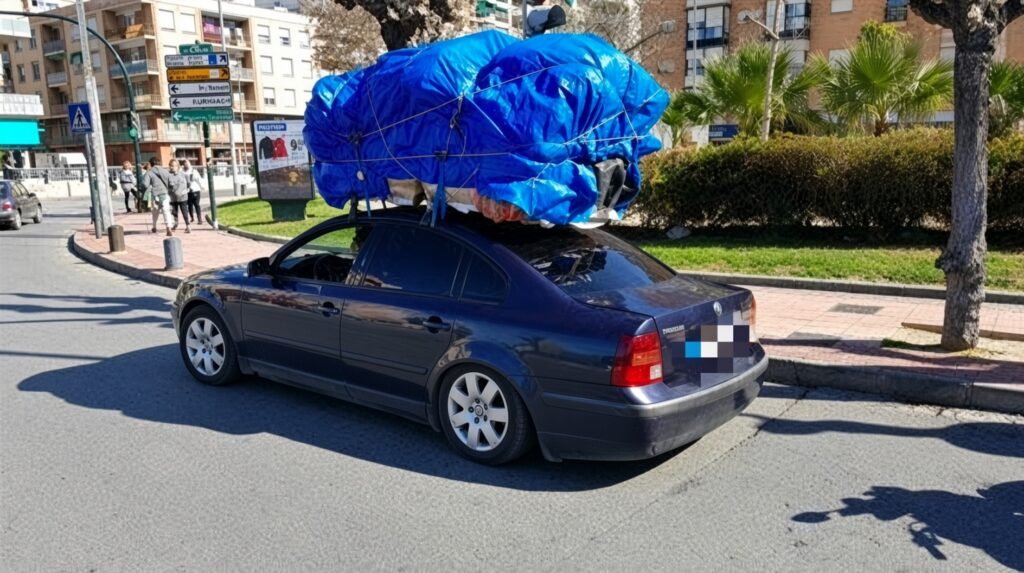
Overloaded roof rack. Credit: Policia local Murcia
Spanish motorways fill each late summer with the same sight: family saloons and old estates running south with tarpaulins, suitcases and boxes lashed to the roof. Many drivers assume those loads must be illegal. Traffic officers say a surprising number are not. The Guardia Civil hand out fines on Spanish roads for everything from leaving a handbag on the passenger seat to taking a sip of takeaway coffee but seemingly not cars that look like their roof racks are overloaded.
Around 800,000 cars are expected to be crossing Spain this year from African ports, most of them driven by Maghrebi families heading home from their holidays in Morocco and Algeria. Speed matters to them. Ports at Algeciras, Tarifa, Almeria, Malaga, Motril, Alicante and Valencia sit at the end of a long dash back to the AP-7, A-4 and A-5. Packed roofs are part of that annual ritual, known as Operacion Paso del Estrecho (OPE), or Operation Strait Crossing.
What still puzzles British and Spanish drivers is simpler: if a car looks ready to tip over, why does the Guardia Civil so often wave it on?
Looks illegal. Often is not
Guardia Civil Traffic sources have been reported saying that cars are treated like any other vehicle on the network. Officers who pull one over keep finding the same thing. These drivers “know every trick in the book”, and they often keep the law to hand when stopped.
Three checks decide whether a fine is even possible. Overall height, including the load, must stay under four metres. Cargo must not stick out beyond the car’s footprint on the ground. Everything on the roof must be strapped down with proper ratchet straps and bungees, not a hopeful bit of string.
Spain’s General Circulation Regulations and the Ministry of Transport’s height rules set that four-metre ceiling as the normal limit for a car plus whatever sits on top. Private cars also cannot let a load poke out of the sides, and rear overhang is tightly watched. Fail those tests and a fine follows. Pass them, and a towering blue tarp can still be perfectly legal.
Instability is the grey area. Officers could argue a roof load makes a car unsafe to handle. That call is subjective and hard to prove at the roadside, especially when the straps are tight and the bundle sits inside the width of the bodywork. Tickets still go out, the same sources said, but for “very specific” breaches, not for a roof that merely looks dramatic.
Weight is a different argument. Spain can fine drivers who exceed a car’s maximum authorised mass, with penalties that climb sharply once the excess is large. A bulky roof is not automatically over the weight limit. Light household goods wrapped in plastic can look enormous and still sit inside the legal kilos.
Morocco has started squeezing the same trade
Moroccan number plates with the same stacked roofs are a familiar sight on Spanish dual carriageways year-round, not only in August. Medium-scale carriers use passenger cars as cheap vans. That model is under pressure at home.
Port authorities in Tanger and Nador have blocked ordinary cars with loaded roofs during Ramadan, citing road safety and the time it takes customs to unload and recheck random roof cargo for smuggling. International small-load hauliers complain that inspections at Tanger Med and Nador crawl, draining time and income. Union voices on the other side say the era of battered cars used as informal freight waggons should end, that roof cargo raises crash risk and carbon output, and that Morocco’s image in Europe is not helped by those photographs.
Spanish officers sit in the middle of that argument. A car that has already cleared Moroccan rules and Spanish height, width and lashing tests can still look outrageous in the fast lane outside Murcia or on the approach to Algeciras. Appearance is not the offence.
Why carry so much?
The answer is simple. If a family is returning to see loved ones abroad for a month, taking the bikes for the kids is normal. As well as Mehdi, a Moroccan man living in Madrid, sometimes you will see a washing machine, or something equally big, on a car roof. These kinds of items are much more expensive to buy in Morocco, so a gift for the in-laws is sometimes sneakily added to the roof load.
What actually gets you stopped
Police still act when a load is plainly unsafe. Murcia officers have, in past summers, pulled over cars so stuffed that children were wedged among bags, or cargo sat so high it changed how the vehicle sat on the road. Those cases are not the same as a well-strapped-in “Operation Estrecho” run that stays inside the published limits.
Anyone sharing the AP-7 this week will keep seeing the blue tarps. Guardia Civil patrols will keep stopping the ones that fail the tape measure, the outline of the car, or the straps. A roof that looks full is, on its own, often not enough.
Follow Euro Weekly News on Google News
Get breaking news from Spain, travel updates, and expat stories directly on your Google News feed.
Follow on Google NewsSign up for personalised news
Subscribe to our Euro Weekly News alerts to get the latest stories into your inbox!
By signing up, you will create a Euro Weekly News account if you don't already have one. Review our Privacy Policy for more information about our privacy practices.




Adam Woodward
Adam is a writer who has lived in Spain for over 25 years. With a background in English teaching and a passion for music, food, and the arts, he brings a rich personal perspective to his work at Euro Weekly News. As a father of three with deep roots in Spanish life, Adam writes engaging stories that explore culture, lifestyle, and the everyday experiences that shape communities across Spain.
Comments