Snakes in Spain: Where you are most likely to come across one
By Molly Grace • Published: 09 Sep 2026 • 17:35 • 4 minutes read
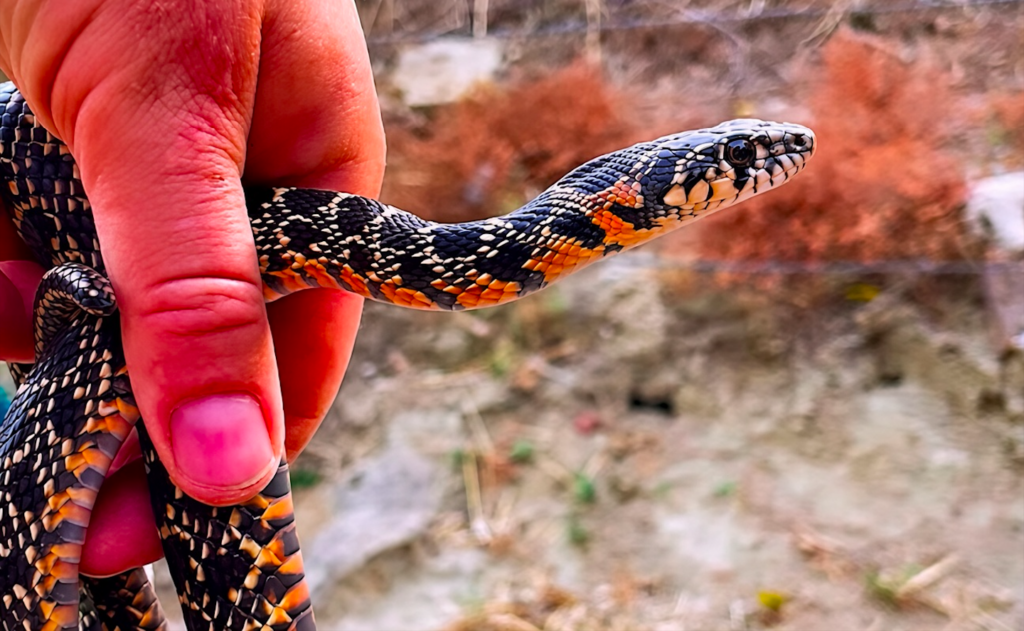
The horseshoe whip snake, is found across much of the southern half of the Iberian Peninsula. Photo credit: Molly Grace
Imagine opening the door to your garden shed, moving a pile of firewood or walking through long grass on a warm morning and finding a snake curled up just metres from you. For many people in Spain, that would be enough to make them freeze or even send them running. But while snakes can turn up in gardens, farms, countryside and even around homes, not every snake is a viper and most of Spain’s snakes are not dangerous to people.
Knowing where they are likely to be found, and recognising that several species deliberately resemble more dangerous snakes, can make an unexpected encounter considerably less alarming. Spain has a surprisingly varied snake population, with the Ministry for the Ecological Transition’s national inventory including species such as the viperine snake, southern smooth snake, false smooth snake, horseshoe snake, Montpellier snake, ladder snake and grass snake, alongside three native vipers.
Where in Spain are you most likely to see a snake?
There is no single snake hotspot. Different species favour different environments, but warm Mediterranean landscapes, scrubland, open countryside, rocky areas, farmland and places close to water can all provide suitable habitat. Southern Spain has a particularly varied snake population. The horseshoe whip snake, for example, is found across much of the southern half of the Iberian Peninsula and along parts of the Mediterranean coast, where it can inhabit warm, open and rocky environments.
Central Spain can also provide excellent habitat. The protected Quintos de Mora estate in Toledo province records several species, including the Montpellier snake, ladder snake, horseshoe whip snake, viperine snake, grass snake and Lataste’s viper. Northern Spain should not be overlooked either. The cooler and wetter conditions support species such as Seoane’s viper and the European smooth snake, while rivers, streams and other wet habitats can attract water-dependent snakes.
View this post on Instagram
One of Spain’s most widespread snakes lives near water
If you see a snake beside a stream, pond, reservoir or another source of water, it could be a viperine snake (Natrix maura). Despite its name and appearance, it is not a viper. The species can imitate the appearance and defensive behaviour of a viper, making it easy for someone unfamiliar with snakes to mistake it for a venomous species.
It is also remarkably widespread. Spain’s national reptile atlas records the viperine snake in every Spanish province, describing it as common across much of its distribution. In the south, however, it becomes more localised around the remaining places where water is available.
False smooth snake among Spain’s less familiar species
The false smooth snake (Macroprotodon brevis) is another Spanish species many people would struggle to identify. It is found principally in the southern half of the Iberian Peninsula, while the southern smooth snake (Coronella girondica) is another relatively discreet species occurring across much of the peninsula. Both appear in the Ministry for the Ecological Transition’s national reptile inventory.
Other snakes found in Spain include the horseshoe snake, Montpellier snake, ladder snake, grass snake and collar snake. The Asociación Herpetológica Española’s identification guide covers 83 reptile species found in mainland Spain, the Balearic Islands and the Canary Islands, showing just how varied the country’s reptile fauna is.
Where are Spain’s vipers?
Spain has three native viper species: the asp viper (Vipera aspis), Lataste’s viper (Vipera latastei) and Seoane’s viper (Vipera seoanei).
Their distributions differ considerably. The asp viper is principally associated with northern and north-eastern Spain, Lataste’s viper has a much wider distribution across the peninsula, and Seoane’s viper is associated mainly with northern and north-western areas. That means finding a snake in Andalucía, Madrid or Valencia does not automatically mean you have encountered a viper. Proper identification matters.
Snakes can find their way into Spanish homes
For a snake, a garden, finca or rural property can provide several things it needs: shelter, warmth, prey and quiet places to hide. Gaps beneath doors, cracks around walls, garages, sheds, storage areas, piles of wood and dense vegetation can all provide opportunities for snakes to shelter close to buildings. Areas supporting rodents can also provide a reliable food source.
If you find one inside your property, do not attempt to pick it up or corner it. Keep children and pets away, give the snake space and contact the appropriate local wildlife or animal-control service if it cannot safely leave.
Snakes are protected in Spain
There is another reason not to harm snakes, other than the fact that it’s simply not right. Spanish biodiversity legislation provides legal protection for wild animals, with additional protection applying to species included in the national List of Wild Species under Special Protection. Depending on the species and circumstances, protections cover actions including killing, harming, capturing, pursuing or disturbing wild animals.
So if a snake appears in your garden, the safest approach is also the responsible one: keep your distance, keep pets and children away and seek professional assistance if necessary. For most people, seeing a snake in Spain will be an unexpected encounter rather than a dangerous one. Knowing which species live in your area and understanding their habitats can make it much easier to tell the difference between a genuine risk and a harmless reptile simply trying to find somewhere to hide.
Follow Euro Weekly News on Google News
Get breaking news from Spain, travel updates, and expat stories directly on your Google News feed.
Follow on Google NewsSign up for personalised news
Subscribe to our Euro Weekly News alerts to get the latest stories into your inbox!
By signing up, you will create a Euro Weekly News account if you don't already have one. Review our Privacy Policy for more information about our privacy practices.





Molly Grace
Molly is a British journalist and author who has lived in Spain for over 25 years. With a background in animal welfare, equestrian science, and veterinary nursing, she brings curiosity, humour, and a sharp investigative eye to her work. At Euro Weekly News, Molly explores the intersections of nature, culture, and community - drawing on her deep local knowledge and passion for stories that reflect life in Spain from the ground up.
Comments
Cati
09 September 2026 • 18:57Stunningly beautiful and very shy. Most snakes will avoid humans and will take any escape route you offer them. They’re really useful neighbours and just as important as geckos!