Guiris go home? Look at the numbers
By Adam Woodward • Published: 26 Sep 2026 • 9:05 • 4 minutes read

Graffiti appearing around Malaga following recent housing protests. Credit: EWN
If you live in Spain and have seen the words “Guiris go home” appearing on walls, banners or social media, it is hard not to take them personally. The housing debate in Spain has seen expats scapegoated for the problems of affordable housing.
(“Guiri” is a colloquial Spanish term commonly used for a foreign visitor or foreigner, particularly someone from northern Europe or an English-speaking country. It is often used for British, German or Scandinavian tourists and residents. The term can be neutral, affectionate, humorous or mildly derogatory, depending on who says it, the context and the tone. In everyday Spain, many foreigners also use guiri about themselves without intending offence.)
For many British residents, and French, Dutch, Polish and German, etc., Spain is not somewhere they simply come for two weeks in August. It is home. There are perfectly legitimate arguments to be had about tourism, house prices, second homes and the pressure on local communities. But before ‘expats’ are scapegoated into the problem, it is worth looking at what they actually bring to the Spanish economy.
What do expats actually contribute?
It is not simply about buying a café con leche or spending money in a supermarket. Foreign residents and visitors generate economic activity in a number of ways:
- They bring money into Spain. Foreign pensions, salaries, savings and tourist spending all put money into the Spanish economy.
- They create jobs. Foreign residents need builders, plumbers, electricians, gardeners, cleaners, lawyers, accountants, estate agents, restaurants and countless other services.
- They spend throughout the year. Unlike some holidaymakers, permanent residents are buying food, filling cars, paying utility bills and using local businesses in January as well as July.
- They support Spanish businesses. A foreign homeowner renovating a property can mean work for several local tradespeople and suppliers.
- They work and pay taxes. Foreign workers are part of Spain’s labour force and contribute directly to economic output.
- They invest. Foreign money goes into property, businesses and other parts of the economy.
- They support tourism. International visitors spent €126.3 billion in Spain in 2024. British visitors alone accounted for €22.6 billion of that total, according to Spain’s National Statistics Institute.
- They help sustain whole communities. In the Balearic Islands, tourism generated €13.956 billion of direct and indirect economic activity in 2019, equivalent to 41.3 per cent of regional GDP and 41.6 per cent of employment.
That does not mean every consequence of foreign demand is positive. It clearly is not. But it does mean the picture is rather more complicated than “foreigners take things from Spaniards”.
Spain and its expats: a two-way street
There is another point that can easily get lost in the argument. Spain is not a country whose people have always stayed at home while foreigners moved in. The distinction between an expat and an immigrant is itself debated, but millions of Spanish nationals live abroad too.
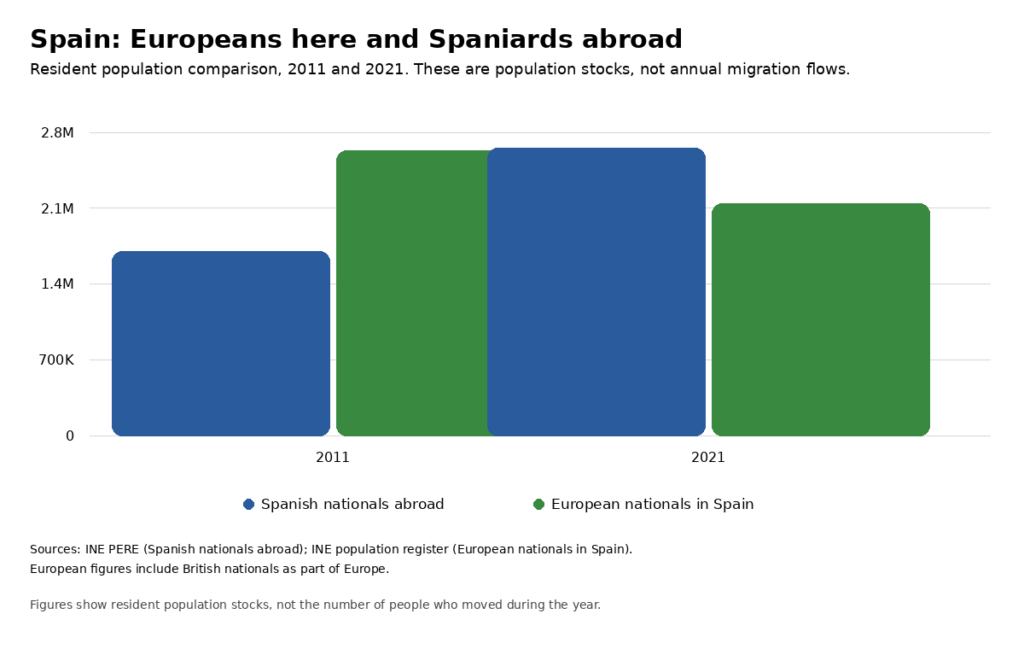
Figures are resident populations, not annual migration flows.
Spain’s official PERE statistics count Spanish nationals habitually resident abroad. There were around 1.7 million in 2011 and 2.65 million by 2021. In other words, movement between countries works both ways.
A Spanish person living in Britain, Germany or France does not suddenly stop being Spanish because they have built a life somewhere else. They become part of another country’s economy. The same principle applies to the British, Germans, French, Dutch and other Europeans who have built lives in Spain.
Yes, but… None of this means Spain should ignore its housing problems.
Foreign demand can add pressure to house prices in places where supply is already restricted. Tourism can put pressure on infrastructure and local communities. Governments have every right to debate how many homes should be holiday lets, how development should be managed and what sort of tourism individual towns want. Those are legitimate arguments. But there is a difference between questioning the impact of foreign demand and deciding that foreigners themselves are the problem. That distinction is important.
Spain’s central bank recently estimated that the foreign population made a direct contribution of between 0.4 and 0.7 percentage points to Spain’s annual per-capita GDP growth between 2022 and 2024, when total per-capita GDP growth averaged 2.9 per cent a year. So the next time somebody sees “Guiris go home”, there is another question worth asking. Go where?
‘Go home’? Where?
Back to Britain? Back to Germany? Back to France? And what happens to the businesses, jobs, rents, mortgages, renovations, restaurants, shops and services that those people currently support?
You do not have to pretend Spain has no housing problem. You do not have to defend every aspect of mass tourism. And you certainly do not have to believe every foreign resident is automatically good for every community.
But there is a difference between having an argument about what Spain needs and telling millions of people who have made Spain their home that they simply do not belong. For many of those people, Spain is not somewhere they have merely visited. It is where they chose to build their lives.
And the numbers show that they have become a big part of Spain’s economy too.
And, before the expat vs immigrant argument fires up again, an ‘expat’ is basically an ‘immigrant’ who can easily take an easyJet flight and be back to the land of their passport in a couple of hours, whereas some other categorised as ‘immigrant’ cannot.
Follow Euro Weekly News on Google News
Get breaking news from Spain, travel updates, and expat stories directly on your Google News feed.
Follow on Google NewsSign up for personalised news
Subscribe to our Euro Weekly News alerts to get the latest stories into your inbox!
By signing up, you will create a Euro Weekly News account if you don't already have one. Review our Privacy Policy for more information about our privacy practices.




Adam Woodward
Adam is a writer who has lived in Spain for over 25 years. With a background in English teaching and a passion for music, food, and the arts, he brings a rich personal perspective to his work at Euro Weekly News. As a father of three with deep roots in Spanish life, Adam writes engaging stories that explore culture, lifestyle, and the everyday experiences that shape communities across Spain.
Comments