Málaga banned new tourist flats. So why has it just approved five more?
By Harry Dennis • Published: 28 Sep 2026 • 11:36 • 2 minutes read
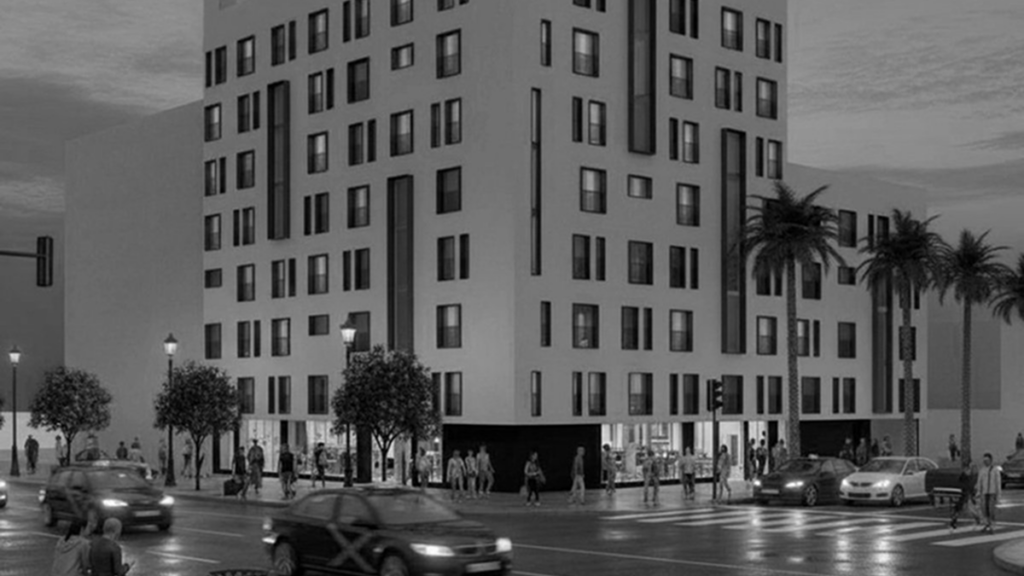
How the 175-room hotel approved on Avenida de la Paloma is set to look once built. Credit: Hiria
Renters battling Málaga’s housing crisis were promised three years without a single new tourist flat. Instead, the council has just waved through five apartment blocks and a 175-room hotel, all approved under a paperwork loophole that predates the ban.
Five blocks and a hotel beat the freeze
Málaga’s Gerencia Municipal de Urbanismo (the city’s planning department) has spent the past two months quietly signing off tourist accommodation that, on paper, should no longer be possible.
Since the freeze became legally binding on Saturday July 25, developers have picked up licences for tourist apartment blocks on Calle Pepe Estrada, Calle Albéniz, Calle Las Navas in the Huelin district and Calle Torre de San Telmo, nine flats apiece.
One project went further still. El Español found that on Calle Eduardo Domínguez Ávila, a licence first granted back in 2023 has just been used to convert 14 ordinary homes into 27 tourist apartments, on a €1.4 million build. A 175-room, three-star hotel on Avenida de la Paloma, developed by the Bilbao firm Hiria, cleared the same route.
The freeze itself only exists because Málaga’s tourist accommodation had grown faster than almost anywhere else in Spain, pushing rents up with it. Spanish courts have already backed cities’ right to restrict new tourist licences where housing supply is under that kind of strain, which is what let the council go further than the 43 individual neighbourhoods it had previously restricted and freeze new licences across the whole city.
Why paperwork from years ago still counts
When councillors approved the freeze, they built in an exemption for anything that had already started working its way through the system, so a project wouldn’t lose its place in the queue just because the rules changed underneath it.
That’s meant to stop the city being sued over applications it had already accepted. However, it also means a developer’s paperwork from 2022 or 2023, filed long before Málaga’s tourist accommodation problem became urgent enough to freeze, still counts as though the ban had never happened.
Opposition says the real total is closer to 100 flats
The five projects making headlines are only part of it, according to Con Málaga’s own tally, the opposition alliance that pulled the figures from the city’s own planning register.
It counts at least seven buildings authorised since the freeze began, adding up to roughly 100 new tourist apartments already in the pipeline. These are officially classed as regulated tourist apartments (a stricter, hotel-style category than a typical short-term let flat), but Con Málaga argues that distinction won’t matter to the rental market once the keys are handed over.
It points out that a flat built and marketed for tourists rarely ends up back on the long-term rental market just because of the licence category on file, whatever the freeze was supposed to achieve.
The city’s own planning council meet for the approval
These latest authorisations are due to be formally ratified at Monday’s meeting of the same Gerencia Municipal de Urbanismo council that signed off the original freeze in July.
Further applications submitted before July 25 are reportedly still moving through the same process, so the total is unlikely to stop at 100. For now, the freeze exists mostly on paper. Until the backlog clears, nobody knows how many more pre-ban applications are still waiting their turn, or how many tourist flats Málaga ends up adding despite the ban it introduced to stop them.
Follow Euro Weekly News on Google News
Get breaking news from Spain, travel updates, and expat stories directly on your Google News feed.
Follow on Google NewsSign up for personalised news
Subscribe to our Euro Weekly News alerts to get the latest stories into your inbox!
By signing up, you will create a Euro Weekly News account if you don't already have one. Review our Privacy Policy for more information about our privacy practices.




Harry Dennis
Born in the UK and raised on the Cádiz coast, Harry brings his background in design, music, and photography to his writing for Euro Weekly News, sharing stories that celebrate culture and lifestyle across Spain and beyond.
Comments