Malaga Cercanias trains are losing passengers: Why isn’t it free to use now?
By Adam Woodward • Published: 28 Sep 2026 • 12:32 • 2 minutes read
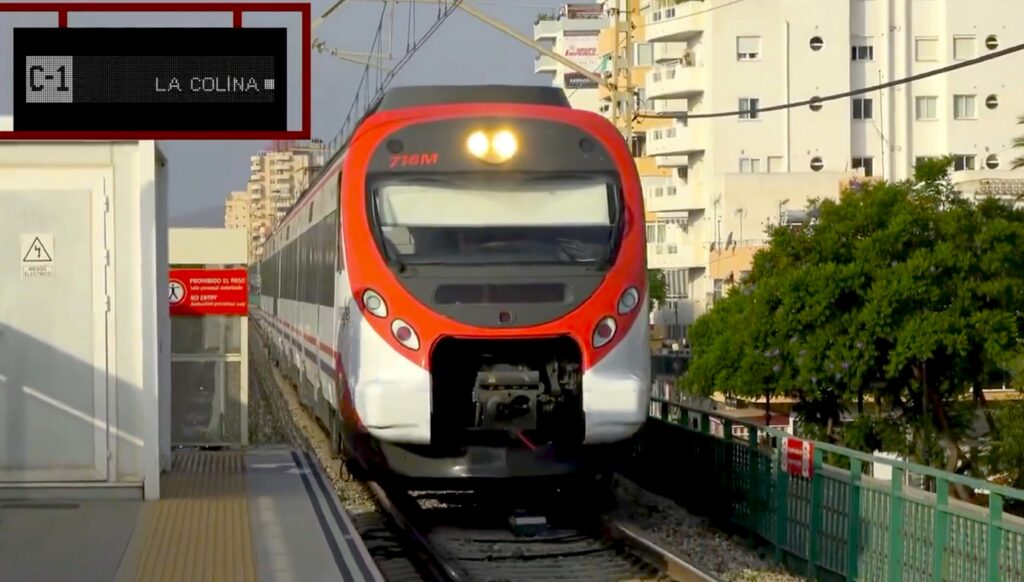
Cercanias commuter train finally arriving. Credit: AS X
Malaga’s Cercanias commuter trains carried two million fewer passengers in the first eight months of 2026 than during the same period last year. So why isn’t it free to use them again?
The question is particularly relevant for commuters on the C-1 between Malaga and Fuengirola and the C-2 between Malaga and Alora, where overcrowding and service disruption are still ongoing problems.
Renfe data reported by El Español shows 8.76 million journeys on the Malaga Cercanias network between January and August 2026, compared with 10.85 million in the same period of 2025. That is roughly 2.08 million fewer journeys, or around 19 per cent, based on the underlying figures.
Malaga once had free travel on commuter trains
Spain’s free recurrent rail passes ran for almost three years before the scheme ended in June 2025. Regular users could make unlimited journeys during the validity period and have their deposit returned if they met the conditions. Malaga Cercanias recorded 17.128 million passengers in 2024, helped by the free travel scheme.
From July 1, 2025, the government replaced free travel with cheaper monthly passes. In 2026, the general Cercanias pass costs €20, while eligible young people pay €10. Children under 15 can travel free with the relevant pass. Renfe recorded 15.543 million passengers on Malaga’s Cercanias network during 2025, down from the 2024 figure.
Why isn’t it free again?
The return of fares is one possible factor behind the lower passenger numbers. Some people who became accustomed to free train travel may have switched back to cars, buses or other options once they had to pay again, or even just staying put.
But fares are only part of the issue facing Malaga’s rail passengers. C-1 and C-2 services have faced breakdowns, cancellations, signalling problems and engineering works during 2026.
Renfe’s August figures showed that 65.2 per cent of delay minutes were attributed to external causes, while 34.8 per cent were attributed to Renfe itself. C-1 trains can also become extremely crowded, with Renfe reporting that some services reach around 150 per cent of seated capacity at busy times.
Free travel would mean another subsidy
Making Cercanias completely free again would not mean creating a new railway system. It would mean the government replacing the little passenger income it now has that currently comes from fares. Malaga Cercanias generated around €21.3 million in fare income in 2024, equivalent to roughly €1.24 per passenger across the network.
Renfe is instead preparing other measures. Seven higher-capacity S452 trains are planned for Malaga from 2028, while major infrastructure work is also planned on the C-1. Adif’s current planning documents include a 5.5-month closure affecting the C-1 between Malaga and Torremolinos, planned between the final quarter of 2027 and the second quarter of 2028.
For passengers, the question is therefore still hanging in the air: with fares back, trains overcrowded and disruption continuing, why isn’t Malaga Cercanias just free to use again? Why are we paying for this?
Follow Euro Weekly News on Google News
Get breaking news from Spain, travel updates, and expat stories directly on your Google News feed.
Follow on Google NewsSign up for personalised news
Subscribe to our Euro Weekly News alerts to get the latest stories into your inbox!
By signing up, you will create a Euro Weekly News account if you don't already have one. Review our Privacy Policy for more information about our privacy practices.





Adam Woodward
Adam is a writer who has lived in Spain for over 25 years. With a background in English teaching and a passion for music, food, and the arts, he brings a rich personal perspective to his work at Euro Weekly News. As a father of three with deep roots in Spanish life, Adam writes engaging stories that explore culture, lifestyle, and the everyday experiences that shape communities across Spain.
Comments