France erupts into violence as schools burn, firefighters attacked and 2,000 arrested
By Molly Grace • Updated: 02 Oct 2026 • 17:04 • 5 minutes read
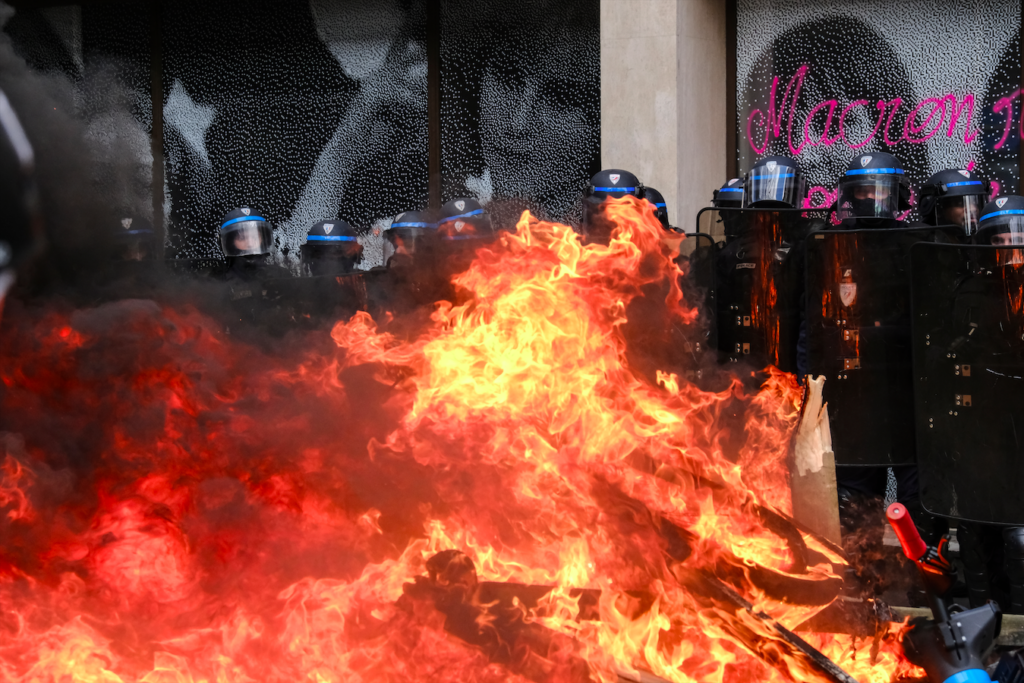
firefighters responding to a fire at Saint-Exupéry high school were surrounded by hundreds of young people. Photo credit: Alexandros Michailidis/Shutterstock
France is no stranger to protests, but the scenes now unfolding across the country are taking the latest demonstrations into very different territory. What began with students blocking school entrances has turned into a confrontation involving police, emergency services and school staff, with the original complaints about education increasingly overshadowed by violence.
Scroll down to watch videos showing the dramatic scenes as the protests unfold.
The demonstrations began over conditions inside French schools, including teacher shortages, overcrowded classrooms, long school days and deteriorating buildings. But as the movement has spread, the number of people being caught up in it has grown too, with teachers, school principals, firefighters, police officers and students among those injured.
Schools set on fire as protests spread
The demonstrations began in the Paris region over complaints about overcrowded classrooms, teacher shortages, inadequate resources and deteriorating school buildings. But scenes on the streets have increasingly involved fires, damaged property and clashes with police. In Nantes, the entrance hall of the Nelson-Mandela high school was badly damaged by fire on Thursday. The school was evacuated and the damage was severe enough for officials to say it could remain closed for weeks. Fires have also affected schools in the Paris region, while the facade of another school in Le Havre was damaged.
In Paris, firefighters were called to schools where fires had been started around entrances, while rubbish bins and other objects were set alight outside several establishments. In Strasbourg, at least one car was torched, while burning bins and other street fires have been reported in several cities. The damage is not confined to buildings. Public transport has been disrupted, bus shelters and other infrastructure have been damaged, and police have been brought in to deal with blockades and fires.
Parents told to keep children off the streets
The warnings have now gone beyond simply closing schools. Education Minister Édouard Geffray has urged parents to tell their children not to go to the protests, warning that young people are in danger on the streets. In the Aix-Marseille region, more than 40 schools were due to move to remote teaching on Friday, with pupils no longer physically attending because of concerns over the potential for further unrest.
Local authorities said the measure was temporary and linked to the level of agitation expected. The government has also moved to restrict gatherings around affected schools, while public transport has been suspended in some areas when authorities have judged that the unrest could put passengers or staff at risk.
Qué bonita mañana para despertarse en Francia… pic.twitter.com/88bs2D9kGG
— Marcos (@marcosgonfer) October 2, 2026
Firefighters attacked in Marseille
Some of the most serious scenes have been reported in Marseille, at the Saint-Exupéry high school, hundreds of young people surrounded a fire engine that had arrived to deal with a blaze. According to authorities, firefighters were forced to leave the vehicle, which was then set on fire. Marseille’s public transport system was subsequently suspended after staff were injured during the unrest. At the nearby Victor Hugo high school, two teachers were splashed with petrol when a student attempted to throw petrol into a rubbish bin.
Earlier reports from prosecutors had described the teachers as having been assaulted and doused with petrol, although subsequent accounts said the petrol had been thrown towards the bin. The incidents involving staff are not isolated. France’s Education Minister Édouard Geffray said 65 education staff had been injured since the movement began, including 40 high-school headteachers, while around 170 students had also been injured. More than 100 high schools have suffered serious damage. Authorities have responded by increasing security around schools, with some establishments switching to remote teaching where pupils and staff could not safely return.
Young second and third-generation migrants film a French firefighter after setting him on fire during the school protests in Bordeaux
— Visegrád 24 (@visegrad24) October 2, 2026
Migrant background claims emerge
The violence has also prompted a separate debate over the background of some of those involved, with several European outlets reporting that young people from migrant families were among the groups involved in the attacks. Media outlets such as Visegrád 24 has described those involved in the Marseille attack on firefighters as second- and third-generation migrants, while other outlets including Proto Thema and Remix News have similarly linked most of the unrest to youths from migrant backgrounds.
Proto Thema has gone further, explicitly presenting the violence as evidence of what it describes as the failure of multiculturalism in France. French authorities have referred to students and to violent individuals who have joined the demonstrations, with the government saying some of those involved are not even students. The government has also accused La France Insoumise party of helping drive the movement, an allegation the party rejects.
A French woman tells one of the second and third-generation migrant rioter no to vandalize her city
He responds by trying to set her face on fire pic.twitter.com/1dkiVXmuhZ
— Visegrád 24 (@visegrad24) October 1, 2026
Barricades, tear gas and clashes
Lyon has also seen serious confrontations. Young people gathered around schools, built barricades and threw objects at police, who responded with tear gas and other crowd-control measures. Across the Rhône department, authorities reported rubbish-bin fires and fireworks, with arrests made during the morning. More than 1,000 French high schools were affected by protests, strikes or other actions on Thursday, including hundreds where access was blocked.
In Strasbourg, police used tear gas as protesters confronted officers, while barriers were burned on tram tracks. Tram services were suspended in an attempt to restrict the movement of demonstrators. Transport has also been disrupted in other cities as authorities attempt to prevent further clashes. Toulouse has seen clashes between riot police and young protesters, with fires and damage to bus shelters reported. In Lille, young people smashed the glass of a bus stop while firefighters dealt with burning rubbish bins. Rennes has also seen fires and a heavy police presence, while police used tear gas at a school in Brest.
🇫🇷 FRANCE : PERTE DE CONTRÔLE TOTAL ?
Dans certaines villes, la situation devient telle que des sirènes d’alerte sont déclenchées et que les habitants sont appelés à rester chez eux.
Pendant ce temps, des groupes violents imposent leur loi dans les rues.
Quand un État en… pic.twitter.com/JKgzgXT2p1
— Sarah Adv (@Sarahsa09309757) October 2, 2026
Nearly 2,000 arrested
Around 2,000 people had been taken into police custody since the protests began, with around 90 per cent of them minors. On Thursday alone, the Interior Ministry recorded 1,949 arrests and said 305 police officers and gendarmes were injured. Rights groups have criticised the use of force against minors, while the government says officers are responding to increasingly violent incidents involving fires, projectiles and attacks on people and public property.
But for students, teachers and parents, the immediate issue is whether schools can open safely. With hundreds closed, dozens of staff injured and fresh fires and clashes still being reported, a dispute over France’s education system has developed into a national security and public-order problem.
Follow Euro Weekly News on Google News
Get breaking news from Spain, travel updates, and expat stories directly on your Google News feed.
Follow on Google NewsSign up for personalised news
Subscribe to our Euro Weekly News alerts to get the latest stories into your inbox!
By signing up, you will create a Euro Weekly News account if you don't already have one. Review our Privacy Policy for more information about our privacy practices.



Molly Grace
Molly is a British journalist and author who has lived in Spain for over 25 years. With a background in animal welfare, equestrian science, and veterinary nursing, she brings curiosity, humour, and a sharp investigative eye to her work. At Euro Weekly News, Molly explores the intersections of nature, culture, and community - drawing on her deep local knowledge and passion for stories that reflect life in Spain from the ground up.
Comments