Something strange is happening beneath Italy – Earth’s crust is slowly ‘unzipping
By Farah Mokrani • Published: 08 Oct 2026 • 12:13 • 3 minutes read
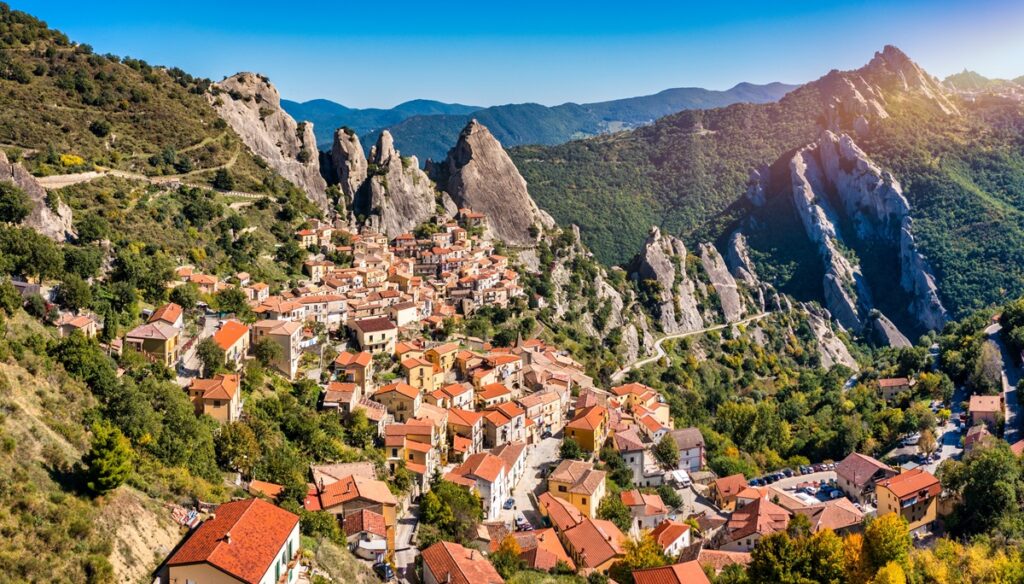
Castelmezzano sits among the Apennines, where scientists say the Earth’s crust is slowly ‘unzipping’. Credit : DaLiu, Shutterstock
Deep in the ground of one of Europe’s most visited countries, something extraordinary is occurring. The Earth’s crust beneath Italy is slowly disintegrating in a process that scientists compare to a large zip being pulled open underground.
There is no massive fault line tearing apart Rome, Florence, or the Italian countryside. It’s taking place in the underground and over time scales that span geological eras. But it could explain something Italians and regular tourists have known for years: Why is the Apennine region one of Italy’s most earthquake-prone regions?
Communications Earth & Environment, in September 2026, combined geological, seismic and geodetic evidence, to demonstrate that lower-crustal delamination is now the primary force driving deformation and seismicity in the Apennines.
And, it is easy to visualize it : imagine slowly unzipping a zipper.
Italy’s crust is ‘unzipping’: what scientists discovered beneath the Apennines
The Apennine Mountains run for about 1,200 kilometers along the Italian peninsula. They are the country’s spine. But below the beautiful landscape, things are happening.
Scientists have long been intrigued by a mysterious phenomenon. Parts of the mountain range are being stretched out while others just tens of kilometres away are being squeezed.
The new study, led by Stefano Tavani at the University of Florence, suggests a mechanism that can bridge these seemingly opposing movements.The process is known as delamination.
The bottom part of the Adriatic crust is gradually separating from the rest and sinking into the Earth. The whole crust does not act as one single mass. The lower layers are flaking off.
Researchers described this splitting as a motion along a hinge, which rearranged the stresses in the crust as it progressed. From behind, the crust can expand, and further on, it continues to compress.
Think of opening a jacket: the slider advances while the two sides behind it separate. The geological reality is considerably more complicated, but the analogy helps visualise a process taking place kilometres beneath the surface.
Crucially, ‘unzipping’ does not mean Italy itself is literally splitting into two pieces.
Why Italy stretches and squeezes at the same time
Italy was shaped as it is today. Scientists have to turn the geological clock back millions of years to understand how Italy has arrived at this point.
The Mediterranean landscape was formed by a complex interaction of tectonic plates, including the continental accretion of Africa and Eurasia. The formation of the Apennines was also associated with the subduction system’s retreat and the Tyrrhenian region’s evolution.
Over time, the active extension moved away from the Tyrrhenian back-arc region and into the Apennines. According to the new study, lower-crustal delamination is the main force driving the continued deformation of the ApEnnines
The previous studies had already established the possibility of delamination beneath the Apennine mountains. There is evidence of a weak zone in the middle-lower crust, and a sign of an evolving double Moho, which is the boundary between the Earth’s crust and mantle.
The new research goes one step further by merging different observations into a single model that can explain extension, contraction and short-term vertical movement around the migrating hinge and this is important because the Apennines are not just a geological remnant.
Does the ‘unzipping’ beneath Italy mean more earthquakes are coming?
For people living in or travelling through Italy, this is inevitably the biggest question.
The study does not mean that scientists have discovered that a catastrophic rupture is about to happen, nor does it offer a way to predict the date or location of the next earthquake.
Instead, it provides a better understanding of the forces that are responsible for ongoing seismic activity in the Apennines.
The researchers found that lower-crustal delamination is the primary geodynamic source of tectonic deformation and seismicity in the mountain chain
In other words, the surface earthquakes may be just a part of a much larger and more gradual change going on far beneath the surface.
The finding is also relevant beyond Italy. The authors suggest that the Apennines can serve as a model for other mature subduction systems, where deformation continues after the back-arc basin has begun to open up less quickly or even stopped.
The mountains are timeless, but the ground is still being reshaped. And deep beneath Italy’s cities, roads and mountain villages, there seems to be a section of Earth’s crust pulling apart in a process far too slow for human eyes to see. But it has had an effect on Italy’ s seismic future.
Follow Euro Weekly News on Google News
Get breaking news from Spain, travel updates, and expat stories directly on your Google News feed.
Follow on Google NewsSign up for personalised news
Subscribe to our Euro Weekly News alerts to get the latest stories into your inbox!
By signing up, you will create a Euro Weekly News account if you don't already have one. Review our Privacy Policy for more information about our privacy practices.





Farah Mokrani
Farah is a journalist and content writer with over a decade of experience in both digital and print media. Originally from Tunisia and now based in Spain, she has covered current affairs, investigative reports, and long-form features for a range of international publications. At Euro Weekly News, Farah brings a global perspective to her reporting, contributing news and analysis informed by her editorial background and passion for clear, accurate storytelling.
Comments