Spain motorway speed limit could drop to just 40km/h under new traffic system
By Farah Mokrani • Published: 09 Oct 2026 • 0:28 • 4 minutes read
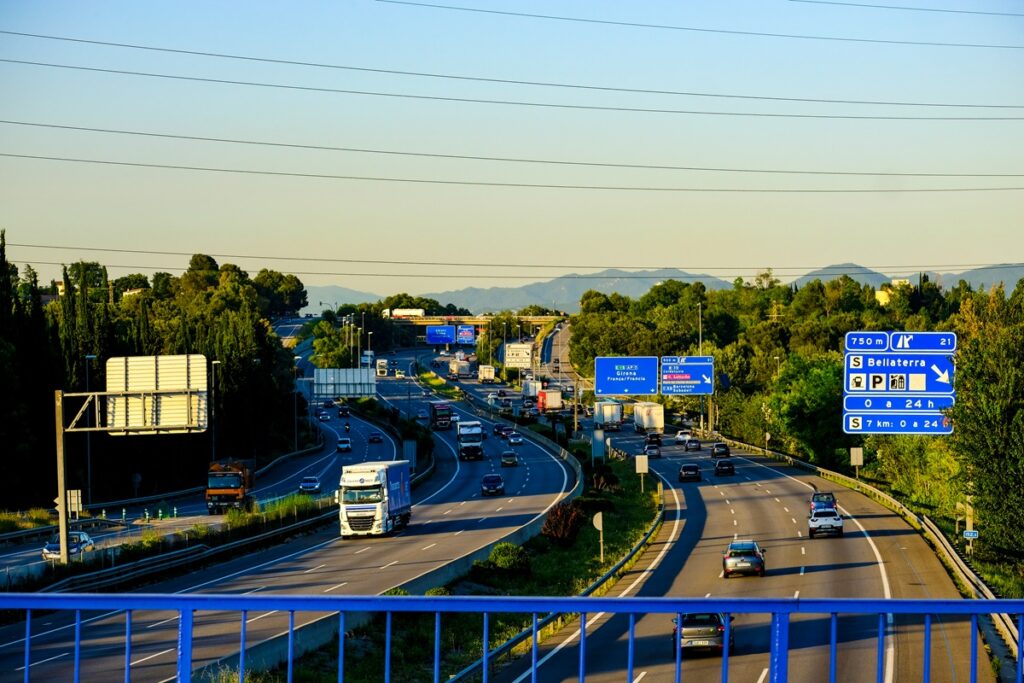
Spain is introducing variable speed limits on key motorway stretches. Credit : csp, Shutterstock
Rides running on the most frequented highways in Spain may no longer feel certain that a 120km/h speed limit set at the beginning of their journey will remain in force.
Since 1 October 2026, a trial is under way of variable limits on the AP-7 and AP-2 sections of Catalonia. This means that the speed at which you can drive is going to be different according to what’s happening on the road.
On sections of the AP-7, the limit of 120 km/h may be reduced to 100, 80 or 60; on the fog-prone stretch of the AP-2, the limit may be much lower, sometimes only 40.
To the drivers, especially those who are accustomed to the route and come into Spain from France, there is an important practical message: be aware of the electronic signs above the road, and not rely on the speed limits shown at the start of the motorway.
The general speed limit of 120 kilometers per hour on Spanish motorways has not been abolished. What is different on certain stretches is that the posted speed limit above the roadway may be modified according to the conditions encountered during the trip.
AP-7 variable speed limits: why 120km/h could suddenly become 60km/h
The AP-7 is one of the main highways involved in the new trial.
Instead of reducing the speed limit permanently, the system allows the authorities to change the speed limits ‘in real time’ when circumstances make the usual speed less appropriate.
Imagine starting on a motorway at a speed of 120 kilometers per hour and then passing a sign showing 100 kilometers per hour. Further on, bad weather or increased traffic might cause the sign to read eighty or even sixty.The lower speed indicated by the variable sign is the speed that a driver must adhere to at that point.
The system responds to congestion of the traffic, collisions, obstacles on the road, bad weather, and lowered visibility.
This is of particular importance on the AP-7 where traffic is generally very heavy, and where a small accident can quickly give rise to large differences in speed between the moving traffic and that approaching the blockage.
For the frequent users, a familiarity with the highways is no longer enough. In the morning the same stretch of road may be subject to a different speed limit than that established in the afternoon.
For the rest of the way, the driver must always keep checking the overhead road signs, and not think that an earlier limit is valid indefinitely.
AP-2 speed limit can fall to 40km/h when fog makes driving dangerous
The most impressive number in the system is 40 kilometres per hour, but this number must be seen in context.
Spanish motorways are not being standardised on 40 kilometres an hour.The figure relates to the stretch between Castelldans and Les Borges Blanques in Lleida, where thick fog can seriously reduce visibility.
The system in operation there was conceived to meet this special circumstance.According to figures given to the Catalan radio channel 3Cat and attributed to Spain’s Ministry of Transport, the system had been in operation for a total of 417 hours since it went into service in November 2023, deploying different measures according to the degree of fog.
Under the most restrictive conditions, the speed limit can be lowered to 40km/h and traffic can also be restricted to one lane.
There is a straightforward safety reason for such a substantial reduction.
At motorway speed, a vehicle covers a considerable distance in a few seconds. If dense fog prevents the driver from seeing far enough ahead, he has less time to notice a stationary vehicle, congestion, loose material, or an accident, and to react accordingly.
Variable speed limits are intended to meet this varying danger rather than to set a maximum speed, regardless of the visibility.
A distinction which it is of the utmost importance for the drivers to observe, is that the forty kilometres per hour limit is only a speed restricted to that particular stretch of road, and not a new national limit imposed on the motorways.
Driving from France into Spain on the AP-7? Watch the signs closely
The change could be particularly noticeable for international motorists.
A major artery between France and Catalonia, the AP-7 carries vehicles into Spain through the La Jonquera border area and on to the Mediterranean coast.
Consequently, a person arriving from France may cross many different speed limits without leaving the same stretch of road.
There are no special regulations for foreign registration plates. Whenever a variable speed limit is displayed it is applicable to all vehicles on that stretch of road – irrespective of where they are registered.
To visitors, it is therefore all the more important to notice the electronic signs above the road, for otherwise they would not know the rules.
It is also worth stressing what the trial does not mean. Actually, spanish motorways have not been lifted from their 120-kph maximum, nor are they all being converted into variable speed limits overnight. These modifications only concern a few stretches of the AP-7 and AP-2 motorways in Catalonia, which are included in the trial.
The trial aims to show whether this system can adapt to the conditions on the road, before deciding whether it might be useful in other places.
Driving through the affected districts, you can already feel the change.
Then a familiar route can have several different speed limits from beginning to end. The speed limit shown some kilometres earlier may no longer be the one that applies now.
On these sections of the motorway, the safest approach is to keep a close eye on the electronic signs.
Follow Euro Weekly News on Google News
Get breaking news from Spain, travel updates, and expat stories directly on your Google News feed.
Follow on Google NewsSign up for personalised news
Subscribe to our Euro Weekly News alerts to get the latest stories into your inbox!
By signing up, you will create a Euro Weekly News account if you don't already have one. Review our Privacy Policy for more information about our privacy practices.




Farah Mokrani
Farah is a journalist and content writer with over a decade of experience in both digital and print media. Originally from Tunisia and now based in Spain, she has covered current affairs, investigative reports, and long-form features for a range of international publications. At Euro Weekly News, Farah brings a global perspective to her reporting, contributing news and analysis informed by her editorial background and passion for clear, accurate storytelling.
Comments