Spain’s digital nomad visa vs France’s options for remote workers: What are the differences
By Nicola EWN • Published: 14 Oct 2026 • 16:04 • 5 minutes read

Credit: Easystart
Spain’s digital nomad visa gives remote workers a named immigration route. France takes a different path: it has no official digital nomad visa in 2026, so applicants must match their work model to an existing French visa category. That distinction affects your paperwork, income proof, tax exposure, family plans, and your employer’s compliance risk.
Introduction: Spain has a dedicated route; France uses alternatives
Spain created its international telework route under the Startup Law framework introduced in 2023. France relies on long-stay visitor, independent-professional, entrepreneur, and Talent Passport routes. For a detailed look at the French side before choosing a path, learn more about the France digital nomad visa and the alternatives that actually exist.
The right country depends on more than lifestyle. A U.S. employee working remotely for a New York company faces a different legal question from a freelance designer billing German clients or a couple living on investments.
Spain vs. France at a glance
Start with the legal category, then compare the practical consequences. The table below helps you identify where your income model fits before you spend money on translations, insurance, or an application.
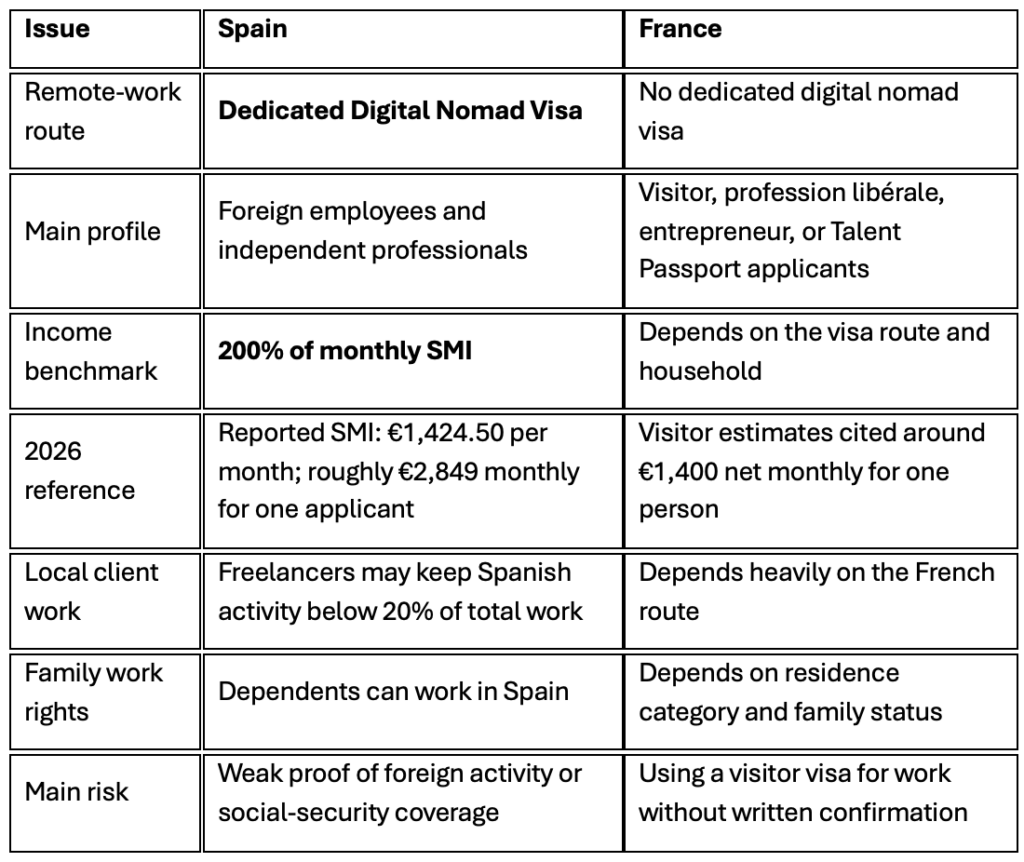
Spain’s 2026 figure reflects the SMI approved on January 29, 2026, backdated to January 1. Older guides cite €2,160, €2,646, or €2,760 monthly. Those figures belong to earlier calculations and should not be treated as current requirements.
France’s options for remote workers
The visitor route suits financially independent residents
The French long-stay visitor visa fits people with passive income, savings, pensions, or other resources that support life in France. It is commonly issued for up to 12 months and can be renewed when financial means, insurance, and residence conditions continue.
Remote work for a foreign employer sits in a compliance-sensitive area. The visa wording bars professional activity in France, while some applicants describe foreign remote employment as acceptable. Get written guidance from the relevant French consulate before relying on that interpretation. Tax residency, payroll, and employment law create separate questions.
Profession Libérale, entrepreneur, and talent passport routes
A Profession Libérale route suits a consultant, freelancer, or independent professional with a real French business plan and viable income. A cited benchmark is roughly €1,766 per month. The reported fees are about €269 for the long-stay visa plus about €200 for validation after arrival.
Entrepreneurs need a credible project, funding, and evidence that their activity can support them. The Talent Passport business-creator route sets a higher bar: a Master’s degree or five years of professional experience, a business plan, and a €30,000 investment. It is not a catch-all digital nomad option for ordinary remote employees.
France’s routes demand a close match between your stated activity and your documents. A contract, client list, invoices, business registration plan, and projected income must tell the same story.
Spain’s Digital Nomad Visa: Eligibility, income, and documents
Spain’s digital nomad visa ties residence to foreign employment or professional activity. It is a work-based immigration route, not a lifestyle label. Employees need proof that their foreign company has carried on real activity for at least one year. Applicants must also show a relationship with that company or client for at least three months.
For a solo applicant, official consular guidance sets financial means at 200% of the Spanish monthly minimum wage. The first accompanying family member adds 75% of SMI, while each further family member adds 25%. Spain also accepts a university or postgraduate degree, or three years of relevant professional experience.
Freelancers need to separate foreign and Spanish revenue carefully. A self-employed applicant may work with Spanish companies only where that activity stays below 20% of total professional activity. An employee should not assume the same flexibility to add local clients.
Prepare the file in a deliberate order:
- employment letter, contract, payroll records, or client agreements;
- company registration and proof of overseas activity;
- bank statements proving the income threshold;
- health insurance, social-security evidence, and an NIE where required;
- criminal-record certificates for the prior two years, plus the five-year declaration;
- apostilles or legalisation, followed by official Spanish translations.
A consular visa can last up to one year. Certain visa-exempt nationals may apply from Spain for a residence authorisation that can run for three years. Citizenship and lawful status at the time of filing determine whether that in-country route is open.
The differences that matter in practice
Legal fit should come before Paris, Barcelona, school options, or broadband speed. The following profiles show why the same remote job can lead to different visa choices.
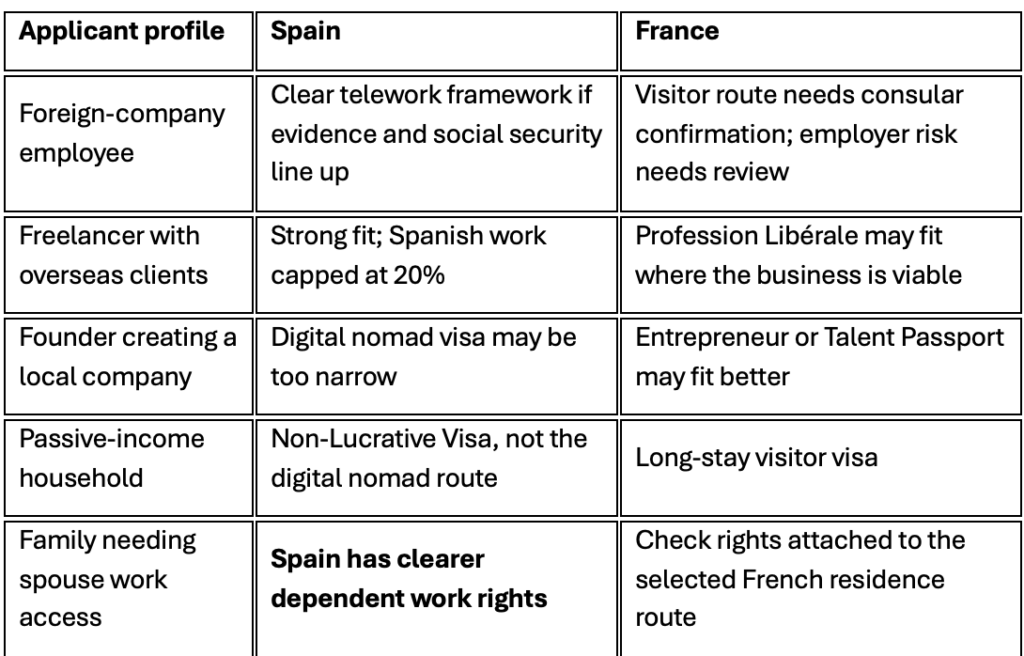
Spain’s Non-Lucrative Visa requires 400% of IPREM for the main applicant. With a reported 2026 IPREM of €600 per month, that equals €2,400 monthly or €28,800 yearly before dependent additions. It bars work, so it does not suit a person planning to work remotely.
Both countries allow Schengen travel, yet Spanish residence does not authorize living or working in France, and French residence does not authorize living or working in Spain. For long-term planning, Spain references five years toward long-term residency. Nationality timelines, physical presence, and route renewals require separate checks.
Taxes, social security, and total relocation cost
A visa approval is not tax clearance. Spending more than 183 days in Spain or France can trigger tax residency, though treaty rules and effective residence facts also matter. Spain’s special impatriate regime, sometimes called the Beckham Law, may apply for up to six years if its conditions are met. The reported 24% IRNR rate is not a universal digital nomad tax rate.
Employees should ask their employer about payroll, permanent-establishment exposure, labor law, and social security before moving. UK applicants should check whether an A1 is available; Spain’s guidance references CA3822 for employees and CA3837 for self-employed people where applicable. Insurance, apostilles, sworn translations, tax advice, housing deposits, and visa fees belong in the real relocation budget.
Remote work policy is still catching up with cross-border employment. As digital nomad programs evolve across Europe, income thresholds and compliance rules can change quickly. Recheck every figure and document rule shortly before you apply.
Which country and route fits your situation?
Choose Spain’s digital nomad visa when you want a defined remote-work category, can document foreign income, and may need work rights for family members. It is particularly direct for employees and freelancers whose clients remain outside Spain.
Consider France when your situation fits a visitor, independent-professional, entrepreneur, or Talent Passport route. France can work very well for a France-centered life plan, yet the visa category must match what you actually do. Do not build your move around an informal reading of visitor status.
Application and relocation checklist
First, confirm your citizenship, country of legal residence, and visa channel. Map every income source and client location. Then review tax, payroll, and social security with the relevant professionals. Collect certificates early, check their validity dates, apostille or legalise them, and commission the right translations before submitting your application.
After approval, the real work starts: housing, a bank account, health coverage, tax registration, school enrollment, and business formalities all have their own deadlines. If retirement rather than remote work is your plan, compare the rules before you retire in Spain under the Non-Lucrative Visa.
Spain wins on clarity for qualifying remote workers. France rewards applicants who choose the right existing route and prepare a consistent file. If your move involves French administration, a family, housing, healthcare, or a new business, seek a personalized France assessment before booking flights. A careful review upfront can prevent a visa choice from creating tax, work, or residency problems after arrival.
This article is for informational purposes only and does not constitute legal, immigration, or tax advice. Always seek independent professional advice before making any visa or relocation decision
Follow Euro Weekly News on Google News
Get breaking news from Spain, travel updates, and expat stories directly on your Google News feed.
Follow on Google NewsSign up for personalised news
Subscribe to our Euro Weekly News alerts to get the latest stories into your inbox!
By signing up, you will create a Euro Weekly News account if you don't already have one. Review our Privacy Policy for more information about our privacy practices.




Nicola EWN
Nicola is a member of the editorial team specialising in features, digital content and online publishing. With broad experience across media and communications, she works across feature articles, editorial content and digital platforms, managing content across a range of subjects.
Comments