AI ‘in your pocket’ could help save lives as Andalucia tests new tool for 061 emergency crews
By Lucy Ramnought • Published: 18 Oct 2026 • 13:29 • 3 minutes read
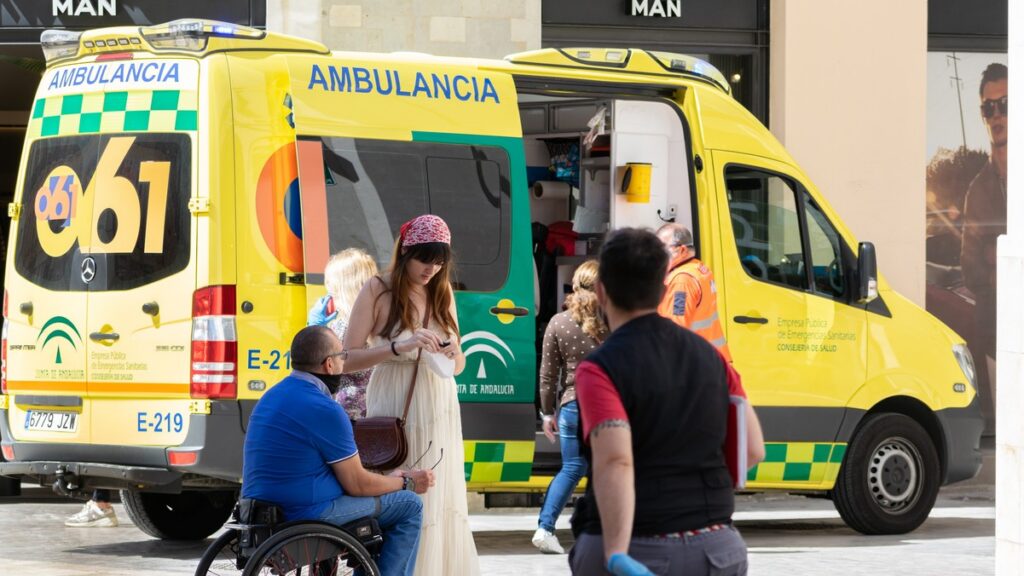
Testing of new AI system to support emergency services Credit: No-Mad / Shutterstock.com
Seconds matter when somebody suffers a heart attack or stroke. Emergency crews must assess symptoms, calculate medication doses and decide which procedures to follow, sometimes while working inside an ambulance, beside a road or in difficult terrain.
A project first developed in Malaga could give Andalucia’s 061 professionals a new way to find the clinical information they need, using an artificial intelligence assistant designed specifically for medical emergencies.
Andalucia’s 061 develops AI assistant for emergency crews
Called SAVE-EM — Support Assistant for Vital Emergencies – Enhanced Memory — the system is being developed by professionals at Andalucia’s Centro de Emergencias Sanitarias (CES) 061. SAVE-EM uses generative AI to let healthcare professionals ask questions in natural language, either written or spoken, and retrieve information relevant to an emergency. Earlier official information about the project says it incorporates natural-language processing and GPT models from OpenAI.
SAVE-EM is intended to support, rather than replace, doctors and paramedics. It is being developed as a clinical decision-support tool that makes the 061 service’s approved procedures and medical guidance easier to access while professionals are treating patients.
Malaga was the starting point for the initiative, which is intended for the wider Andalucian 061 service. Maria Jose Luque, one of the researchers leading the project, explained that emergency staff regularly work in places where documentation is not easily accessible, including ambulances, roads and even ravines.
From drug doses to stroke emergencies
Andalucia’s 061 works with more than 100 standardised processes covering clinical care and operational support. Its coordination centre handles more than 1.5 million requests annually, while emergency units attend more than 65,000 patients, over 80 per cent of whom are classified as maximum priority.
SAVE-EM could allow crews to check a clinical procedure, consult risk scales or perform calculations using a patient’s details.
One example involves calculating a medicine dose according to a patient’s weight while considering the drugs and formulations available in an ambulance. Staff could also check the criteria for activating emergency pathways involving hospitals and other medical teams.
The project team has outlined how the system could work when a 72-year-old woman suddenly develops speech difficulties and weakness on the left side of her body. Clinicians could use SAVE-EM to access the relevant stroke protocol, consult treatment recommendations and support activation of the stroke pathway and transfer to an appropriate hospital.
Can medical AI be trusted when lives are at stake?
Reliability is one of the biggest hurdles. General-purpose generative AI can sometimes produce false information with convincing confidence. Such errors carry very different consequences when an emergency professional is treating a critically ill patient.
SAVE-EM is therefore being designed to recognise when it lacks enough information to provide a reliable response rather than inventing an answer. “This tool cannot invent anything,” Luque told Malaga Hoy while explaining the safety requirement.
Researchers plan to test the prototype with around 130 or more questions to assess the reliability and safety of its answers. Advanced simulations using medical teams and mannequins are planned afterwards, allowing realistic emergency scenarios to be recreated without putting patients at risk.
Award-winning project is not yet in ambulances
Recognition has already arrived. SAVE-EM won an Ennova Health 2026 award from Diario Medico and Correo Farmaceutico in the Artificial Intelligence and Data Management category. It had previously received the Fundacion Unicaja Innovation in Biomedicine and Health award, organised with IBIMA Plataforma BIONAND, in 2025.
SAVE-EM is not currently in use in Andalucia’s ambulances, however. The technology remains under evaluation and has not been introduced into real patient care. Current funding covers stages that do not involve treating patients, while any future deployment will depend on testing and subsequent decisions.
Official 061 information published earlier this month said the project was expected to be completed in December 2026. Any move from testing to real-world emergency care has yet to be decided.
Follow Euro Weekly News on Google News
Get breaking news from Spain, travel updates, and expat stories directly on your Google News feed.
Follow on Google NewsSign up for personalised news
Subscribe to our Euro Weekly News alerts to get the latest stories into your inbox!
By signing up, you will create a Euro Weekly News account if you don't already have one. Review our Privacy Policy for more information about our privacy practices.




Lucy Ramnought
Lucy Ramnought is a local news writer and mother of 4 from the UK who has lived in the Costa Del Sol for just over 4 years. With a background in content writing and social media for various companies, and with vast experience in PA and project management, Lucy is committed to producing accurate, engaging and reliable stories to her work at Euro Weekly News.
Comments