Is your rubbish bill one of Spain’s most expensive? Check the list of cities, from €47 to €292 a year
By Harry Dennis • Published: 21 Oct 2026 • 17:09 • 4 minutes read
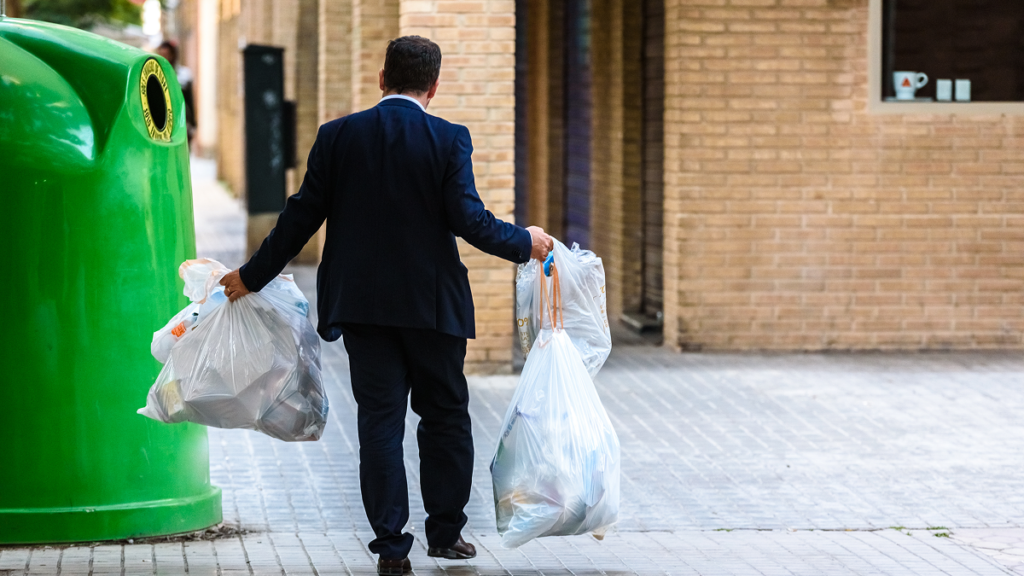
Rubbish bills vary widely from one Spanish town to the next. Credit: Rebel Red Runner / Shutterstock
Two households in near-identical flats can get rubbish bills more than six times apart just by living in different Spanish cities. A new nationwide comparison puts the charge at about €47 a year in Soria and €292 in Valencia, all because each town hall sets its own rules.
Valencia households pay more than six times what Soria does
A couple in a 75 square metre flat in Valencia are charged €292.48 a year for rubbish collection (the tasa de basuras), while the same couple in Soria would pay just €47.31. That’s a gap of about €245 for the same service, according to a Fundació ENT report covering 134 towns and cities.
Here’s the picture at a glance:
- Most expensive provincial capital: València, €292.48
- Cheapest provincial capital: Soria, €47.31
- Average household bill: about €120 a year
- Average hotel bill: €1,589 a year, with restaurants on €789
- Share of costs covered: councils are recovering about 69 per cent of what the service costs them
The 10 most expensive cities for rubbish
Valencia is a long way clear, but five cities all top €200 a year, and Palma is one of them.
| Rank | City | Annual charge |
|---|---|---|
| 1 | València | €292.48 |
| 2 | Girona | €224.56 |
| 3 | San Sebastián | €215.53 |
| 4 | Palma | €209.72 |
| 5 | Castellón de la Plana | €201.16 |
| 6 | Ourense | €181.02 |
| 7 | Murcia | €170.10 |
| 8 | Huelva | €155.81 |
| 9 | Pamplona | €152.99 |
| 10 | Madrid | €151.63 |
Palma’s €209.72 is almost three times what a household pays in Zaragoza. Madrid just scrapes into the top 10, though its bill is still almost €60 higher than Sevilla’s.
The 10 cheapest cities all sit inland
| Rank | City | Annual charge |
|---|---|---|
| 1 | Soria | €47.31 |
| 2 | Palencia | €58.45 |
| 3 | León | €62.53 |
| 4 | Cáceres | €68.29 |
| 5 | Zamora | €70.00 |
| 6 | Valladolid | €70.80 |
| 7 | Zaragoza | €72.68 |
| 8 | Toledo | €76.23 |
| 9 | Teruel | €76.30 |
| 10 | Badajoz | €77.93 |
Every city on that list is inland, in Castilla y León, Extremadura, Aragón or Castilla-La Mancha. A household in Soria pays less over a whole year than a Valencia household pays in two months.
Most Costa and island hotspots pay above the average
The average household bill is about €120 a year. Here’s how some of the places Brits and other foreign residents know best compare:
| City | Annual charge | Against the €120 average |
|---|---|---|
| Palma | €209.72 | €90 more |
| Murcia | €170.10 | €50 more |
| Madrid | €151.63 | €32 more |
| Las Palmas de Gran Canaria* | €149.33 | €30 more |
| Alicante | €142.23 | €23 more |
| Barcelona | €136.68 | €17 more |
| Almería | €132.15 | €13 more |
| Málaga | €129.41 | €10 more |
| Santa Cruz de Tenerife | €122.48 | €3 more |
| Granada | €97.02 | €23 less |
| Sevilla | €94.28 | €25 less |
*Las Palmas de Gran Canaria appears in the report, although its charge is now being refunded after a court ruled it unlawful.
Hotels and restaurants pay far more than homes
Businesses face a much heavier bill, and it grows with the size of the town. These are simple averages for a set of standard businesses in the places studied:
| Business | Average across all towns | Average in places of more than 50,000 people |
|---|---|---|
| Hotel (three stars, 72 rooms) | €1,589 | €2,238 |
| Supermarket | €1,034 | €1,303 |
| Restaurant | €789 | €1,125 |
| Bank branch | €565 | €773 |
| Bar | €544 | €726 |
| Hairdressers | €239 | €276 |
- The highest restaurant bill in the whole sample is €9,232, and it’s in Valencia.
- The highest hotel bill among the largest cities is €10,707, in Las Palmas de Gran Canaria.
- A restaurant in a village of fewer than 1,000 people averages €402, about a third of the big-city figure.
Why the same rubbish costs so much more in some cities
There’s no national formula for working out the charge, as each council passes its own ordinance and picks its own way of calculating the bill. Councils were told to bring in a dedicated rubbish charge by April 2025 to cover what the service costs, and they’ve budgeted €5.7bn for it this year while expecting to raise €3.9bn through the charge. Here’s what the bills are based on:
- Based on a flat fee for every home: 32.8 per cent of towns
- Where the home is: 23.9 per cent
- Property value: 12.7 per cent, using the cadastral value (the official valuation used for property tax)
- How many people live there: 11.2 per cent
- How big the home is: 10.4 per cent
- How much rubbish a household throws away or sorts: just 3 per cent, which is four of the 134 towns
How to check, and maybe cut, your own bill
Some councils knock money off for recycling, so it’s worth knowing what yours offers. Among the towns in the report:
- Composting: 19.4 per cent of towns give a discount, including Almería, Málaga, Burgos, Segovia and Valladolid
- Sorting rubbish properly: 18.7 per cent, with San Sebastián giving discounts to card holders who make a minimum number of food waste deposits each month
- Using the punto limpio (the local recycling centre): 18.7 per cent, including Sevilla, València, Girona and Bilbao
For Brits used to bin collection being folded into council tax, a separate bill can come as a shock. However, not every town is heading upwards, with Torremolinos voting to cut its bin tax by 12.5 per cent from January 2027.
Remember that all these figures are for a standard two-person flat with no discounts, so your own bill could land higher or lower. So before the next one arrives, you can find your town hall’s rubbish ordinance on its website, check how the charge is worked out, and ask whether any of these discounts apply to you.
Follow Euro Weekly News on Google News
Get breaking news from Spain, travel updates, and expat stories directly on your Google News feed.
Follow on Google NewsSign up for personalised news
Subscribe to our Euro Weekly News alerts to get the latest stories into your inbox!
By signing up, you will create a Euro Weekly News account if you don't already have one. Review our Privacy Policy for more information about our privacy practices.




Harry Dennis
Born in the UK and raised on the Cádiz coast, Harry brings his background in design, music, and photography to his writing for Euro Weekly News, sharing stories that celebrate culture and lifestyle across Spain and beyond.
Comments