Glasgow museum removes Egyptian mummies because the dead had never given consent
By Adam Woodward • Updated: 01 Nov 2026 • 9:31 • 2 minutes read
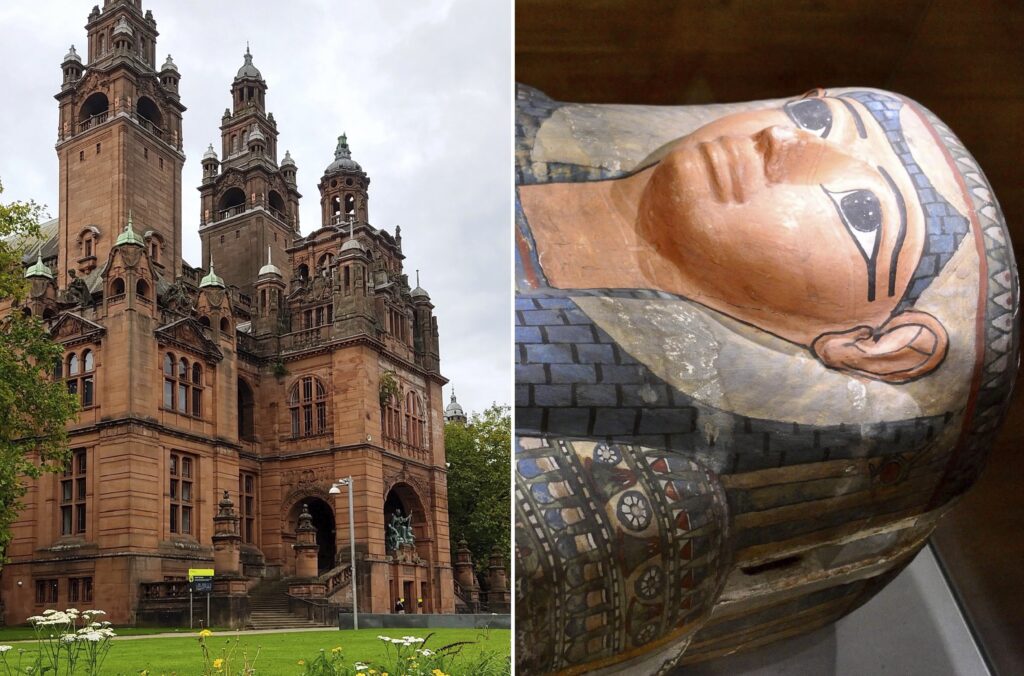
Historic remains of Nekht, an Egyptian priest. Credit: KAG FB
Kelvingrove Art Gallery and Museum in Glasgow has taken several ancient Egyptian human remains off public display after deciding the people involved never gave permission to be shown.
Visitors now find empty cases and a simple notice reading: “We have removed human remains from this display as a mark of respect.” Staff at Glasgow Life, the organisation that runs the museum, explained the move follows a draft policy that only allows human remains on show when there is documented, informed consent from the deceased person or, in some cases, their descendants. Without that paperwork, it’s impossible for people who died thousands of years ago, to have said ‘yes I agree to have my remains on public display in a museum.’ So, the remains stay in storage.
Items taken down include the painted coffin and body of Nekht, an Egyptian priest from the Middle Kingdom period who lived between roughly 1985 and 1797 BC. His remains, excavated at Beni Hasan and given to Glasgow in 1923, had been on view for generations. A mummified right hand recovered from the Valley of the Kings in Luxor, plus a mummified male head and right foot, have also gone. Kelvingrove draws more than 1.3 million visitors a year, so the change is hard to miss.
What brought about the decision
Glasgow Life pointed to the International Council of Museums’ revised Code of Ethics, published in June 2026. The updated guidance tells museums to “uphold the inherent dignity of human remains and promote respect for their significance.”
Decisions about such material should involve descendants or communities of origin when those groups can be identified. A 2025 report from the UK’s All-Party Parliamentary Group on Afrikan Reparations also raised concerns about displaying Egyptian mummies without any form of consent, describing the practice as a disregard for the wishes of the people originally buried.
Scottish Conservative MSP Murdo Fraser called the move “woke madness at its most ridiculous.” He added that Egyptian mummies were now being cancelled by a society so focused on modern sensibilities that it had lost perspective. People go to museums to learn about ancient civilisations, he argued, not to find history tucked away because it fails today’s standards.
Similar moves elsewhere in Britain
Manchester Museum made a comparable choice in September 2026 when it removed the mummified body of Asru, an Egyptian woman who had been on display in the city almost continuously since 1825. Curators said the decision matched what they understood of her own wishes and of elite Egyptian practices of the time, which expected mummified bodies to stay wrapped and out of sight. They had consulted Egyptian colleagues, members of the diaspora and visitors before acting. At Glasgow’s Hunterian Museum, the body of Lady Shep-En-Hor is now covered by a specially made textile so visitors cannot see her, though her ornate sarcophagus is still on view. Staff said she “deserved privacy in death” after consulting Egyptologists.
National Museums Scotland has said it has no plans to remove its Egyptian mummies, arguing they stay on display only when they help tell a clear story. The British Museum continues to show mummified people as well. Both museums in Glasgow have indicated they would consider repatriation if Egypt or another appropriate body requested it.
Readers interested in Egyptian finds can look at earlier Euro Weekly News coverage of King Tutankhamun’s full treasure collection heading to the Grand Egyptian Museum and the discovery of Pharaoh Thutmose II’s tomb. Full details of the Glasgow decision appear in BBC News reporting, while the Manchester case is covered here.
Follow Euro Weekly News on Google News
Get breaking news from Spain, travel updates, and expat stories directly on your Google News feed.
Follow on Google NewsSign up for personalised news
Subscribe to our Euro Weekly News alerts to get the latest stories into your inbox!
By signing up, you will create a Euro Weekly News account if you don't already have one. Review our Privacy Policy for more information about our privacy practices.



Adam Woodward
Adam is a writer who has lived in Spain for over 25 years. With a background in English teaching and a passion for music, food, and the arts, he brings a rich personal perspective to his work at Euro Weekly News. As a father of three with deep roots in Spanish life, Adam writes engaging stories that explore culture, lifestyle, and the everyday experiences that shape communities across Spain.
Comments