Halloween unrest: Spain prevents riots as violence hits France and Germany
By Adam Woodward • Published: 01 Nov 2026 • 8:28 • 5 minutes read
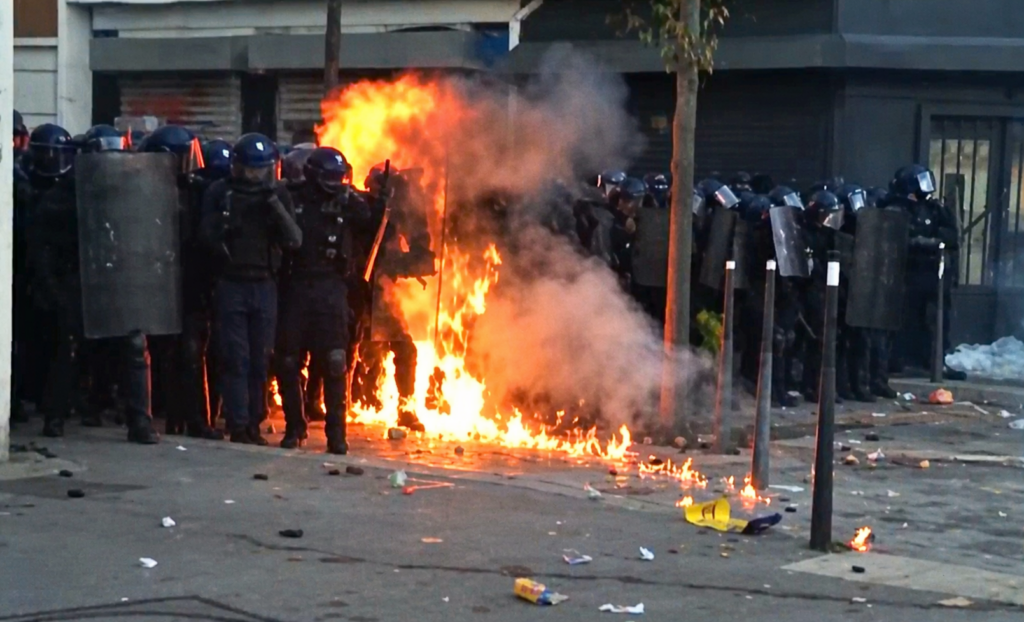
Police in Paris had to deal with petrol bombs. Credit: Viral images X
Spain has escaped the widespread Halloween looting feared by police after a major nationwide security operation, but violence broke out in France and Germany as demonstrations continued across Europe.
Spanish police identified more than 1,000 people and made at least 11 arrests during Saturday night’s operation targeting suspected organisers and participants linked to the Blocus movement.
Meanwhile, Germany experienced serious disturbances after largely peaceful youth demonstrations, with shops looted in Frankfurt and police attacked in several cities. France also saw fresh clashes following another weekend of demonstrations involving hundreds of thousands of people.
Although the countries share concerns about living costs, housing, education and public services, the protests are not all connected to one organisation or coordinated European campaign.
Spain: Police prevent widespread Halloween looting
Spain’s major Halloween security operation appears to have prevented the widespread disturbances authorities had feared following last weekend’s violence in Barcelona.
‼️⚠️ En lo que llevamos de tarde ya han detenido a más de 450 personas en Barcelona #blocus https://t.co/CFv395nvzp
— Maria 🩷 (@maariaprv) October 31, 2026
More than 1,000 people were identified and at least 11 arrested during Saturday’s nationwide operation, according to reporting published on Sunday morning by El Español. Police seized dozens of potentially dangerous objects, including knives and balaclavas, while security measures were reinforced in major cities.
Barcelona and Madrid were among the locations where police restricted access to central areas and monitored groups of young people following online calls for gatherings. The operation followed serious disturbances on October 24, when groups of young people looted businesses, smashed shop windows and clashed with police in Barcelona.
Investigators subsequently turned their attention to Blocus, a movement whose name appeared in online calls encouraging gatherings and alleged acts of vandalism.
On Friday, October 30, the Guardia Civil arrested a 20-year-old in Picanya, Valencia province, described by investigators as the alleged founder and main driving force behind Blocus in Spain.
The Spanish Interior Ministry also confirmed separate arrests in Malaga, Fuengirola, Marbella, Tenerife and Bilbao involving people suspected of promoting looting, sabotage and violence.
The Malaga arrest was particularly relevant to Costa del Sol residents. A 20-year-old was detained over alleged calls to loot businesses in Malaga city, Fuengirola and Marbella during Halloween night.
Although the police operation prevented further spread of a call to violence, and after many shops and businesses boarded up their windows, potential rioters appear to have been dissuaded from carrying out their threats. Investigations into the online networks and alleged organisers are continuing.
France: 320,000 protesters take to the streets as clashes erupt
France experienced another major day of demonstrations on Saturday, October 31, with the Interior Ministry estimating that approximately 320,000 people took part nationwide. Around 70,000 demonstrators gathered in Paris, although the overall turnout was lower than the previous two weekends.
The demonstrations began with students protesting against deteriorating school facilities, teacher shortages and education funding. They have since attracted trade unions and other groups angry about living costs, housing and public services. Most authorised marches proceeded peacefully, but tensions increased when demonstrations dispersed.
Police used tear gas and carried out charges against groups in Paris, Lyon, Toulouse and Marseille. Authorities said they had prevented more radical groups from breaking away from the main demonstrations to carry out looting and vandalism. The government had deployed approximately 70,000 police officers and gendarmes to deal with the security threat.
The demonstrations followed serious disturbances on October 17, when masked groups smashed shop windows, set vehicles alight and attacked public buildings.
Businesses have suffered substantial losses during the unrest, with the French retail sector estimating the damage from several weeks of disturbances at more than €1 billion.
Germany: Frankfurt shops looted as youth protests turn violent
Germany has experienced some of the most serious overnight disturbances, despite the majority of Saturday’s demonstrations initially passing peacefully. Thousands of young people took part in demonstrations organised under the Gen Z regelt banner, which translates roughly as ‘Gen Z takes charge’.
Rallies were held in 34 cities, including Berlin, Frankfurt and Munich, with participants demanding better education, affordable housing, improved public services and greater investment in climate protection. The campaign has also attracted opposition to plans to reintroduce compulsory military service.
However, trouble erupted in Frankfurt after the main demonstrations. Masked groups smashed shop windows and looted at least two businesses, stealing trainers and other goods. A gun shop was also attacked, prompting police intervention. Officers recovered two weapons from the premises.
🇩🇪🇩🇪🇩🇪👇🏾
Last night in Frankfurt, Germany looked like France: masked rioters smashed shop windows, looted stores (including a gun shop), set bins and barricades alight, and threw Molotov cocktails at the police… https://t.co/dNcvVpzAk1
— ‘Seeing is believing’ (@dave24144975) November 1, 2026
Police reported that officers were attacked with stones, bottles, fireworks and other projectiles. Several officers were injured.
In Cologne, disturbances included attacks on police and thrown objects, while Hamburg experienced burning barricades and further confrontations. Water cannon were deployed during the unrest. German authorities said the majority of demonstrators had behaved peacefully, with smaller groups responsible for the violence.
Netherlands: Police prepare for trouble but major violence fails to materialise
The Hague experienced an increased police presence after online calls for demonstrations and fears that Halloween could bring further looting. Like in Spain, Many businesses boarded up their windows, while officers carried out checks on groups of young people dressed in black.
However, the situation remained relatively calm during Saturday afternoon, with no major disturbances reported in the latest available coverage.
The Netherlands has been among the countries where online calls for demonstrations have circulated, but there is no evidence of widespread Halloween-related violence.
Italy: Police remain alert after earlier clashes
Italy has also experienced demonstrations and confrontations during the wider European protest movement. Cities including Milan, Turin and Bologna have seen unrest, with police monitoring further gatherings.
Protests have focused on living costs, wages, education and public services, alongside opposition to government policies. However, the latest reporting does not establish a comparable nationwide Halloween security operation or widespread Halloween-night looting in Italy.
Why are young people protesting across Europe?
Although the demonstrations are organised separately, several common grievances have emerged. Rising living costs, unaffordable housing, deteriorating education facilities and dissatisfaction with public services are among the issues bringing younger demonstrators onto the streets. In Germany, opposition to compulsory military service has also become a central issue.
Spain’s Blocus investigation is somewhat different, with police alleging that some online groups used the appearance of student demonstrations to encourage looting, sabotage and attacks on businesses. Authorities across Europe are continuing to monitor social media activity and possible further gatherings.
For now, the biggest overnight development is the contrast between Spain, where the feared widespread Halloween looting failed to materialise, and Germany and France, where further violence accompanied the demonstrations.
Follow Euro Weekly News on Google News
Get breaking news from Spain, travel updates, and expat stories directly on your Google News feed.
Follow on Google NewsSign up for personalised news
Subscribe to our Euro Weekly News alerts to get the latest stories into your inbox!
By signing up, you will create a Euro Weekly News account if you don't already have one. Review our Privacy Policy for more information about our privacy practices.





Adam Woodward
Adam is a writer who has lived in Spain for over 25 years. With a background in English teaching and a passion for music, food, and the arts, he brings a rich personal perspective to his work at Euro Weekly News. As a father of three with deep roots in Spanish life, Adam writes engaging stories that explore culture, lifestyle, and the everyday experiences that shape communities across Spain.
Comments