Looting and street violence hit Barcelona as El Corte Inglés customers are trapped
By Molly Grace • Published: 24 Oct 2026 • 23:47 • 3 minutes read
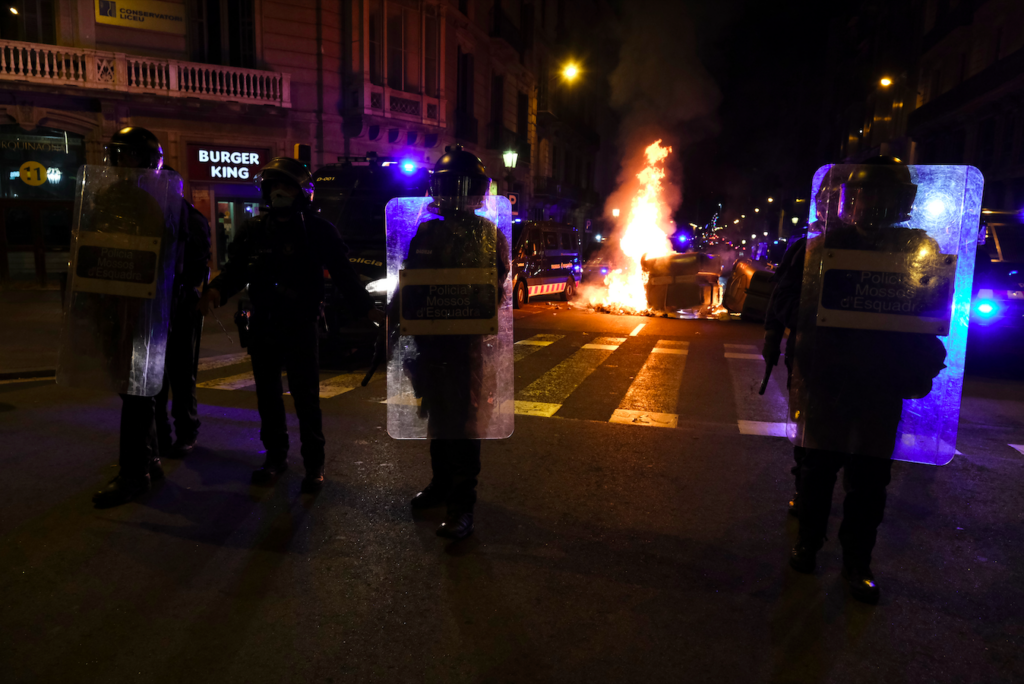
The Mossos d’Esquadra and Barcelona’s Guàrdia Urbana deployed more than ten police units. Photo credit: Alexandros Michailidis/Shutterstock
Barcelona’s city centre became a very different place on Saturday evening as a student protest against ‘the system’ descended into violence. Anyone heading into the centre to shop, eat out or enjoy an evening in the city faced a situation involving burning bins, looting, clashes with police and shops closing their doors, with El Corte Inglés among the businesses caught up in the unrest.
The demonstration began with young people gathering in Plaça de Catalunya under the slogan ‘Against the system, schools in struggle’. Called Instituts Indignats and organised through social media, it was inspired by the Lycées Indignés student movement in France. Rising housing costs and demands for better living conditions were among the grievances behind the gathering, which had not been formally notified to the authorities.
Fires, smashed street furniture and looted shops in Barcelona
By early evening, the protest had turned violent. Groups of demonstrators, many dressed in black with their faces covered, threw stones at bus shelters and set off fireworks and flares. Rubbish bins were set alight, parked motorbikes were knocked over and a barricade made from bins and motorcycles was set on fire near Carrer de Bergara and Plaça de Catalunya. Bus shelter glass was smashed and a traffic light damaged.
The damage was not confined to street furniture. Groups moved through nearby streets, including La Rambla and Portal de l’Àngel, where shops were targeted and some were looted. Businesses that had expected an ordinary Saturday trading day instead found themselves shutting their doors or protecting their windows as the unrest spread through the shopping district.
The Mossos d’Esquadra and Barcelona’s Guàrdia Urbana deployed more than ten police units as the situation escalated. Officers moved through the square and nearby streets, pursuing groups who scattered after police intervention. Stones and other objects were thrown at officers, and riot police carried out charges to disperse demonstrators.
El Corte Inglés closes as customers remain inside
El Corte Inglés in Plaça de Catalunya was among the businesses that closed as the unrest intensified. Catalan news outlet Nació reported that customers were still inside when the department store shut its doors. Other retailers in the area also lowered their shutters or took precautions to protect their premises as fears of further damage and looting grew.
The closure came as groups moved through the shopping district and reports of looting emerged. However, the available reporting does not establish how long customers remained inside El Corte Inglés, whether they could leave through another exit or when everyone was able to get out.
Police restricted access to the surrounding streets, closing off parts of the area between Plaça d’Universitat and Plaça d’Urquinaona. Access to the central metro station was also restricted, although transport services continued running without stopping there. The measures affected one of Barcelona’s busiest shopping and transport hubs on a Saturday evening.
Interior de El Corte Inglés de Plaza Cataluña. La gente no puede salir a la calle.
¿Qué pasa? ¿Es este el país seguro del que presume el autócrata Pedro Sánchez? https://t.co/ZnlZbdSOGT— J. Simón 🇪🇸 ##SanchismoNoGracias (@mehuelea) October 24, 2026
Police move in as the crowds scatter
The Mossos d’Esquadra and Barcelona’s Guàrdia Urbana deployed more than ten police units as the situation escalated. Officers moved through the square and nearby streets, pursuing groups who scattered after police intervention. Stones and other objects were thrown at officers, and riot police carried out charges to disperse demonstrators. The scale of the disorder grew as the evening went on. El País reported that close to 100 people had been detained, while shops and restaurants across the centre closed to avoid further damage. Firefighters were called to deal with fires, and police urged people to stay away from the area.
The unrest happened beside a separate encampment supporting the right to housing, which has occupied part of Plaça de Catalunya for weeks. Organisers of that protest distanced themselves from the violence, saying they did not want their peaceful campaign to be associated with the destruction taking place nearby. The two gatherings shared the same square but were separate demonstrations. Catalan president Salvador Illa condemned the violence while defending the right to protest. His message was that demonstrating is a democratic right, but attacking people, intimidating others and damaging property are not.
Barcelona joins the wave of European protests
The Barcelona gathering came as demonstrations over living costs, housing, education and public services have spread across Europe. In France, student protests over school conditions and teacher shortages have fed into wider anger over the cost of living. Belgium has also seen clashes during demonstrations over austerity and education, while protests in Italy have focused on prices, wages and public services. In Portugal, housing costs and pressure on household budgets have drawn thousands into the streets.
These are separate movements, not one coordinated European protest. But the issues behind them overlap: people are struggling with the cost of essentials, young people face barriers to finding affordable homes, and many feel that their concerns are not being addressed. In Barcelona, those grievances were the backdrop to Saturday’s demonstration. The fires, looted shops and clashes that followed left businesses closing early and parts of the city centre restricted as police worked to restore order.
Follow Euro Weekly News on Google News
Get breaking news from Spain, travel updates, and expat stories directly on your Google News feed.
Follow on Google NewsSign up for personalised news
Subscribe to our Euro Weekly News alerts to get the latest stories into your inbox!
By signing up, you will create a Euro Weekly News account if you don't already have one. Review our Privacy Policy for more information about our privacy practices.



Molly Grace
Molly is a British journalist and author who has lived in Spain for over 25 years. With a background in animal welfare, equestrian science, and veterinary nursing, she brings curiosity, humour, and a sharp investigative eye to her work. At Euro Weekly News, Molly explores the intersections of nature, culture, and community - drawing on her deep local knowledge and passion for stories that reflect life in Spain from the ground up.
Comments