Renting in Spain? Rents are up 5.6% in a year, so see what a flat costs in your city
By Harry Dennis • Published: 05 Nov 2026 • 16:30 • 3 minutes read
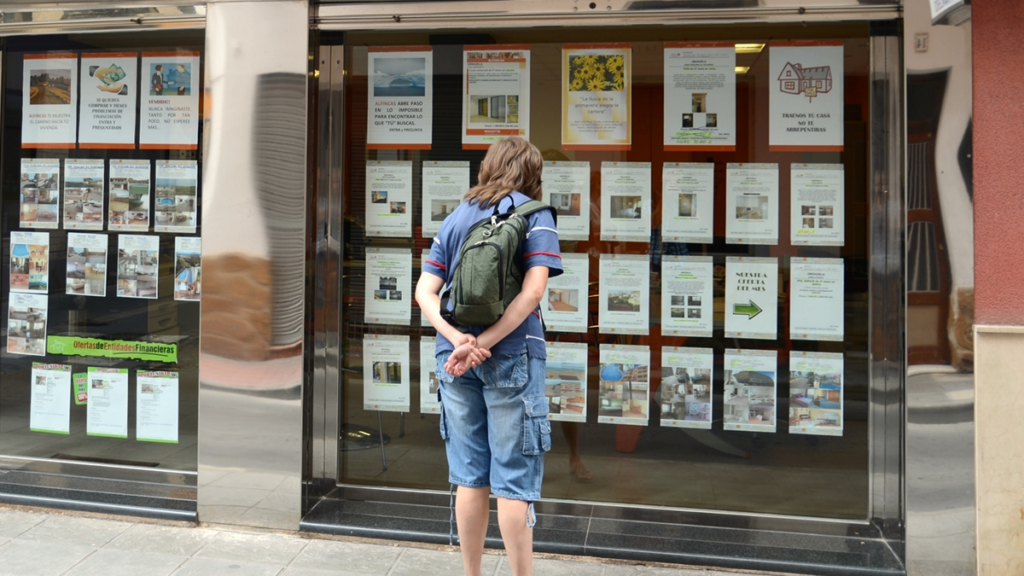
Rents are rising in 48 of Spain’s 50 provinces. Credit: Free Wind 2014 / Shutterstock
Rents are higher than a year ago in 48 of Spain’s 50 provinces, with a flat in Madrid costing almost three times as much per square metre as one in Cáceres. The national average has stopped climbing from month to month, though, holding at €15.10 a square metre for the third month running.
Rents have held at €15.10 a square metre for three months
Tenants across Spain are paying an average of €15.10 per square metre a month, according to idealista’s October figures. That’s the same price for the third month running, with the monthly change at just 0.1 per cent.
However, rents are still 5.6 per cent higher than they were a year ago. On an 80 square metre flat, the national average works out at about €1,200 a month.
It’s worth knowing that idealista updated its method in July, and its index now leaves out seasonal and holiday lets.
Madrid is the most expensive capital at €23.40 a square metre
Madrid tops the list, followed by Barcelona and Palma, while Cáceres, Zamora and Jaén cost less than half as much as Palma. Here’s how the main capitals compare, with the monthly figure our own calculation for an 80 square metre flat.
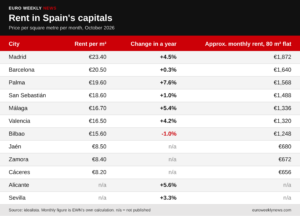
Palma has seen the biggest jump of the main cities at 7.6 per cent, with Alicante (5.6 per cent) and Málaga (5.4 per cent) not far behind. Barcelona rents have barely moved, and Bilbao is the only one of the main capitals where they’ve fallen.
Málaga is the third most expensive province in Spain
Málaga province comes in at €18.80 a square metre, behind only Madrid and the Balearics. Here are the most and least expensive provinces:
- Most expensive: Madrid (€21.60), Baleares (€20.60), Málaga (€18.80), Barcelona (€17.40), Guipúzcoa (€16.10) and Santa Cruz de Tenerife (€15.30).
- Cheapest: Jaén (€7.00), followed by Ciudad Real, Cáceres and Badajoz (all €7.70).
Huesca, Huelva and Palencia are seeing the sharpest rises
The biggest increases aren’t in the glamorous places. Among capitals, these are the top five:
- Huesca: +19.7%
- Huelva: +13.1%
- Palencia: +12.7%
- Pontevedra: +12.5%
- Castellón de la Plana: +12.0%
Across whole provinces, Huesca (+12.1 per cent) also leads, followed by Toledo (+11.5 per cent) and Cuenca (+10.8 per cent). Only Guipúzcoa (-1.4 per cent) and Álava (-1.1 per cent) saw rents drop.
Castilla-La Mancha leads the rises among the regions
Here’s how every region compares, ranked by the rise over the last 12 months.
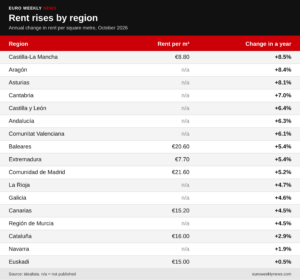
In the regions most popular with British residents, Andalucía (+6.3 per cent) and the Comunidad Valenciana (+6.1 per cent) are rising faster than the national average. Baleares (+5.4 per cent) and Canarias (+4.5 per cent) are rising more slowly, although both are still among the dearest places to rent.
Rent takes 39 per cent of the average family’s income
Renting a two-bedroom flat takes 39 per cent of net household income across Spain, according to idealista data for the third quarter, reported by El Español. Experts generally recommend spending no more than 30 per cent.
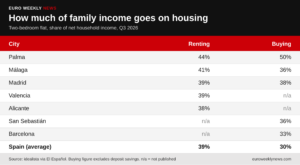
Palma is the most stretched city for both renters and buyers, with buying a flat there taking half of a family’s income. The buying figures don’t include the savings needed upfront for a deposit either.
If you’re already renting and thinking of moving, our guide to whether expats should switch rental property in 2026 is a good place to start. Either way, it’s worth working out what share of your take-home pay the rent would swallow before you sign or renew a contract.
Follow Euro Weekly News on Google News
Get breaking news from Spain, travel updates, and expat stories directly on your Google News feed.
Follow on Google NewsSign up for personalised news
Subscribe to our Euro Weekly News alerts to get the latest stories into your inbox!
By signing up, you will create a Euro Weekly News account if you don't already have one. Review our Privacy Policy for more information about our privacy practices.



Harry Dennis
Born in the UK and raised on the Cádiz coast, Harry brings a creative eye to his writing, sharing stories that celebrate culture and lifestyle across Spain and beyond.
Comments