Deadly fog causes Bulgaria’s largest motorway pile-up as 86 vehicles crash, 12 dead
By Molly Grace • Published: 10 Nov 2026 • 19:24 • 3 minutes read
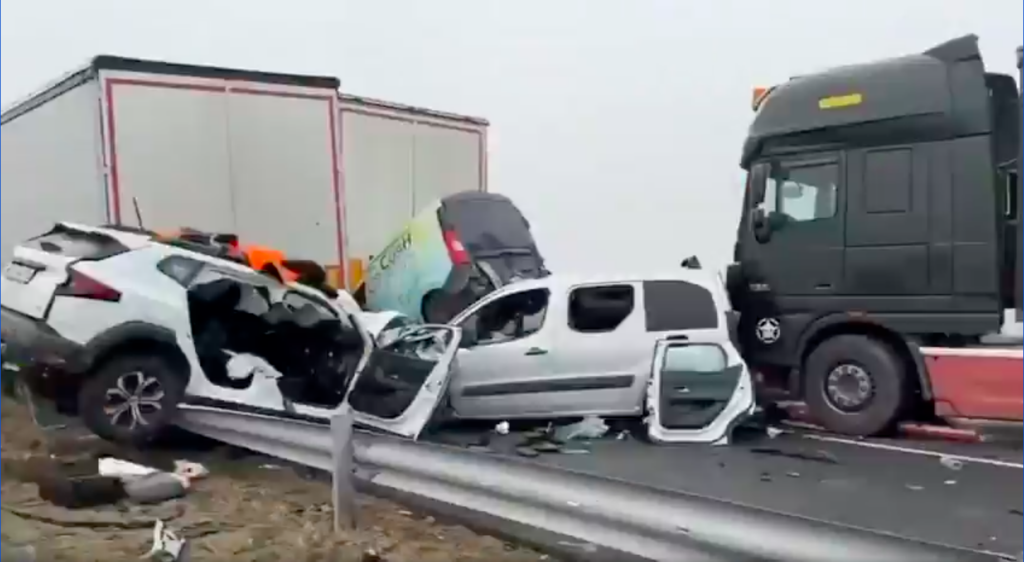
The collisions continued as vehicles approached the scene in poor visibility. Photo credit:@volkova_ma57183 on X
Thick fog can be every driver’s nightmare, but when it descends without warning, the danger is even greater. With visibility suddenly reduced to just a few metres, there may be no time to brake or avoid the traffic ahead. That is what happened on Bulgaria’s Trakia Motorway, where dozens vehicles were caught up in two devastating pile-ups.
The wreckage stretched across both carriageways of the motorway linking Sofia with the Black Sea port of Burgas. Cars and lorries were crushed together, emergency crews had to fight their way into the pile-ups, and the route was closed in both directions as rescuers worked to reach those trapped.
Fog turns motorway into scene of mass collision
The first emergency call was received at around 7.10am local time on Tuesday, November 10. The crashes happened near the Zimnitsa junction in the Yambol region, in southeastern Bulgaria. A total of 86 vehicles were involved. Sixty-three were caught in the pile-up on the carriageway towards Burgas, while another 23 were involved in a separate collision on the opposite side, heading towards Sofia.
Officials said visibility had initially been between 70 and 80 metres before suddenly dropping to around 10 metres. The fog arrived quickly, leaving drivers with little warning of the stationary or slowing traffic ahead. The road surface was also wet, adding to the difficulty of stopping safely.
First collision involved lorry and passenger bus
According to the initial account from the Interior Ministry, the first crash began on the Burgas-bound carriageway when a lorry blocked the path of a passenger bus. A second lorry, which was carrying grain, then became involved, followed by further vehicles crashing into the wreckage.
The collisions continued as vehicles approached the scene in poor visibility. A second chain-reaction crash developed on the opposite carriageway, where investigators believe some drivers may have become distracted by the disaster unfolding across the central reservation.
All the reported fatalities occurred on the side heading towards Burgas. Authorities have stressed that the precise causes are still being investigated, although the sudden fog, wet conditions and driving speeds unsuitable for the weather are among the factors being examined.
Drone footage reveals the horrifying scale of the tragedy on Bulgaria’s Trakia Motorway. Over 50 vehicles, including cars and trucks, were involved in the massive pile-up, leaving at least 12 people dead and dozens injured. One of Bulgaria’s deadliest road disasters. 😭 https://t.co/NfyVJyGotH
— една българка (@transbulgaria) November 10, 2026
Rescue teams work among wrecked vehicles
The scale of the crash required a major emergency operation. Police, firefighters and medical teams from neighbouring regions were sent to the scene, with 15 fire engines and hundreds of police officers involved in the response. Rescuers had to remove sections of the crash barriers to reach some of the injured. The fog also prevented helicopter evacuations, complicating efforts to move casualties quickly.
Injured people were taken to hospitals in Yambol, Sliven and Burgas, with several requiring intensive care and emergency surgery. The latest figures released on Tuesday afternoon put the death toll at 12, while around 50 people had been injured. Officials had warned earlier that the number of casualties could change as hospitals continued treating those involved.
Bulgaria declares national day of mourning
Prime Minister Rumen Radev visited the scene and described the crashes as a tragedy for the country. The government announced that Wednesday, November 11, would be a national day of mourning for those who died.The scale of the disaster also disrupted official engagements. Radev cancelled scheduled events, while European Commission President Ursula von der Leyen, who was visiting Bulgaria, shortened her trip and expressed condolences to the victims and emergency crews.
Two separate investigations have been opened because the crashes occurred on opposite carriageways. The National Investigation Service is expected to take over the enquiries, with investigators examining how the first collision developed and why the second pile-up followed.
The tragedy has also renewed questions about warnings for drivers in areas where fog regularly forms. Officials have raised the possibility of improving road markings and installing more reflective measures to make dangerous stretches easier to navigate when visibility deteriorates. For now, investigators must establish exactly how a sudden change in weather turned a busy motorway into Bulgaria’s worst multi-vehicle disasters.
Follow Euro Weekly News on Google News
Get breaking news from Spain, travel updates, and expat stories directly on your Google News feed.
Follow on Google NewsSign up for personalised news
Subscribe to our Euro Weekly News alerts to get the latest stories into your inbox!
By signing up, you will create a Euro Weekly News account if you don't already have one. Review our Privacy Policy for more information about our privacy practices.


Molly Grace
Molly is a British journalist and author who has lived in Spain for over 25 years. With a background in animal welfare, equestrian science, and veterinary nursing, she brings curiosity, humour, and a sharp investigative eye to her work. At Euro Weekly News, Molly explores the intersections of nature, culture, and community - drawing on her deep local knowledge and passion for stories that reflect life in Spain from the ground up.
Comments