Strike in Spain: Workers protest cost of living while others refuse stoppage
By Adam Woodward • Published: 11 Nov 2026 • 15:06 • 4 minutes read
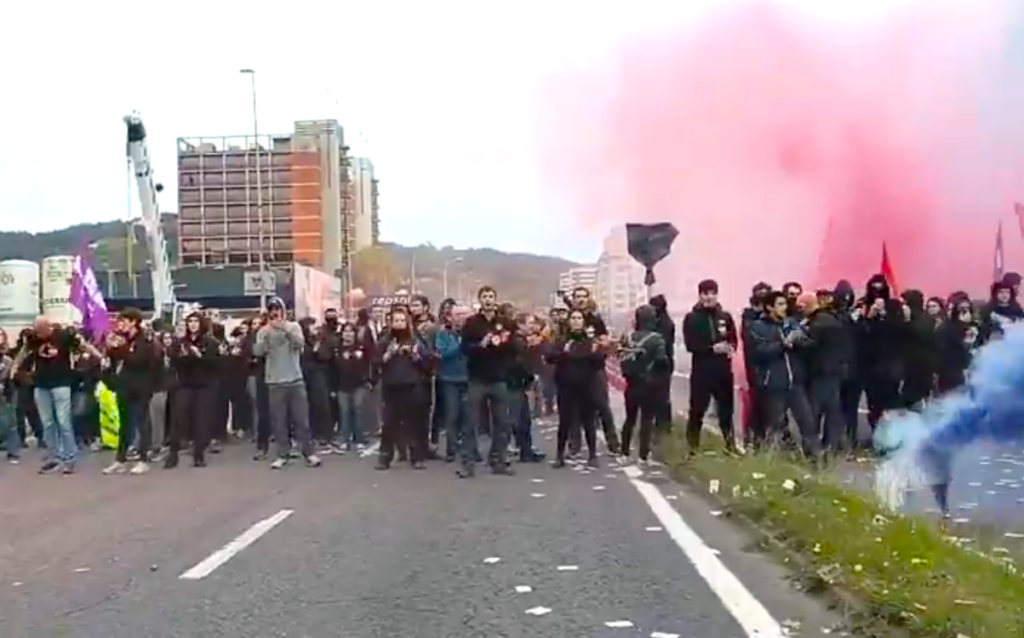
Strikers blocking roads. Credit: nacho X
Spain is experiencing its first general strike in 14 years today, Wednesday, November 11, as workers, housing campaigners and trade unions take to the streets.
They demand action over unaffordable homes, falling purchasing power and the rising cost of living. The 24-hour stoppage, organised by Spain’s two largest trade union confederations, CCOO and UGT, has brought pickets, workplace closures and demonstrations to cities across the country. However, early reports suggest that participation has varied considerably between industries and regions.
The strike is being held under the slogan ‘Wages, housing and prices’, reflecting growing frustration over the amount of household income being swallowed up by rent, mortgages and everyday expenses.
Why are Spaniards going on strike?
Unlike many traditional general strikes, the November 11 action did not begin with a dispute over a particular employment law or government decision. Its origins lie in Spain’s growing housing crisis and a wave of public anger following the eviction of 87-year-old Maricarmen Abascal from her Madrid home in September. She died in hospital in October, shortly after the eviction, and her case became a rallying point for housing campaigners.
The Tenants’ Union and other housing organisations subsequently called for a general strike, with the two major unions eventually backing the action.
Their demands include:
- More affordable rents and stronger protection for tenants.
- Greater investment in publicly owned social housing.
- Action against property speculation and large investment funds.
- Better wages and protection against rising living costs.
- A new national agreement on collective wage increases.
- Improved funding for public services, including healthcare and education.
Union leaders argue that wage increases mean little when housing costs continue to consume an ever-larger proportion of workers’ earnings.
How many workers are taking part?
The early participation figures released by the unions suggest particularly strong support in manufacturing, ports and certain industrial sectors. However, figures from government departments and public administrations paint a rather different picture in some areas.
The latest reported figures include:
- 90 per cent: Participation claimed by unions in automotive factories and at the ports of Valencia and Algeciras.
- 85 per cent: Reported participation in meat-processing industries.
- 82 per cent: Reported participation in rubbish collection.
- More than 60 per cent: The unions’ estimate of overall participation in Malaga province.
- Just 2.4 per cent: The Junta de Andalucia’s figure for teachers striking in Malaga.
- Just 3.81 per cent: The official figure for morning-shift healthcare workers striking in Malaga.
- Just 10 per cent: The reported reduction in electricity demand during the strike, an indication of reduced industrial activity.
The union figures are their own estimates and have not been independently verified across the country. The government figures relate to specific public-sector workforces rather than the entire provincial workforce.
Demonstrations and clashes across Spain
The strike has also brought confrontations between demonstrators and police in several locations. In Malaga, officers intervened at bus depots after pickets blocked access, while Barcelona experienced road blockages and disruption to commuter rail services.
Nationally, at least 27 arrests had been reported during the first 12 hours, according to Wednesday’s coverage, with incidents involving pickets, police and blocked roads.
Afternoon demonstrations have been organised in more than 130 places. In areas popular with foreign residents, marches are planned in Malaga, Alicante, Elche, Murcia, Cartagena and Palma, among other towns and cities.
Public transport has continued to operate under legally required minimum-service arrangements, meaning that some demonstrators have been able to use buses and trains to reach rallies despite transport workers also being called upon to strike. Spain’s official minimum-service orders for the November 11 stoppage explain how essential operations are protected during the industrial action.
For a closer look at the early disruption, see EWN’s report on clashes and transport problems during the general strike.
La huelga es esto: el “derecho” de dos docenas de violentos a agredir (esto es una agresión) a un anciano que camina con andador hasta echarlo de la cafetería donde está leyendo el periódico.
La noche de la purga, pero en formato sindical. https://t.co/W1NF7BaADS
— Cristian Campos (@crpandemonium) November 11, 2026
Why is the strike happening now?
The timing is politically significant, coming just 18 days before Spain’s November 29 general election. Prime Minister Pedro Sanchez has been in office since 2018, meaning his administration has had more than eight years to address many of the problems now being raised by protesters. His government introduced housing legislation and other measures, but campaigners argue that these have not gone far enough to make homes affordable.
The unions insist their demands are directed at all levels of government, rather than simply targeting Sanchez. They want whoever takes office after the election to commit to tackling housing costs, wages and living standards.
The opposition has questioned the timing of the strike, suggesting that it could influence the election campaign. Meanwhile, several professional and sector-specific unions, including the train drivers’ union Semaf, have declined to support the action.
Whether today’s stoppage will translate into lasting political change remains to be seen. However, the demonstrations underline how housing affordability and the cost of living have become major issues for workers and families across Spain.
In other news, he okey cokey seems popular in Barcelona.
La Huelga General en Barcelona es un jodido MEME
https://t.co/OGAmjQd4H5— Anonymous Tabarnia 🃏 (@Anonymous_TA) November 11, 2026
Follow Euro Weekly News on Google News
Get breaking news from Spain, travel updates, and expat stories directly on your Google News feed.
Follow on Google NewsSign up for personalised news
Subscribe to our Euro Weekly News alerts to get the latest stories into your inbox!
By signing up, you will create a Euro Weekly News account if you don't already have one. Review our Privacy Policy for more information about our privacy practices.



Adam Woodward
Adam is a writer who has lived in Spain for over 25 years. With a background in English teaching and a passion for music, food, and the arts, he brings a rich personal perspective to his work at Euro Weekly News. As a father of three with deep roots in Spanish life, Adam writes engaging stories that explore culture, lifestyle, and the everyday experiences that shape communities across Spain.
Comments