What should Spain’s working-hours record show beyond hours?
By Nicola EWN • Published: 12 Nov 2026 • 15:12 • 5 minutes read
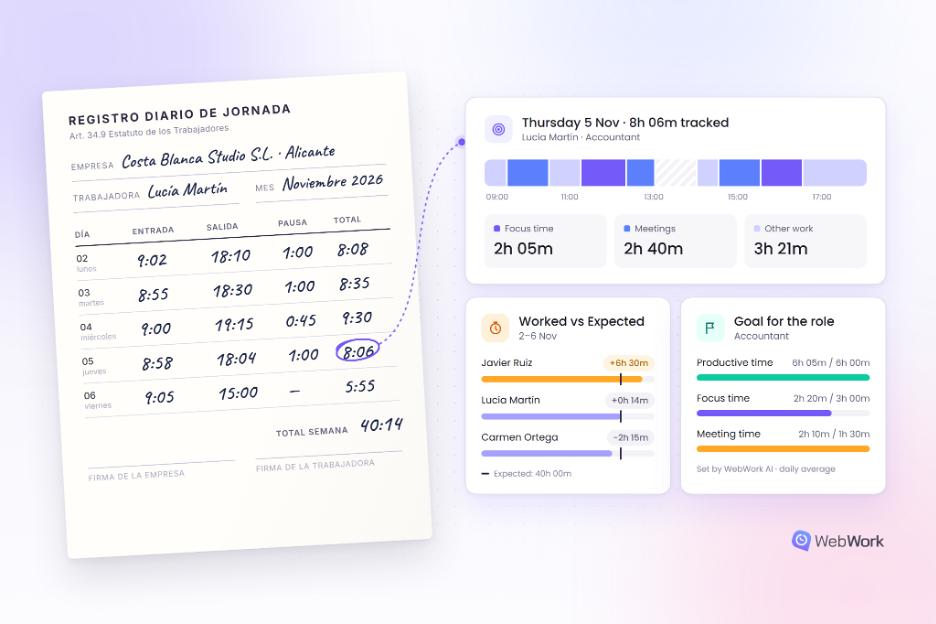
Credit: WebWork
Spain’s plan for a digital register of working hours is still not in force, months after the Council of State advised against it. The record every employer has kept since May 2019 shows when each worker starts and finishes, and nothing about what the hours held.
Software can record more: how much of a day was focused work, how much went to meetings, and how far a month’s hours are running over what was expected. Some providers now go further. In October 2026, the time tracker WebWork began using AI to set a goal for each job title, with targets for productive time, focus time, meeting time and activity level, the company says.
The digital register has stalled
In September 2025, Congress rejected the bill that would have cut the working week to 37.5 hours. The bill would also have raised the fines for a missing or false register, from a range of €751 to €7,500 per infringement to €1,000 to €10,000 for each affected worker.
The government then moved the register into a royal decree of its own, which needs no vote in Congress. The draft requires a digital, unalterable register. The Labour Inspectorate could read it remotely, and worker representatives could consult it at the workplace.
On 19 March 2026, the Council of State advised unanimously against approving the decree. It cited data protection, the limits of what a decree can regulate and the room left to collective bargaining. Its opinion is not binding.
At the time of writing the decree has not been approved, and a general election has been called for 29 November, so its timing now depends on the result. For a small business in Alicante or Malaga, a digital register still looks like the likely direction of travel: a file the Inspectorate can open from its own office.
What the law requires today
The duty to keep the record comes from Royal Decree-Law 8/2019, which wrote it into article 34.9 of the Workers’ Statute from 12 May 2019. Employers keep the record for four years and show it on request to the worker, their representatives and the Labour Inspectorate.
Two days later, the Court of Justice of the European Union ruled in case C-55/18. Every member state must require an “objective, reliable and accessible” system for measuring each worker’s daily time.
The record was built to catch unpaid overtime. In that case, brought against Deutsche Bank, the CCOO union argued that without a daily record, the 40-hour week and the overtime cap could not be checked.
The court recalled that a worker is the weaker party in the employment relationship. It ruled that without an objective record, a worker cannot reliably prove the hours worked or enforce the limits on them.
Spain’s National High Court, which referred the case, told the court that 53.7% of overtime hours in Spain went unrecorded, a figure from a 2016 survey.
The Inspectorate uses the register. In 2024 it carried out 9,097 inspection actions on it and found 1,869 infringements affecting 21,649 workers, according to figures published in February 2025.
On working time overall, its 2024 annual report lists 35,500 inspection actions, 11,945 infringements and €15.2 million in proposed fines. In the third quarter of 2026, the National Statistics Institute’s labour force survey counted 6.14 million overtime hours a week worked by employees, 2.21 million of them unpaid.
The register does not show whether those hours were spent well, or whether one team is carrying another’s load. A start time and an end time say nothing about a day of eight hours of interruptions, or a developer whose working day was four meetings and two hours of work.
Three things worth recording beyond hours
Software that records hours can record three more things. Each answers a question the register raises and cannot answer, and each reaches further into the employee’s working day.
The first is focus. After “how long”, the next question is “how much of that was work”.
Modern time tracking software can split a tracked day into productive, neutral and non-productive time by application, and measure focus time and meeting time. A team that averages two hours of focus in an eight-hour day can see in the same report how much of the rest went to meetings.
The second is overload. Spain’s register shows overtime after the fact, on the summary employers must hand each worker with the payslip.
A report that compares worked hours with the hours a shift expected can show the same gap while the month is still running. A Worked vs Expected report of this kind lists tracked time, paid leave, holidays and expected hours side by side, with the difference for each member, over or under.
The third is a goal for each role. A target for focus time or meeting time that suits an accountant will not suit a salesperson, so some tools now set expectations by job title, drawing on the role’s own results, benchmarks and the industry. That is the point at which monitoring starts to resemble performance management, and where the rules matter most.
The rules that make it acceptable
Every one of those layers is personal data about an employee. In Spain it falls under the GDPR, the 2018 Data Protection Act and the Workers’ Statute’s right to digital disconnection.
Employers generally have to tell workers that monitoring is in place and what it covers, and covert tracking carries legal risk. A software tool does not make monitoring lawful by itself. Some products offer a silent mode, and their own guidance typically still recommends clear written policies and consent at onboarding.
Data protection was also one of the Council of State’s objections to the draft decree. So the question of what to record comes with a second one: under what rules.
Three controls matter in practice: a log of who changed what, tracking settings that can differ per team and per member, and a way to switch off any automated analysis.
Those three controls are where responsible employee monitoring starts in practice: a record of every change, no more tracking than each team needs, and AI only where the company has chosen it. Vendors often describe their products as GDPR compliant, but employers remain responsible for how they use them.
What it costs, and who else does it
The hours record itself is free: today, a sheet of paper meets the law. The layers above it are a software market, and the Spanish buyer has the same shortlist as everyone else.
Toggl Track, Hubstaff, Time Doctor and WebWork are among the providers of time tracking and employee monitoring software. Prices vary by plan and billing period and change often, so check each provider’s current rates. WebWork’s Pro plan, for example, starts at $3.99 per user a month billed annually, according to the company.
Tracking employee hours without spreadsheets is, in 2026, largely a solved problem. Most tools do it on desktop, web and mobile, and in Spain the output can double as the legal register.
The open question is the one the register was never designed to answer. A company that records only hours has met the law. Focus, overload and a goal for each role make a second record, one the employer keeps for itself.
The Inspectorate will keep asking the first question. The second one is the employer’s to ask.
This article is for general information only. It does not constitute legal advice. Rules on working-time records and employee monitoring are changing and depend on individual circumstances. Seek advice from a qualified labour lawyer or adviser.
Follow Euro Weekly News on Google News
Get breaking news from Spain, travel updates, and expat stories directly on your Google News feed.
Follow on Google NewsSign up for personalised news
Subscribe to our Euro Weekly News alerts to get the latest stories into your inbox!
By signing up, you will create a Euro Weekly News account if you don't already have one. Review our Privacy Policy for more information about our privacy practices.




Nicola EWN
Nicola is a member of the editorial team specialising in features, digital content and online publishing. With broad experience across media and communications, she works across feature articles, editorial content and digital platforms, managing content across a range of subjects.
Comments