France’s €400m ‘riot tax’: Millions face higher insurance bills to pay for damage done
By Adam Woodward • Updated: 19 Nov 2026 • 19:42 • 3 minutes read
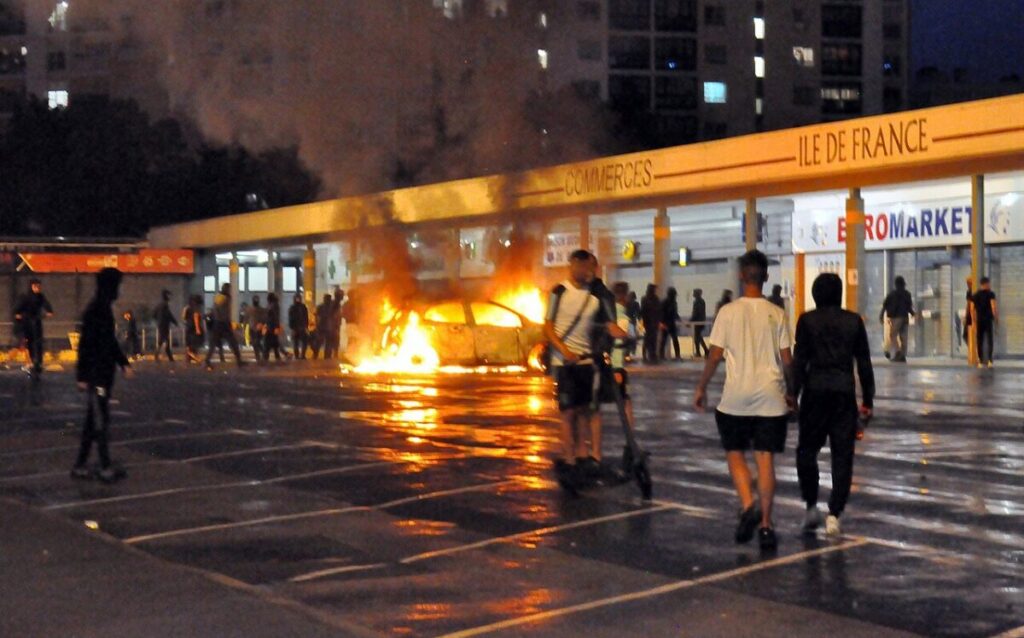
Riots in Paris. Credit: Toufik-de-Planoise CC wiki
France is introducing a new insurance levy to cover damage from recent violent civil unrest. What will it cost French taxpayers, and what does it already cost Europeans across the continent?
Approved under the 2026 Finance Law, the French government measure plans to raise roughly €400 million for demonstration damage annually by spreading financial risks across the insurance sector.
Although widely referred to as a “riot tax”, insurance firms will pay the contribution directly. Draft plans indicate a proposed rate of 0.8 per cent on qualifying premiums, though legislation permits up to 1.5 per cent. The levy applies to policies covering private and commercial property, motor vehicles, and specific business interruption losses.
Funds will support a mutual pool managed by the Caisse Centrale de Réassurance, backed by a €3.25 billion annual state guarantee. The European Commission granted state-aid clearance on Friday, July 24, 2026. French officials are currently finalising regulations ahead of the expected launch on Friday, January 1, 2027.
Rising costs of civil unrest
Escalating payouts from previous disturbances drove the government to create this shared safety net. Senate data reveals that insured losses reached €204 million during the 2005 riots and €230 million during the 2018 and 2019 Yellow Vest protests. Riots in 2023 following the police shooting of teenager Nahel Merzouk cost insurers €793 million.
The 2024 riots in New Caledonia generated approximately €945 million in claims, according to France Assureurs. More recently, demonstrations over living costs and public services turned violent across several French cities on Saturday, October 17, 2026. These totals exclude uninsured losses, policing bills, and public infrastructure repairs, such as smashed-up schools and bus shelters (property of everyone).
Potential impact on households
While households will not receive a direct government bill through the post, insurers will certainly pass the expense onto policyholders through higher premiums. If firms pass on the proposed 0.8 per cent rate in full, an annual €300 policy would rise by €2.40, while a €600 policy would increase by €4.80.
Final price changes depend on how insurers absorb the cost. Under the new law, an insurable riot requires violent collective action against public authority causing substantial economic damage, excluding peaceful protests.
How Spain and other countries compare
Spain already has a state-backed system for dealing with certain extraordinary risks. The Consorcio de Compensación de Seguros (CCS) provides compensation for qualifying events, such as riots, including damage caused violently by terrorism, rebellion, sedition, mutiny and other disturbances.
The system is funded through compulsory surcharges on eligible insurance policies, collected by insurers and passed to the Consorcio. It is therefore not a specific riot tax, but Spanish policyholders already contribute to a shared insurance fund which can cover certain forms of civil unrest.
The recent 38-day housing protest camp in Madrid’s Puerta del Sol is a separate example of the public resources demonstrations can require. Police dismantled the camp on November 3, with cleaning crews brought in afterwards. Euro Weekly News reported on the Madrid camp clearance after 38 days of housing protests. It was a housing protest, not automatically a legally defined riot, and no official overall bill for the operation has been published. That is currently between Madrid council, and their insurer.
In the UK, the Riot Compensation Act 2016 provides a route for people whose property is damaged, destroyed or stolen during a qualifying riot to claim compensation from the relevant local policing authority, particularly where the property was uninsured or inadequately insured.
France is taking a different route by creating a specific and dedicated insurance pool backed by the state. The question now is how much protection the new arrangement will provide, and how much of its cost will eventually find its way onto ordinary insurance bills. And also, how much the public will continue tolerating this kind of behaviour when it ends up coming out of their own pockets.
Follow Euro Weekly News on Google News
Get breaking news from Spain, travel updates, and expat stories directly on your Google News feed.
Follow on Google NewsSign up for personalised news
Subscribe to our Euro Weekly News alerts to get the latest stories into your inbox!
By signing up, you will create a Euro Weekly News account if you don't already have one. Review our Privacy Policy for more information about our privacy practices.





Adam Woodward
Adam is a writer who has lived in Spain for over 25 years. With a background in English teaching and a passion for music, food, and the arts, he brings a rich personal perspective to his work at Euro Weekly News. As a father of three with deep roots in Spanish life, Adam writes engaging stories that explore culture, lifestyle, and the everyday experiences that shape communities across Spain.
Comments