Canary Islands migrant crisis reaches emergency level
By Adam Woodward • Published: 25 Nov 2026 • 23:46 • 3 minutes read
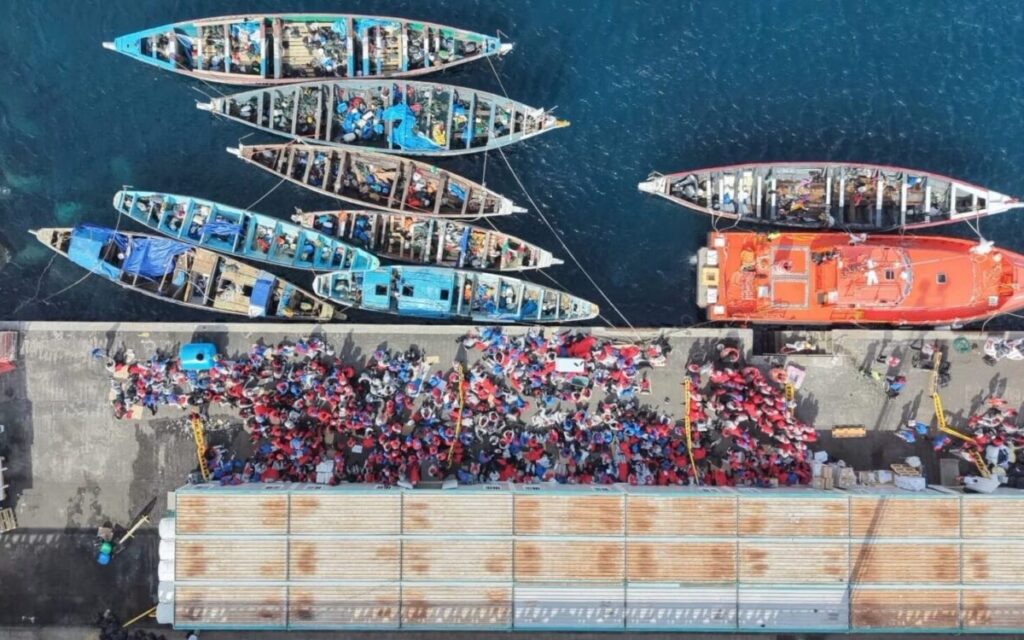
100s more migrants arrive in El Hierro. Credit: Salvamento Maritimo
Record arrivals overwhelm El Hierro as officials seek urgent support.
El Hierro in the Canaries has declared a Level Two emergency after a record influx of migrants overwhelmed services on the island, with more than 2,100 people rescued in a single day.
The Canary Islands Government activated its regional emergency plan at 3pm on Wednesday, November 25, citing exceptional health, social and security pressures caused by continued arrivals from West Africa.
The emergency follows Tuesday’s unprecedented arrivals. The previous daily high was set on November 14, when 1,580 people arrived across El Hierro, Gran Canaria and Tenerife. Tuesday’s arrivals included at least 203 women and 127 children; some boats had spent five to nine days at sea.
Fifteen cayucos brought around 2,100 people to El Hierro, according to emergency services. One person died during the crossing. Among those rescued was a four-day-old baby girl born at sea.
November has become the busiest month in the 32-year history of the Atlantic migration route, with more than 16,000 people reaching the islands, according to the regional government. The previous monthly record was 6,814 arrivals in November 2024.
Why are so many arriving now?
The massive surge has prompted questions about whether migrants are trying to reach Spain before a possible change of government, or believe they may benefit from the last days of the Sánchez government’s immigration policies.
The government’s proposed regularisation of undocumented migrants has become a major issue in the election campaign. Some political voices argue that a more welcoming approach could encourage arrivals. However, there is no evidence establishing that the current surge is being driven by people trying to arrive before a change of government.
Reasons for the journeys are varied. Many people come from countries facing poverty, instability or violence, including Senegal, Gambia, Mali and Guinea. Seasonal sea conditions can also make departures more likely in autumn. The crossing is still incredibly treacherous, and record arrivals do not mean the journey is safe.
Where are people being housed?
El Hierro, with a population of around 12,000, has become the main arrival point. Hundreds of people were still at the port of La Restinga on Wednesday after Tuesday’s rescues. The temporary reception centre and other accommodation were unable to cope with the volume.
Transfers to Tenerife and mainland Spain have been accelerated. Around 865 people who had arrived earlier left the island on Wednesday. The pressure is particularly acute for unaccompanied children: the regional government says more than 1,100 arrived in November, while thousands are already in its care.
What is the government proposing?
Madrid announced €15.18 million in additional funding earlier this month for more places in state-run centres and transfers between the islands and mainland Spain. A further €1 million was earmarked for Red Cross healthcare and first-response services, and an additional coastguard vessel was deployed.
The central government says it is also working with Senegal and Gambia to discourage dangerous departures. Sánchez said on Wednesday he hoped arrivals would fall in the coming days.
Clavijo has called for urgent European support and asked European Commission president Ursula von der Leyen for a meeting. He has also called for faster transfers of unaccompanied minors to other regions.
Is there a solution?
The island’s president, Alpidio Armas, has previously said more resources and faster transfers are needed, warning that more people are arriving than can be moved on.
The immediate challenge is to move people safely from El Hierro, increase reception capacity and provide enough staff for rescue and healthcare teams. Longer-term measures depend on cooperation with countries of origin and transit, as well as European support.
Will arrivals keep rising?
A further increase cannot be ruled out. Autumn often brings more favourable conditions for Atlantic crossings, and arrivals can change quickly with weather and departure patterns. But a continued rise is not certain; sea conditions can deteriorate rapidly as winter approaches.
The political debate may influence perceptions, but it is not possible to predict arrivals on that basis alone. The recent record figures show the scale of the pressure, not what will happen next.
Salvamento Marítimo under strain
Salvamento Marítimo crews have reported exhaustion and shifts lasting up to 18 hours. The agency says it has reinforced its operation around El Hierro with additional vessels and crews.
The human cost was illustrated by the baby born during the crossing. Clavijo said he had just been told about the four-day-old girl and described it as “the reality we have to live with”. He added that people cannot fully understand the situation until they have stood at the quay and seen how exhausted arrivals are. The mother and baby were reported to be in good health, although medical staff said the birth had been extremely difficult.
For El Hierro, the emergency declaration is an attempt to bring more help to an island whose reception and rescue systems are stretched. Whether new resources can match the pace of arrivals remains the central question.
Follow Euro Weekly News on Google News
Get breaking news from Spain, travel updates, and expat stories directly on your Google News feed.
Follow on Google NewsSign up for personalised news
Subscribe to our Euro Weekly News alerts to get the latest stories into your inbox!
By signing up, you will create a Euro Weekly News account if you don't already have one. Review our Privacy Policy for more information about our privacy practices.



Adam Woodward
Adam is a writer who has lived in Spain for over 25 years. With a background in English teaching and a passion for music, food, and the arts, he brings a rich personal perspective to his work at Euro Weekly News. As a father of three with deep roots in Spanish life, Adam writes engaging stories that explore culture, lifestyle, and the everyday experiences that shape communities across Spain.
Comments