Drinking, smoking and sex on Benidorm’s beaches: What’s legal and what’s not?
By Santiago Carneri • Updated: 26 May 2026 • 9:53 • 3 minutes read
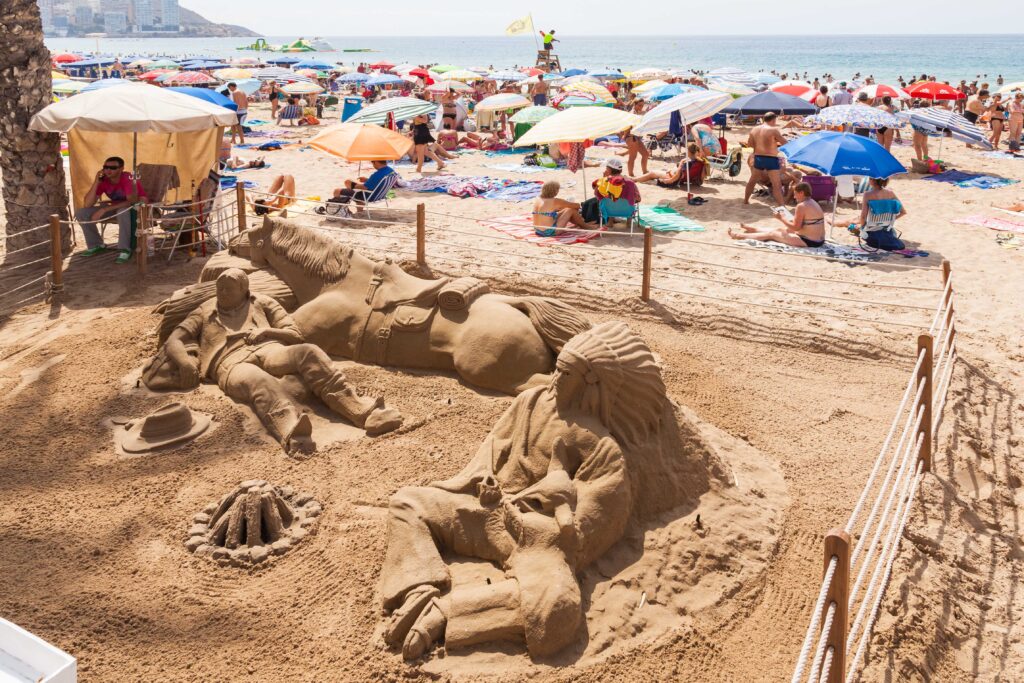
Levante beach in Benidorm. Credit: Diego Delso. Creative Commons
If you’re heading to Benidorm this summer, you may come across viral warnings from British TikToker Frank the Stagman. In one of his popular videos, Frank claims you can be fined for drinking, smoking, vaping or buying cocktails on the beach. But how much truth is there in all this? And to what extent does Frank’s version match up with Spanish law?
We’ve cross-checked his claims with local municipal by-laws and regional legislation to clarify what really is – and isn’t – allowed on Benidorm’s beaches. Here’s a practical guide to what you can and can’t do, according to official sources.
What’s allowed in Benidorm (with a few caveats)?
- Drinking alcohol on the beach: Frank says it’s banned, but that’s not entirely accurate. What carries a €300 fine is unauthorised street vending, not private consumption. However, if you buy from illegal vendors (like homemade cocktail sellers), you can still be fined for encouraging an unauthorised activity.
- Smoking and vaping: Unlike other beaches in the Marina Baixa region, Benidorm hasn’t fully banned smoking. It’s only restricted in three accessible areas (two on Poniente Beach and one on Levante). So, for now, smoking or vaping is still legal on most of the coast – though Benidorm may soon join the Generalitat Valenciana’s smoke-free beach network.
- Being on the beach at night: Despite rumours, there’s no blanket ban on staying at the beach between midnight and 7am. What is punishable (with a €751 fine) is obstructing cleaning services if you’re asked to move and refuse.
- Playing ball games or paddle games: This is allowed as long as you don’t disturb other beachgoers. It only becomes an offence (carrying a €120 fine) if it interferes with others’ enjoyment.
What really is banned (and the cost of breaking the rules)
| Prohibited activity | Approx. fine | Notes |
| Buying or selling illegal goods (e.g. cocktails) | €300 | Both the vendor and the buyer can be fined for unauthorised sales. |
| Smoking in restricted areas (accessible beaches) | Up to €750 | Only banned in some areas in Benidorm; other towns have full bans. |
| Using soap or shampoo in beach showers | Up to €750 | Strictly enforced in places like Alicante. |
| Reserving spots with unattended towels | Up to €150 or removal | Particularly enforced in places like Torrox; Benidorm is more relaxed. |
| Bringing pets to the beach without authorisation | €100 – €150 | Only allowed outside peak season (April–October) or in dog-friendly zones. |
| Throwing or carrying glass | Up to €750 | For safety reasons. Even carrying glass bottles may be restricted. |
| Having sex on the beach | €100 – €3,000 | Not explicitly banned by national law, but can be fined under “public order” laws (Ley Mordaza). If minors are present, it becomes a criminal offence. |
| Swimming during red flag warnings | €1,000 | Considered a serious offence for endangering life. |
| Fishing in unauthorised areas | €750 | Forbidden in tourist or protected zones. |
| Setting up tents or gazebos without a permit | €1,500 – €3,000 | Considered a very serious offence in parts of the Valencian Community. |
| Using loudspeakers on the beach | Up to €300 | Only allowed for authorised or regulated events. |
Is Benidorm really the most restrictive beach in Spain?
British tabloids like The Mirror have claimed that “Benidorm is the most restrictive beach in Spain”, but local tourism authorities disagree. “All councils regulate the same thing: coexistence and safety. We don’t fine for the sake of it – it’s to ensure everyone can enjoy the beach,” they explain.
In fact, while nearby towns like La Vila Joiosa, Altea or L’Alfàs del Pi already ban smoking outright on their beaches, Benidorm still applies more relaxed policies.
Frank isn’t entirely wrong: some fines do exist, especially around illegal sellers or behaviour that disturbs the public. But if you’re heading to Benidorm this summer, your best bet is to follow common-sense rules: respect others, keep things clean and you’ll be all right.
Read here more news about Costa Blanca North.
Read here more European news.
Follow Euro Weekly News on Google News
Get breaking news from Spain, travel updates, and expat stories directly on your Google News feed.
Follow on Google NewsSign up for personalised news
Subscribe to our Euro Weekly News alerts to get the latest stories into your inbox!
By signing up, you will create a Euro Weekly News account if you don't already have one. Review our Privacy Policy for more information about our privacy practices.




Santiago Carneri
Santiago is a freelance journalist, writer, photographer, and documentary producer with over a decade of experience reporting from Paraguay and Brazil. His work has appeared in The New York Times, The Guardian, Vice News, BBC, Associated Press, France Press, Der Spiegel, Deutsche Welle, El País, and more. Now based in Dénia—his self-described secret paradise—Santi contributes to Euro Weekly News, bringing a global perspective to both local and international stories. Outside of journalism, he enjoys boxing and cultivating his home garden.
Comments