Digital Euro by 2028? Why Sweden is defending cash while Spain pushes for digital-only
By Dora Urbancsek • Published: 19 Apr 2026 • 12:31 • 2 minutes read
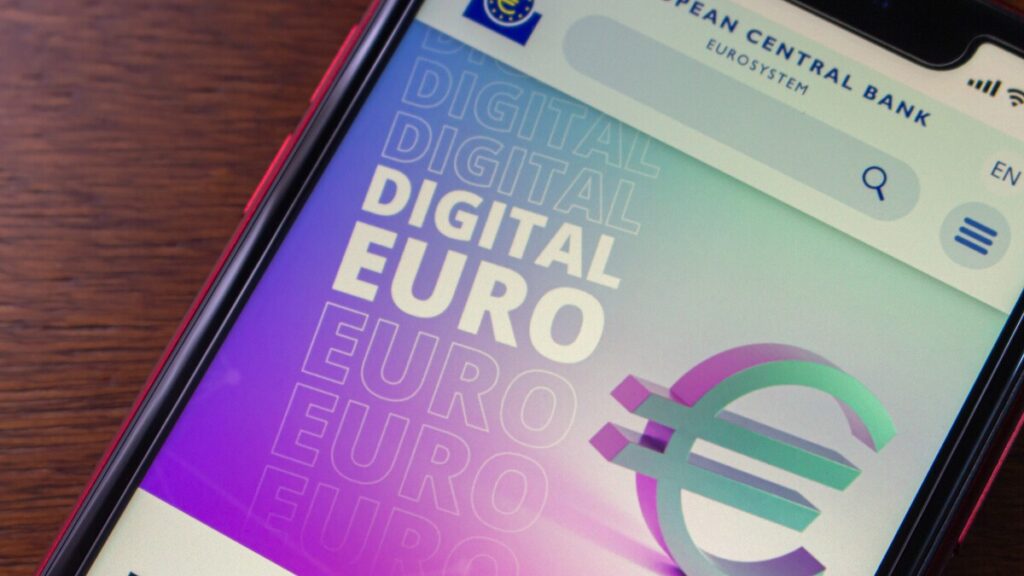
The digital euro would allow payments via mobile devices across the eurozone Credit: Shutterstock/Koshiro K
In a letter sent in March 2026, Pedro Sánchez urged the European Council to accelerate the digital euro launch to 2028, framing it as a necessity for “financial sovereignty.” However, this push contrasts sharply with Sweden, where authorities are now mandating physical cash reserves as a defense against 2026’s rising geopolitical cyber-risks.
For residents in Spain, the shift is already hitting home; as of April 2026, new Hacienda rules require all digital wallets (including Bizum and Revolut) to report transactions regardless of size. While the ECB promises a €3,000 holding limit and an “offline” mode for privacy, the era of anonymous digital spending in Spain has effectively ended.
Why Europe wants a digital euro
The digital euro is designed to modernise how money moves within the European Union. Unlike cryptocurrencies, it would be issued and guaranteed by the central bank, offering a public alternative to private payment systems. Supporters argue that this could reduce Europe’s dependence on international card networks and tech companies, while also ensuring that central bank money remains relevant in an increasingly digital economy.
For expats, the concept may sound familiar in practice. It would function similarly to a digital wallet, allowing instant payments without relying on traditional banks or intermediaries. Cross-border transactions could become faster and more consistent across EU countries. However, the project is still under development. The ECB has not confirmed a launch date, and discussions continue around privacy, usage limits and technical design.
Why some countries are holding on to cash
While the digital euro moves forward, Sweden is taking a different approach. Despite being one of the most cashless societies in the world, Swedish authorities have recently emphasised the importance of preserving access to physical money.
The reasoning is not based on resistance to innovation, but on resilience. Cash is increasingly being viewed as a safeguard in situations where digital systems fail. Cybersecurity threats, power outages or geopolitical instability could all disrupt electronic payments, leaving societies vulnerable if no alternative exists. Sweden has already explored its own digital currency, the e-krona, yet continues to protect cash infrastructure in parallel. This dual approach is now influencing wider European discussions.
A system under pressure from both sides
The debate highlights a deeper question about the balance between efficiency and security. Digital payments offer speed, convenience and traceability, but they also introduce dependencies on infrastructure and raise concerns about privacy. Physical cash, while less efficient, provides anonymity and independence from digital systems.
Rather than replacing one with the other, Europe appears to be moving towards a hybrid model. In this scenario, digital currencies expand alongside renewed efforts to keep cash available. This creates a more complex financial landscape, where both systems serve different purposes depending on the situation.
What this means for residents in Spain
For people living in Spain, including the large international community, the shift may not be immediate but will gradually shape everyday transactions. Digital payment options are likely to increase, potentially offering more flexibility and lower costs for certain services. At the same time, access to cash is expected to remain, particularly as concerns about system reliability continue to influence policy decisions.
The key takeaway is that Europe is not moving in a single direction. Instead, it is testing two models at once, balancing innovation with caution. As discussions continue at EU level, the outcome will determine not just how people pay, but how secure and adaptable the financial system remains in the years ahead.
Sign up for personalised news
Subscribe to our Euro Weekly News alerts to get the latest stories into your inbox!
By signing up, you will create a Euro Weekly News account if you don't already have one. Review our Privacy Policy for more information about our privacy practices.




Dora Urbancsek
Dora Urbancsek is an SEO writer with over eight years of experience producing high-quality, search-optimised journalism and digital content. Based in Spain for more than five years, she covers a wide range of topics concerning Spain and Europe, including current affairs, community stories, culture, and lifestyle. Dora is known for accurate, well-researched reporting that keeps readers informed and engaged.
Comments